01432 610152 Get a quote Call 01432 610152

Roof cleaning and moss removal in Hereford

Moss, lichen and algae taken off by hand and soft brush, then treated with a biocide.

While we are up there we look at the ridge, the valleys and the gutters, and photograph anything that needs a roofer's eye.

Get a free quoteCall 01432 610152

  • Ridge to eaves, checked first
  • Photos of your own roof
  • One written price
  • 10-year workmanship guarantee
  • Find us on Google

What we clean, clear and treat on a roof

Moss, lichen and algae lifted by hand, brushed off and treated with biocide.

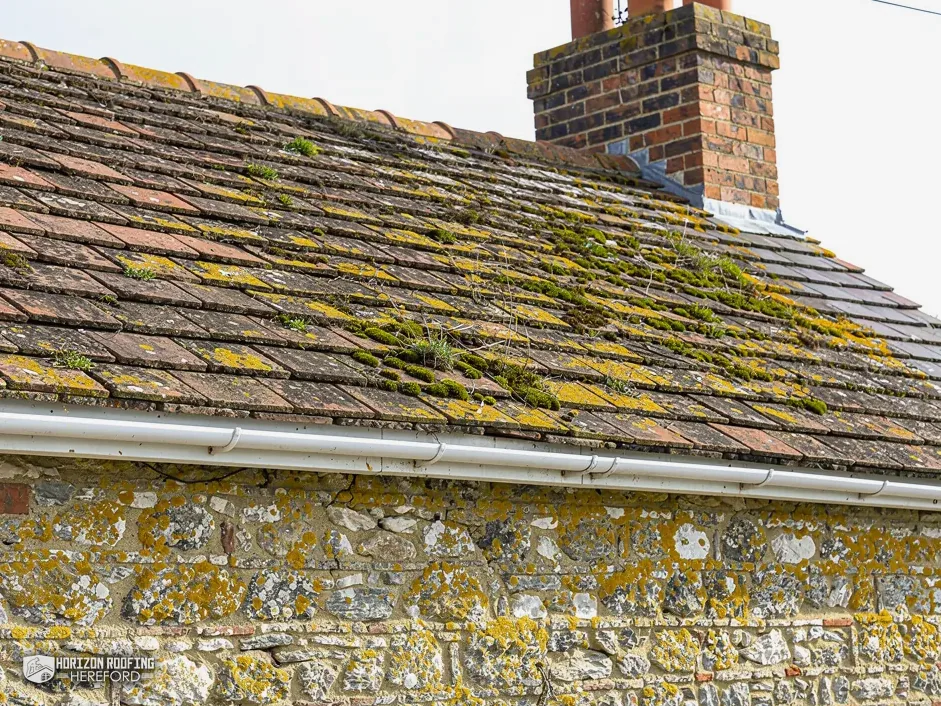
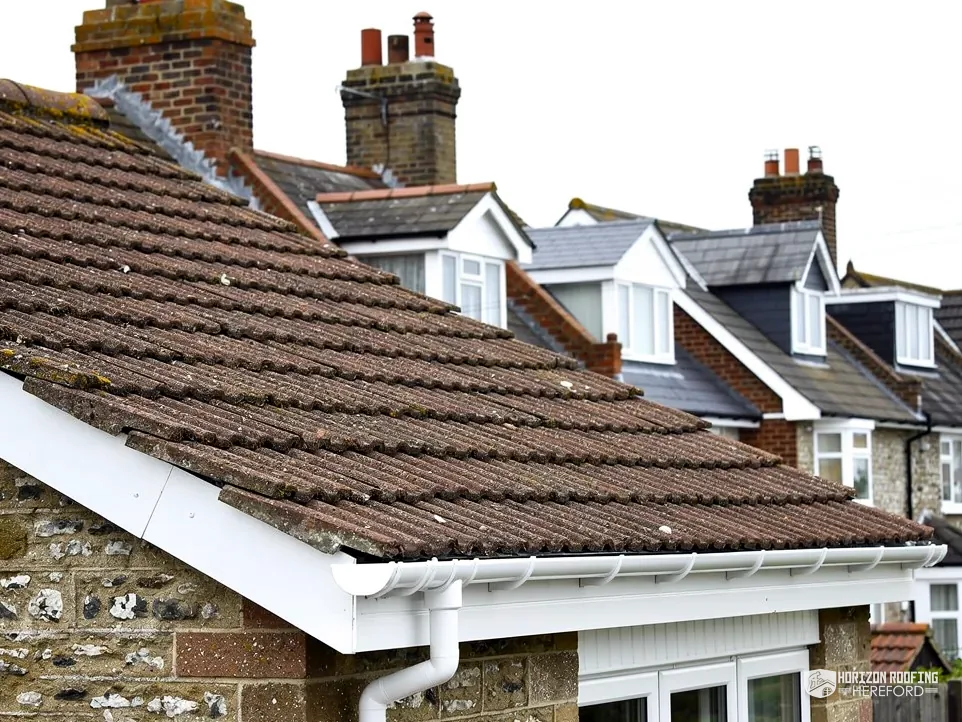
  • Lichen and moss on weathered clay plain tiles

    Moss lifted by hand

    Thick cushions eased off with hand scrapers, working down each slope from the ridge.

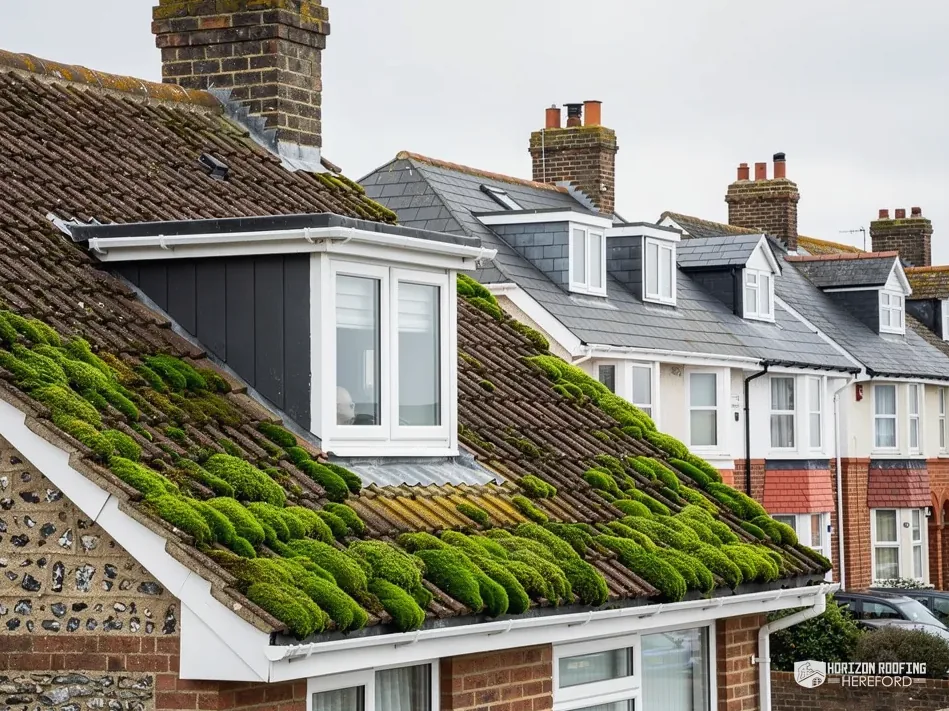
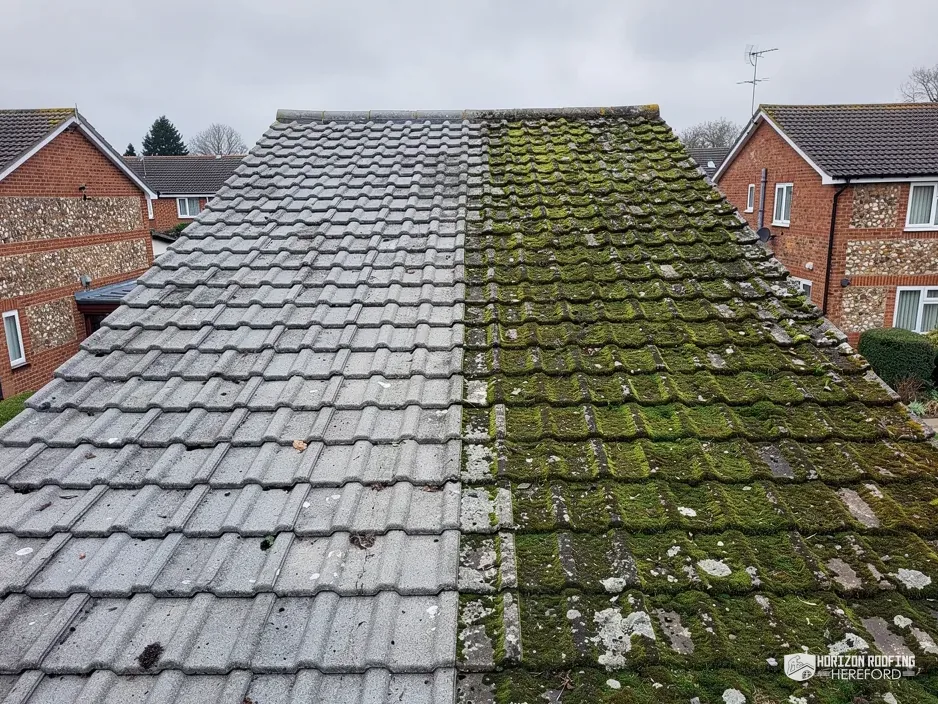
  • Thick moss on the concrete tiles of a chalet bungalow

    Soft brushing

    Leftover growth brushed from the joints with brushes chosen for slate, clay or concrete.

  • A concrete tile roof half cleaned, moss still on one side

    Biocide treatment

    A biocide applied at low pressure to kill the growth left in the laps.

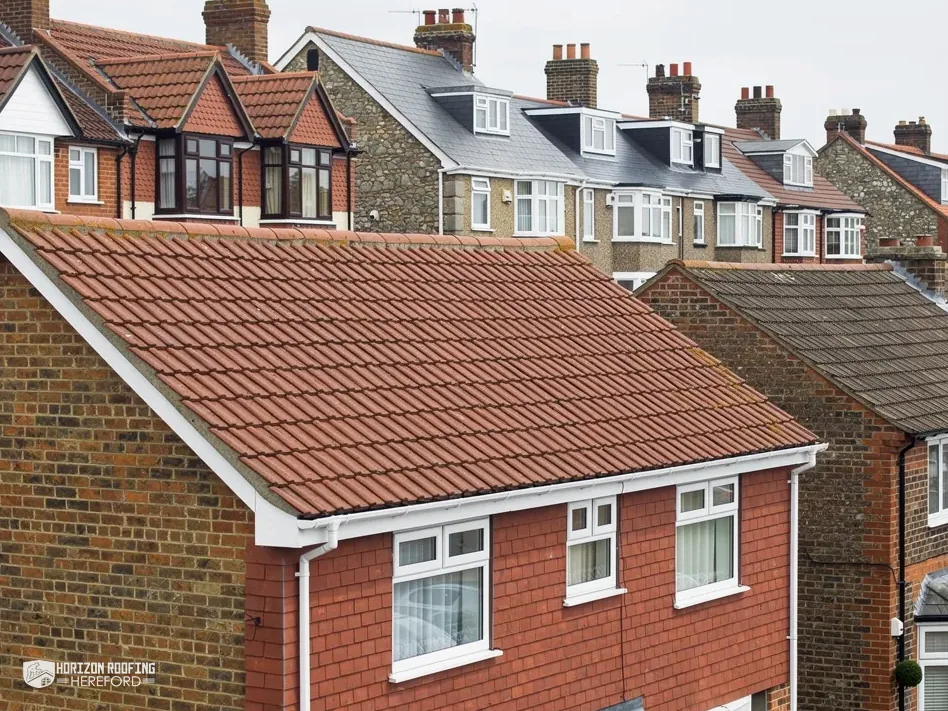
  • A clean tiled roof, free of moss, on a brick house

    Soft wash for algae

    A biocide solution misted on for green algae and dark streaks, then left to work.

  • A new white uPVC gutter, fascia and soffit under a tiled roof

    Gutters and outlets cleared

    Moss and grit bagged from gutters, hoppers and valley channels, then taken away.

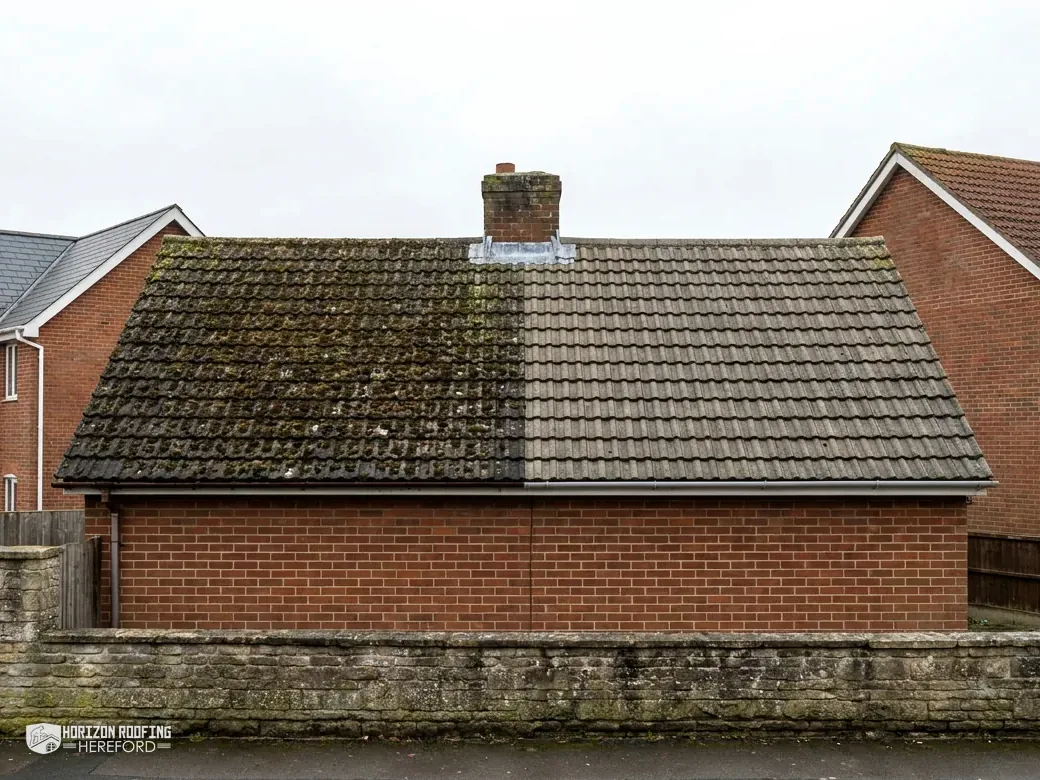
  • A bungalow roof half cleaned of moss, the clean side beside the mossy side

    Condition noted as we go

    Slipped tiles, open ridges and split lead photographed and shown to you.

The roof clean, ridge to flat roof

How moss, lichen and algae settle on a Hereford roof, and how each comes off

We clean in the same order we survey: the ridge first, then down the main slopes, into the valleys, along the gutters and eaves, and last across any flat roof on the extension or garage. Each stop says what grows there and what we do about it.

Climb to the ridge

A drawn cut-away section through a Herefordshire border house: the front of the main roof is cut open to show the rafters, underlay, battens and slates, beside a black-and-white timber-framed gable. Numbered, from the ridge down: 1 Ridge tiles and hips; 2 Main roof slopes; 3 Valleys; 4 Gutters and downpipes; 5 Eaves and bottom course; 6 Flat roofs and outbuildings.

Fig. 1 Section through a Herefordshire house showing where moss, lichen and algae take hold.

Callout 1 of 6

Lichen on the ridge and what it hides

A roof clean starts at the ridge, the row of capping tiles that closes the top of the roof, because everything we loosen up there falls onto the slopes below and is cleared on the way down. Ridges stand in open wind and sun, so the growth on them is less the soft green cushion of moss and more lichen: the flat grey, yellow or orange crust that looks as if it was painted on. Lichen bonds tightly to the surface. Scraping it hard can score a clay or concrete ridge, so we lift off whatever comes away freely by hand and leave the stubborn crust to the biocide, which kills it where it sits so that it weathers off over the following seasons.

The ridge is also where a cleaning visit earns its keep as a check. On an older roof each ridge tile is bedded on a sand and cement mix. Moss roots and lichen work into hairline cracks in that bedding and keep them wet, and frost can open a wet crack further. As we pass along the ridge we press each tile in turn. One that rocks, a joint that has opened, or bedding that crumbles under a thumb is photographed, and we show you the pictures on the ground before anything else is discussed. Hips, the angled ridges running down the outer corners of a hipped house, get the same check in the same pass.

Loose ridge tiles are a repair rather than a cleaning job, and the photographs let you judge that for yourself. A ridge can be rebedded in fresh mortar with a mechanical fixing for each tile, or fixed dry to a batten under BS 8612, the standard for dry-fix systems. Our roof repairs page sets out both methods. On a clean, every ridge tile stays exactly where it was, and the scraper stays well away from any bedding that is already soft.

Herefordshire's clay ridges carry some history of their own. The county's building stone atlas records that clay from the Raglan mudstones fed "the famous Herefordshire brick, tile and pipeworks industries", so an old clay ridge on a farmhouse near Leominster or Bromyard may be a local piece that is hard to match today. That is one more reason to clean it gently. Where a ridge tile is cracked already, we point it out to you rather than finishing it off with a stiff brush.

Lichen is slow to go. It is the growth that can still look patchy straight after a clean, because the biocide works on it over months rather than hours. A grey crust that fades through the following year is the treatment doing its job, and we tell you to expect that before we start, so a pale ridge the week after is no surprise.

What the ridge check covers on a clean

  • Lichen crust on ridge and hip tiles
  • Cracked or crumbling mortar bedding
  • Ridge tiles that rock under hand pressure
  • Moss packed into the ridge joints
  • Hairline cracks across older clay ridges

From the lawn, lichen on a ridge looks like weathering. Up close, it is sitting in the cracks.
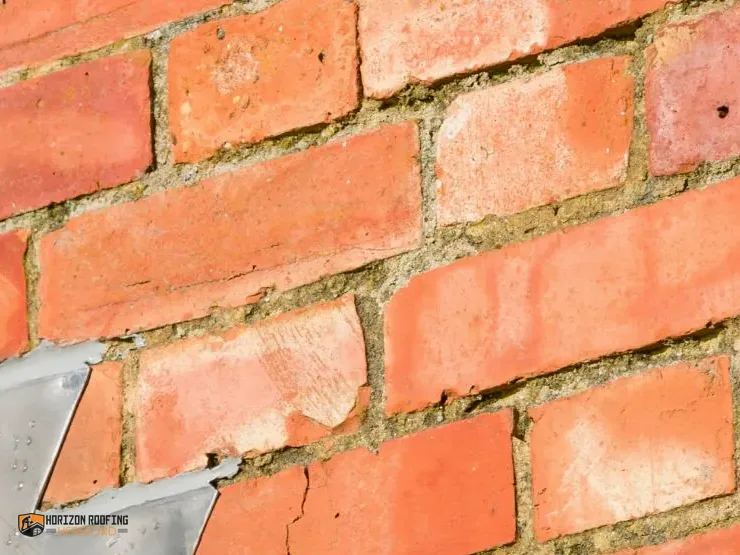
Fig. 2 The ridge, drawn close
Lichen
A flat, slow-growing crust of fungus and algae living together.
Biocide
A treatment that kills moss, lichen and algae where they grow.
Hip
An angled ridge running down a corner where two slopes meet.

Callout 2 of 6

Moss on tile, slate and stone slopes

Moss grows thickest on the main slopes, and above all on the slopes that stay damp longest: the side facing away from the sun, the slope under a tree, and the roof sitting in the shadow of a taller neighbour or a hillside. Its cushions soak up rain and hold it against the covering. On a tiled roof the moss packs into the gap where one tile laps over the next, and as a cushion thickens it can lift the tail of the tile above and keep water sitting in the joint. Birds pull the cushions apart looking for insects and drop them into the gutters, so lumps of moss on the path or the drive are a good reason to look up.

We take moss off by hand. Working from the ridge down, the cushions are eased off with a hand scraper drawn the same way the tiles lap, so nothing is levered upwards. A soft brush follows to clear what is left in the joints, and loose material is collected at the eaves. The tools change with the covering. Concrete interlocking tiles take a firmer brush than handmade clay. Natural slate is scraped lightly, because its surface splits along the grain and a slate edge can chip. Sandstone tilestones get the gentlest treatment of all, since each stone is laid to its own size and a broken one cannot simply be swapped from stock.

A scraper drawn the way the tiles lap lifts moss. Drawn the other way, it lifts tiles.

Those stone roofs are part of the local picture. Herefordshire's building stone atlas points to the St Maughans sandstones around the Golden Valley as the main source of Herefordshire's traditional stone roofing, and it notes that "Older cottages in Longtown are still roofed with flagstones". SPAB describes the slate and stone roofs of Wales and the Marches as "predominantly double-lapped", with each course covering the joints of the two below. A double-lapped stone roof hides a lot of moss in its laps, and we clean it a course at a time.

The method matters as much as the moss that comes off. Blasting a slope clean with water in a morning is tempting, and the box below gives the tile maker's view of it. We scrape, brush and treat instead, and the clean takes longer as a result.

Cleaning also shows when a slope needs more than a clean. Tiles that are flaking at the surface, slates that are delaminating into layers, or a slope where many pieces have slipped point to a repair, and sometimes to a re-roof. We say which on the photographs, and we only suggest roof replacement when that is the honest answer for the house.

How we clean a slope, step by step

Top down
Start at the ridge so debris falls onto roof not yet cleaned.
Scrape
Ease cushions off in the direction the tiles lap.
Brush
Soft brush through the joints, matched to the covering.
Collect
Gather loose moss at the eaves and bag it.
Treat
Apply biocide at low pressure once the slope is dry.
Record
Photograph any slipped, cracked or flaking pieces.

Why not jet wash the roof and save a day?

Marley says "The use of high powered jet washes is not recommended as it can damage the surface of the slate or tile, thus reducing its expected life considerably". We follow that advice, so every roof we clean is scraped, brushed and treated by hand instead.

Fig. 3 The slopes, drawn close

Callout 3 of 6

Valleys that fill with moss and leaf litter

A valley is the internal angle where two roof slopes meet and drain into one channel, as on an L-shaped house or where a back wing joins the main roof. Everything that loosens on both slopes ends up there: moss, leaf litter, seeds, and the grit that weathers off concrete tiles. Valleys are lined in lead, in preformed trays of glass fibre or plastic, or laid as a swept or laced valley, with tiles or slates cut and worked to turn the corner without a metal lining. Royston Lead's table lists codes 4 to 8 as suitable for pitched valley gutters, so a lead valley on a sound roof is a heavy, long-lived piece of work worth keeping clear.

Close-up of lead step flashing against red brick and tiles

Trouble starts when growth builds up in the channel. A clump of moss the size of a fist can dam the flow, and in heavy rain the water backs up behind it. Once it rises above the edge of the lead it can run sideways under the cut tiles at each side of the valley and into the roof timbers below. A tray valley with a blocked channel behaves the same way. On a swept or laced valley there is no channel at all, and moss sitting in the tight joints of the cut pieces holds water right where the roof is most complicated to repair.

We clear valleys by hand from the top down. The debris is lifted out and bagged rather than flushed down, because flushing only moves the blockage into the gutter and the downpipe. As the channel is exposed we look at what it is made of and how it is doing: splits along the length of the lead, laps that have slipped, lead that has been dressed too tight to move, and the mortar or clips holding the cut tiles along each edge. Any fault is photographed where it sits.

Trees make a big difference. A house under oak, ash, sycamore or a row of conifers can fill a valley with leaves and needles in a single autumn, and that wet mat is where moss takes root next. Where a valley sits under trees, clearing it once the leaves are down keeps it running through the winter. Our guide to moss in gutters and valleys goes into the signs to watch for from the ground.

A split or slipped valley lining is a repair job for lead or tile work, and it is far better found on a clean than through a stain on a bedroom ceiling. We tell you what we found, show you the photograph, and leave the choice of what happens next with you.

One clump of moss in a valley can stop the drainage of two whole slopes.

A valley channel, clear and choked

SoundLead channel open, laps tight, rain running straight through
Needs workMoss and leaves damming the channel above a lap

Callout 4 of 6

Gutters, hoppers and the moss that lands there

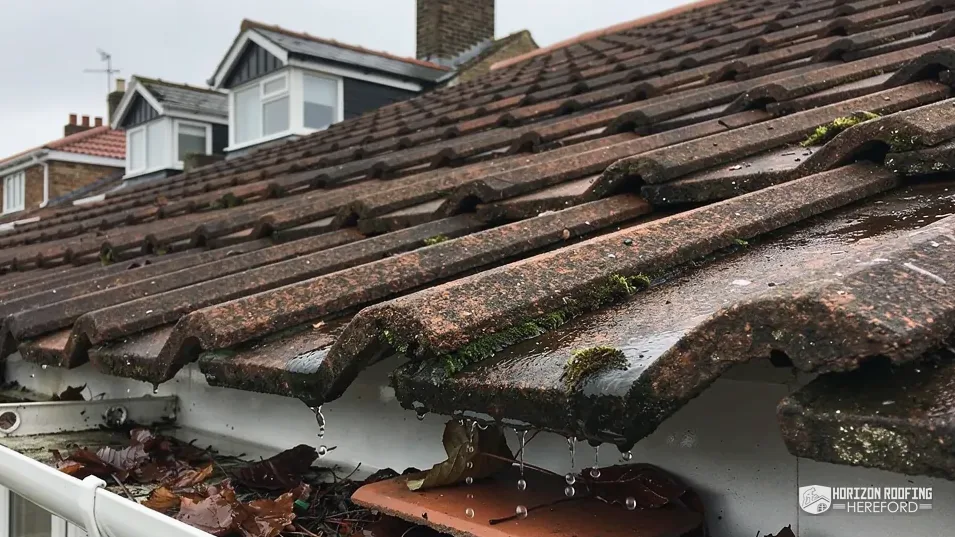
Moss that comes off a roof has to go somewhere, and left to itself it goes into the gutters. A blocked gutter holds water against the fascia board behind it, spills over the front edge in heavy rain and runs down the face of the wall. On brick and stone that means damp patches, green staining and, in time, soft mortar joints. The outlet into the downpipe and any hopper, the funnel-shaped collector where a gutter meets a downpipe, are the narrow points where a blockage lodges, and a single wedge of moss there can back up the whole run.

Our order of work deals with this. During the clean, loose moss is moved down to the eaves and collected by hand or in bags. It is never washed down the downpipes, where it can set solid in a bend below ground and turn a gutter job into a drainage job. At the end of the clean we clear every run of gutter, front and back, bag what comes out and take it away with us, so nothing is left in a heap by the bins. Then we run water along each run to show you it falls to the outlet and drains.

Brett Martin, a gutter maker, advises a fall of "1mm for every 600mm" along a gutter run. A gutter that has sagged between its brackets, or was hung level in the first place, holds a pool along part of its length, and silt and moss collect again in that pool soon after a clean. We note any sagging runs, cracked joints, loose brackets and leaking unions on the photographs. Where the gutters themselves need work, our guttering, soffits and fascias service covers new runs, refitted brackets and replacement fascia boards.

Older houses in Hereford and the market towns may still carry cast iron gutters and downpipes. Cast iron is heavy and strong, but its joints are bolted and sealed, and the inside of a gutter rusts where wet moss has sat in it. Cleaning one out properly lets us see whether the inside is sound or flaking. On plastic gutters, a full gutter can drag a run out of line, and we look for clips that have sprung open under the weight.

None of this needs anyone to climb onto the roof itself. Gutters are cleared from ladders or access equipment at the eaves, which is also the safest place to look along the bottom course of tiles while we are there.

Order of work

Is it better to clean the gutters before or after the roof?

After. A roof clean drops moss and grit into the gutters however carefully it is done, so we clear them at the end, bag what comes out and run water through each outlet to show it drains. Clearing them first only means clearing them twice.

Moss washed down a downpipe does not disappear. It waits for you in the first bend.

Fig. 5 Gutters and downpipes, drawn close

Callout 5 of 6

The eaves, where nests, bats and vents meet

The eaves are the lower edge of the roof, where the bottom course of tiles runs out over the wall and into the gutter. Birds use the gap behind a fascia board, a lifted eaves tile or a hole in a soffit to nest, and bats use similar gaps to roost. Both have to be considered before a clean starts, because the law protects them in England and Wales alike.

Under section 1 of the Wildlife and Countryside Act 1981, which applies in England and in Wales, it is an offence for anyone to intentionally destroy, damage or take a wild bird's nest during building or while it is in use. So before the first scrape we look along the eaves and into the gutters from the ladder. If birds are coming and going from a nest, that stretch of roof waits until the nest is no longer in use, and the rest of the clean is planned around it.

Bats need more care again. Under section 9(4) of the same Act, which applies in England and in Wales, it is an offence to disturb a bat while it occupies its roost, or to obstruct access to the roost, "intentionally or recklessly". Regulation 43 of the Conservation of Habitats and Species Regulations 2017 is stricter still, because a person who "damages or destroys a breeding site or resting place of such an animal" commits an offence there whether or not it was meant. Small dark droppings stuck to the wall or a window below the eaves, or bats seen leaving at dusk, are a reason to stop and take advice. A licence for work that affects bats comes from Natural England for a house in England and from Natural Resources Wales for a house in Wales. Our answer on roof cleaning and bats sets out what that means for a clean.

Ventilation is the other check at the eaves. In a cold roof, the loft floor carries the insulation and the space above it needs air moving through. For a cold roof with high resistance (HR) underlay, Marley gives "25mm along the length of the eaves for pitches of 15° or less; 10mm along the length of the eaves for pitches of more than 15°." Moss and debris can pack those gaps, and some eaves vents sit hidden behind the gutter. We clear what we can reach by hand and note any vent that is blocked, crushed or missing. Air-permeable underlays work on different terms, so we check what is on the roof before we draw conclusions.

Before the first scrape at the eaves

Nests
Watch for birds coming and going; an active nest waits.
Bats
Droppings or bats at dusk stop work in that area.
Vents
Eaves gaps and vent strips checked and cleared by hand.
Fascia
Rot or splits behind the gutter noted on the photographs.
Bottom course
Eaves tiles checked for lifting or broken tails.

A nest in the eaves sets the timetable. The roof clean fits around it.

Fig. 6 Eaves and gutters, drawn close
Eaves
The lower edge of a roof, where it oversails the wall.
Soffit
The board closing the underside of the eaves overhang.
Cold roof
A loft insulated at floor level, left cold and ventilated above.

Callout 6 of 6

Flat roofs, garages and the fragile ones

The last stop is any flat roof: the kitchen extension, the porch, the garage, or the dormer roof seen from a bedroom window. Flat roofs collect whatever the pitched roof sheds, and where water lies in shallow ponds, green algae and moss take hold. NFRC sums up BS 6229:2025, the current British Standard for membrane-covered flat roofs, as setting "a minimum 1:80 finished fall for general roof areas and internal gutters". A roof laid flatter than that, or one whose deck has sagged, keeps its puddles after rain, and the algae returns wherever the puddles sit.

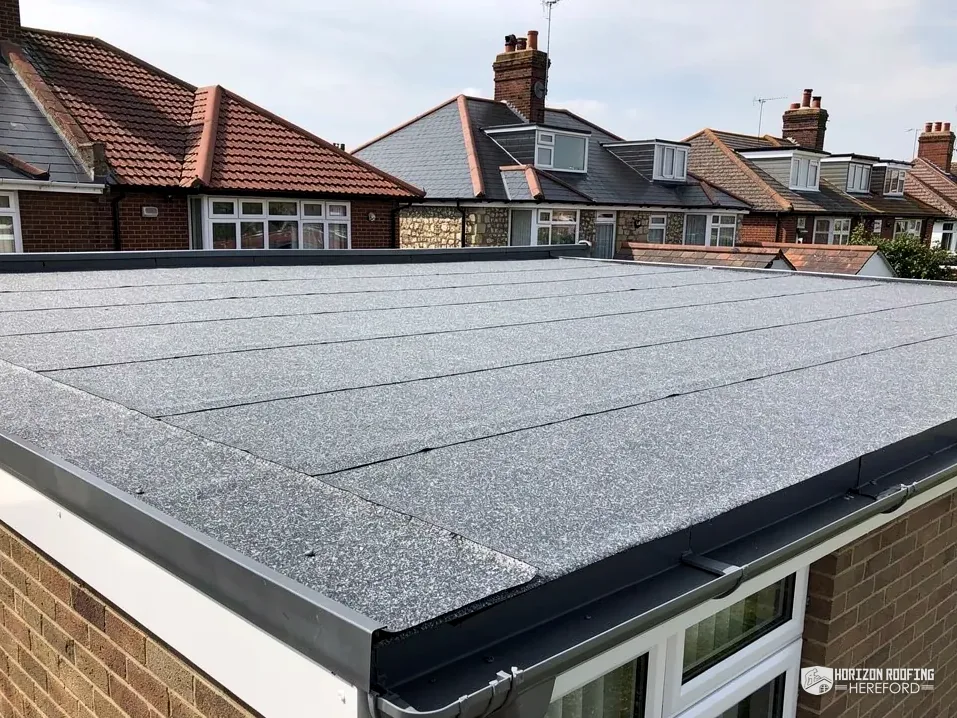
A new mineral felt flat roof on a rear extension

Membranes are cleaned gently. Felt, EPDM (a synthetic rubber sheet) and GRP (glass-reinforced plastic) all scratch or wear under a scraper, so we sweep, lift moss by hand, treat with a biocide suited to the surface and rinse at low pressure. On felt we take care not to strip the mineral chippings that protect it from the sun. A felt roof with its surface worn bare, with blisters, or with splits along the laps is a repair or re-covering question, and the photographs show which.

Garages and outbuildings need a different first question: what is the roof made of? HSE says "If the building was built or refurbished before 2000, assume that there is asbestos in it", and corrugated or profiled cement sheets on a garage, a lean-to or a farm building may well be asbestos cement. HSE guidance is plain that "AC roofs are always fragile". We clean an asbestos cement roof only from access equipment set up beside it, never from the sheets, and we avoid anything that would break up the surface. Our guide to cleaning an asbestos cement roof explains why, and HSE's page on spotting asbestos is worth a read before anyone goes up a ladder at an older garage.

Access shapes every roof clean, and it is part of the price. A bungalow may be reached from ladders and a roof ladder hung from the ridge. A three-storey house in Hereford or Ledbury may need a tower, a cherry picker or a scaffold, and if that has to go on the pavement or the road, a licence from the highways authority is needed first, in England or in Wales alike. We arrange the licence with our scaffolder. The cost band below sets out what else moves the price, so you know what the written figure covers before you see it.

When the clean is done, the site is swept, the bags of moss and grit go with us, and you get the photographs of every fault we noted from the ridge down.

A flat roof that holds puddles grows its algae in the same places every year.

What sets the price of a roof clean

Size and pitch
The area to clean and how steep the slopes are
Access
Ladders, tower, cherry picker or scaffold, and any licence
Growth
A thin film of algae or deep cushions of moss
Covering
Concrete, clay, slate, tilestone or a flat membrane
Extras
Valleys, gutters, outbuildings and fragile roofs

One written total price, never itemised.

Want us to look at your roof?

We survey from the ridge down, send you photographs of what we find and give you one written price.

Get a free quote01432 610152

Roof cleaning in Hereford, questions answered

How much does roof cleaning cost in Hereford?

Checkatrade's roof cleaning guide, last updated in April 2026, says roof cleaning in the UK typically costs between £8.50 and £14 per m², with hand removal and biocide treatment at around £11.50 per m². Those are national per square metre rates, so treat them as a starting point rather than your price. Checkatrade's list also includes pressure washing, which Marley does not recommend for slates or tiles. Access, the depth of the moss and the state of the gutters set the rest, and you get one written total price once we have seen the roof.

Is getting moss removed from a roof worth the money?

It depends on how much is there and what it is doing. A light film of algae on a sound concrete tile roof is a question of looks. Deep moss packed into the laps, moss filling the gutters, or a valley dammed with growth are different, because they hold water where the roof is meant to shed it. A clean also puts someone at the ridge with time to look, so slipped tiles and loose ridges are found while they are still small repairs rather than leaks.

What time of year is best for removing moss from a roof?

A dry spell matters more than the month. Moss comes away well when it is slightly damp, but a biocide needs dry weather after it goes on so that rain does not rinse it off, and a frosty or icy roof is never worked on. We also check for nesting birds first, because intentionally damaging a nest in use or being built is an offence in England and in Wales. Autumn leaves can refill valleys and gutters quickly, so a clean after leaf fall keeps them clear for longer.

How often should a house roof be cleaned?

There is no fixed interval. A roof is worth cleaning when growth is causing a problem, rather than on a calendar. A sunny, open roof can go a long time between cleans, while a shaded slope under trees, a north-facing roof near the Wye or the Lugg, or a house on a damp hillside can grow back sooner. The biocide slows regrowth after a clean. Between visits, the simplest maintenance is a look from the ground each spring, at the gutters, the valleys and any moss on the path, tells you when to call.

How long does a roof clean take, and can it shorten the roof's lifespan?

The time depends on the size of the roof, the depth of the moss, the access and the weather, so we give you an estimate of the days with the price. A hand clean is slower than a pressure wash, and that is deliberate: Marley warns that high powered jet washes can damage the surface and shorten a slate or tile's expected life. Lifespans are ranges, never promises. Marley gives concrete tiles a life of around 60 years, while HomeBuilding gives plain concrete tiles 40 to 50 years.

Can moss on a roof cause a leak?

It can play a part. Moss packed into the joints between tiles holds water against the roof, and thick cushions can lift the tails of tiles so that wind-blown rain gets beneath them. Moss in a valley or a gutter outlet can dam the flow until water overtops the lead or spills behind the fascia. A ceiling stain still needs tracing to its cause, and moss is only one possible culprit. We photograph what we find, and if the leak turns out to be a slipped slate or split lead, that becomes a repair.

Does access equipment on the road need a licence for a roof clean?

Yes, if a scaffold, tower or cherry picker stands on the highway. In England, Herefordshire Council asks for the application at least 10 days before a scaffold, cherry picker or hoarding is placed, and charges £167, a maximum of 1 month per licence. In Wales, a Monmouthshire County Council scaffold licence carries a £108 administration fee and needs at least 5 working days' notice. We arrange the licence with our scaffolder, and the access is part of the one price you receive in writing.

Which towns and villages near Hereford do you clean roofs in?

Our patch runs 30 road miles out from Hereford, through England's border counties and across into Wales. In England that takes in Herefordshire, from Leominster, Ledbury and Ross-on-Wye to Kington and Bromyard, and on into neighbouring corners of Worcestershire, south Shropshire and Gloucestershire. Over the border, it reaches the Monmouthshire and Powys border towns, such as Monmouth, Abergavenny, Presteigne and Hay on Wye, and the Bannau Brycheiniog National Park. The areas we serve page lists them all, and the clean is the same wherever the house stands.

Ask for a roof clean and condition check

Send a few photographs of the moss or book a visit, and we will come back with one written total price for the clean.

10-year workmanship guarantee, in writing