
Callout 1 of 3
A Hunderton extension and its flat roof
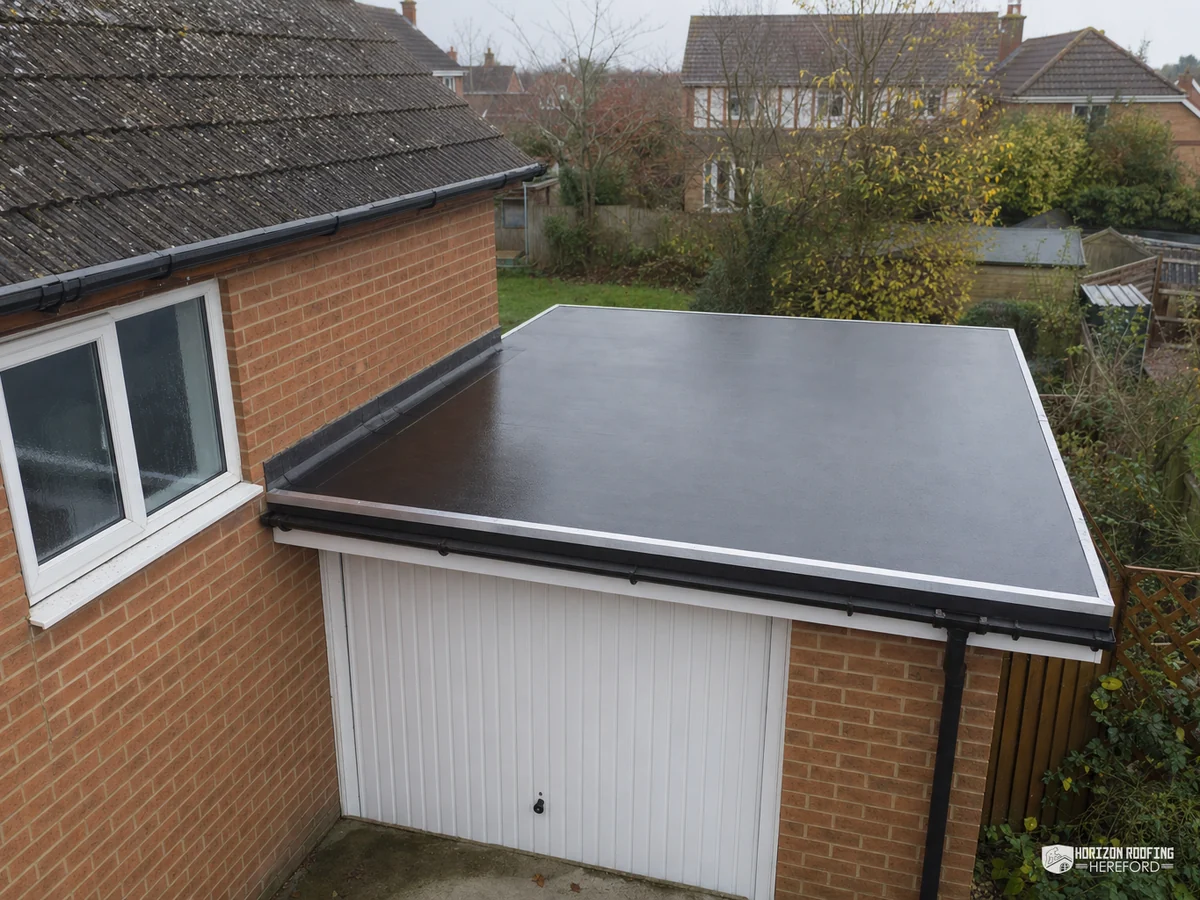
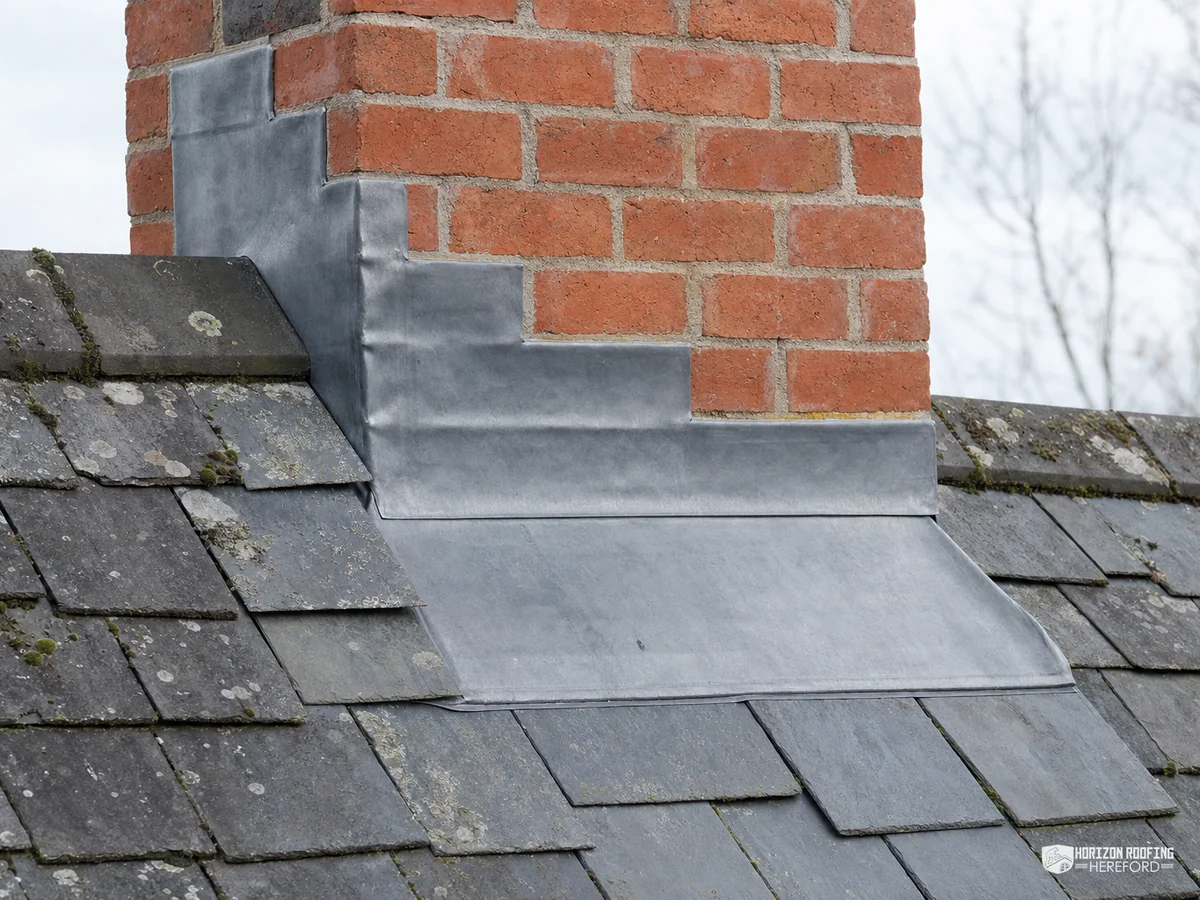
A house with a flat-roofed extension gets a separate survey of that roof, because it behaves differently from the pitched one beside it. Three things decide how it behaves: the covering, the fall and the edges. The covering is the waterproof layer, whether felt laid with a torch, a rubber sheet called EPDM, or glass-reinforced plastic (GRP). The fall is the slope that sends water to the outlet. The edges are the upstands, drips and flashings where the covering meets a wall or stops short. At the edges we check the upstand, where the felt or sheet turns up a wall, the drip over the fascia, and the flashing that covers the top of the upstand. A gap in any of the three lets water behind a covering that looks sound from the middle of the roof.
Published lifespans disagree from one source to the next, so each figure is given with its source. HomeBuilding puts EPDM at 25 to 30 years and Less at 30 to 50. For GRP, HomeBuilding says 25 to 30 and Less says 25 to 40. For torch-on felt, HomeBuilding gives 10 to 15 years, while Less says 10 to 20 depending on quality and installation. These are ranges for typical roofs, not promises; what the deck underneath is like matters as much as the age of the covering over it. A deck that has soaked up water over a few winters can need new boards before any membrane is laid, and the survey records the state of the boards where the existing covering has lifted.
BS 6229:2025 is the current code for membrane coverings that are continuously supported on a flat roof, and the NFRC takes it to mean a minimum finished fall of 1:80. IKO, which makes membranes, recommends a design fall of 1:40. Lead is outside this standard, which covers membranes only. A flat roof that holds a puddle for days has a fall problem, and a new covering laid over it will keep the puddle. So we measure the fall, and tell you what correcting it would involve, before a new membrane is priced.
Re-covering a flat roof with a new waterproof layer counts as renovation under AD L 2021, so insulation comes into the conversation. Table 4.3 sets a threshold of 0.35 and an improved figure of 0.16. Where 0.16 is out of reach, or the saving would need over 15 years to repay it, paragraph 4.13 allows a lower standard, generally no worse than 0.7. AD L 2026 takes over on 24 March 2027. Our flat roofing page sets out the coverings in more detail.
Flat roof coverings and their published lifespans
- EPDM
- 25 to 30 years (HomeBuilding), 30 to 50 (Less)
- GRP
- 25 to 30 years (HomeBuilding), 25 to 40 (Less)
- Torch-on felt
- 10 to 15 years (HomeBuilding), 10 to 20 (Less)
- Fall
- Minimum finished 1:80 under BS 6229:2025
A flat roof that keeps a puddle for days has a fall problem, and new felt keeps the puddle.