
01432 610152 Get a quote Call 01432 610152

Roofers in Powick

Roof repairs and re-roofs in Powick, a Worcestershire village about 40 minutes east of Hereford.

Every finding from ridge to stack gets a photograph, and the survey ends with a single price written down.

Get a free quoteCall 01432 610152

A Grade I church and Powick's conservation area

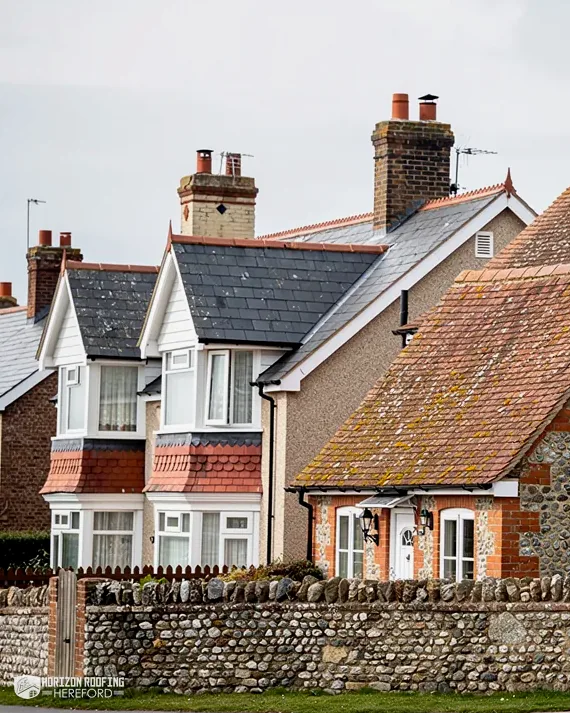
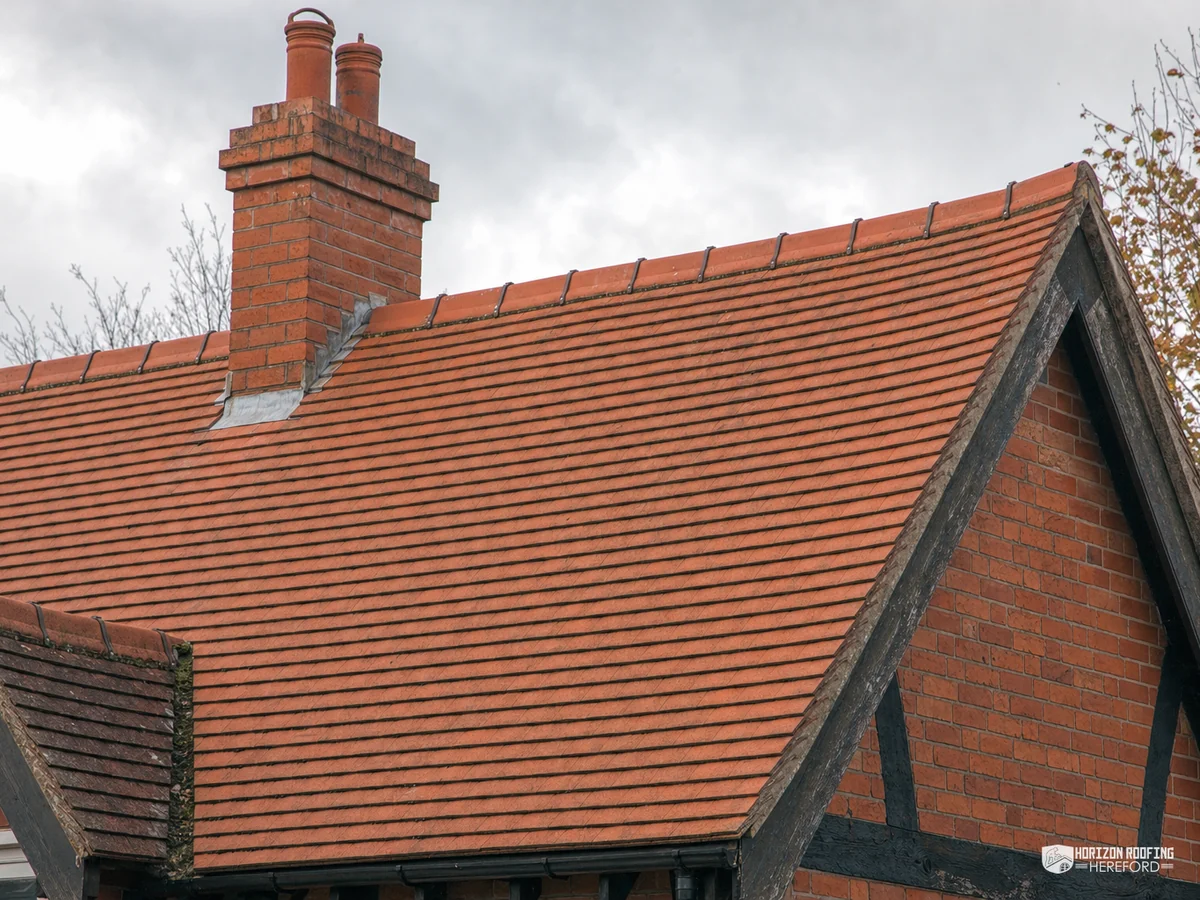
  • Older cottages with weathered clay tile roofs and brick chimneys behind a flint wall
    A Grade I churchSt Peter and St Lawrence is listed Grade I, list entry 1166920.
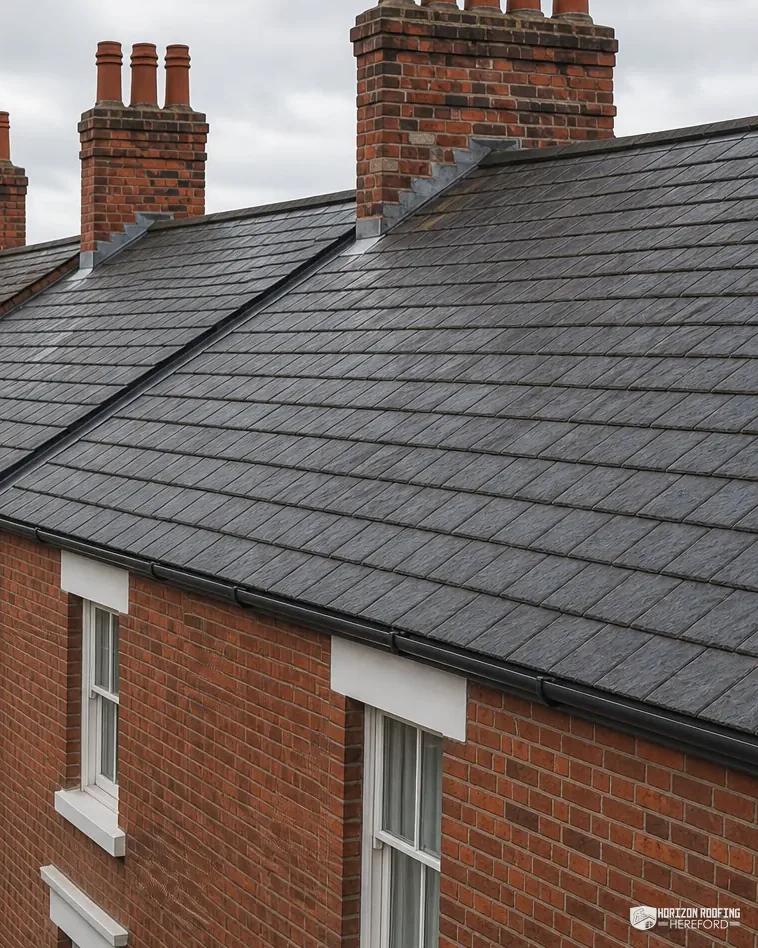
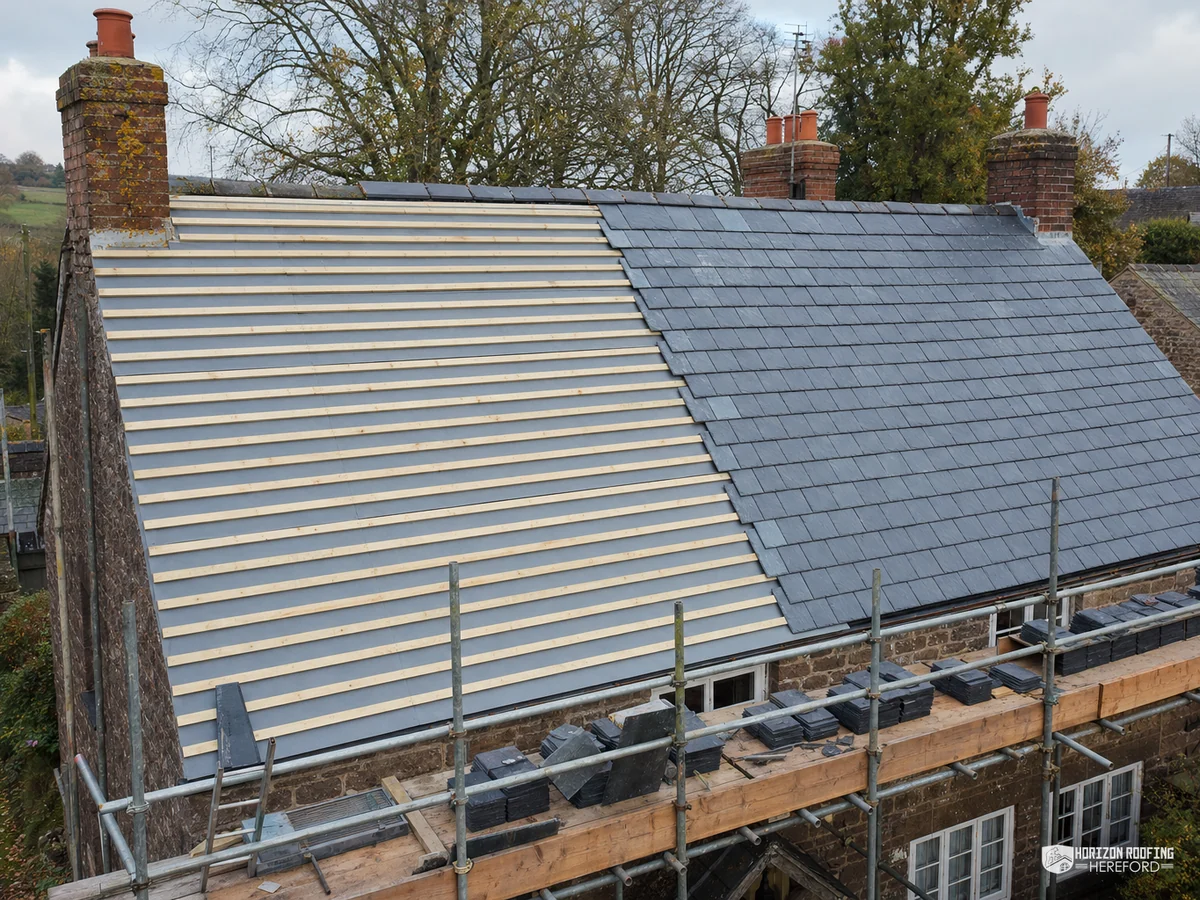
  • Slate roofs and chimney stacks along a red brick Victorian terrace
    A conservation areaMalvern Hills District Council's list includes a Powick conservation area.
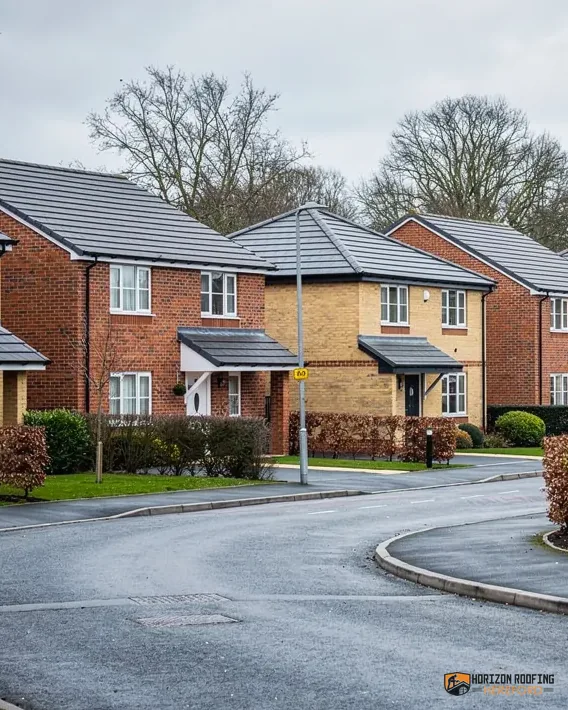
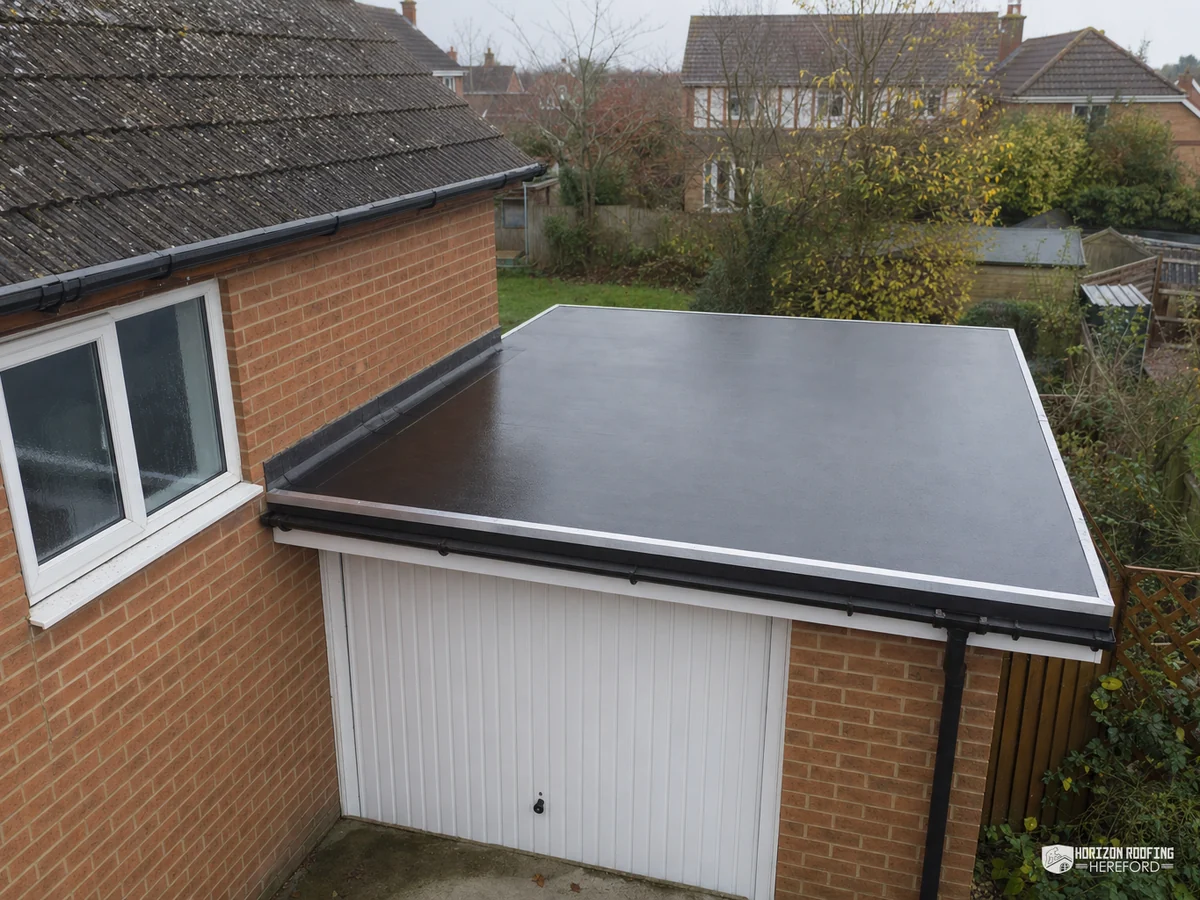
  • Newer homes with grey concrete tile roofs along a curving estate road
    Listed cottages and a vicarageThe Old Vicarage and The Coachmans Cottage and Stable Cottage are both Grade II.

Close to Powick

Powick on a street map, with a dashed circle around the town and the nearest towns we cover. Tiles © Esri; map data © Esri, HERE, Garmin, OpenStreetMap contributors.

Powick roofs, ridge to church wall

Ridge, chimney stack and a Grade I church wall: three callouts on a Powick roof

Every Powick survey of ours climbs in the same order: the capping along the ridge, then the stack together with its lead, then the protected walls, where the paperwork can weigh as much as the tiles.

A drawn cut-away section through a Herefordshire border house: the front of the main roof is cut open to show the rafters, underlay, battens and slates, beside a black-and-white timber-framed gable. Numbered, from the ridge down: 1 Ridge line; 2 Stack and lead; 3 Church and cottages.

Fig. 1 A Powick roof opened up, with ridge, chimney and wall numbered.

Callout 1 of 3

Bedding and clips along a Powick ridge

Capping tiles straddle the join between the two slopes at the top of a Powick house, and two methods keep them there. One beds each tile on a ribbon of mortar; the other fixes them mechanically with clips and screws, a dry-fix system that BS 8612 specifies. Marley is plain that fitting to BS 5534 isn't required by law. It adds that since the 2015 amendments mortar alone has stopped counting as a sufficient way of securing a covering, which is why a rebedded ridge now also gets a fixing.

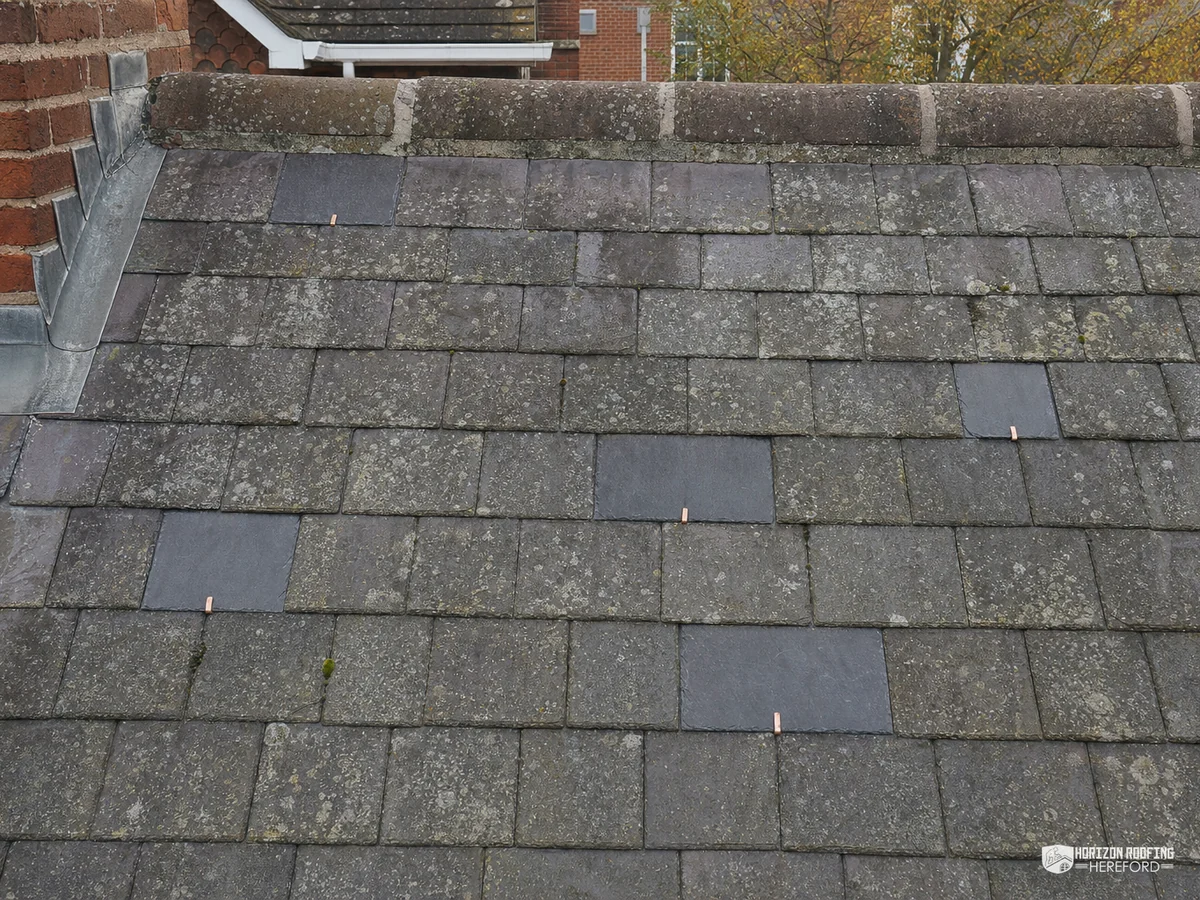
Up the ladder we press each capping tile and mark any that rock. We look for mortar that has crazed, shrunk back from the tile or dropped out in lumps, and we check the end tile at each gable, the place where a gust gets under a roof first. A hip, the sloping line at an outside corner, is read the same way, because it carries the same capping and meets the same wind. Mortar that has failed under sound tiles is a rebedding job with a fixing added to each tile. Cracked capping is replaced tile by tile.

In its 1924 account of Powick, the Victoria County History records that at St Peter's church the aisles sit "under leaded lean-to roofs, but all the rest of the roofing is covered with modern red tiles overhanging at the eaves". That describes the church alone, and it tells us nothing about the houses outside. If your own roof is clay, Marley reports that the BRE set a minimum life expectancy of 60 years for clay roof tiles. That figure describes the clay tile and not the ridge bed, which may need redoing several times within that span.

Photographs run from the ridge down to the first course, so you see the line as we see it, with a wider frame of the whole slope to put each close-up in place. If the trouble is only the bedding, the repair is a ridge repair and the price on paper says so. Should the tiles below have slipped as well, that goes in the report too. Our roof repairs page explains how a repair is scoped, and the price you receive covers the lot.

Ridge points we photograph in Powick

  • Capping tiles that rock under a hand
  • Mortar crazed, shrunk or lost in lumps
  • A mechanical fixing on every capping tile
  • End tiles at each gable
  • The joint where hip meets ridge

Mortar is not banned from a ridge, but it can no longer be the only thing holding the tiles on.

Fig. 2 The ridge, drawn close

Callout 2 of 3

Brick stacks and the lead round their bases

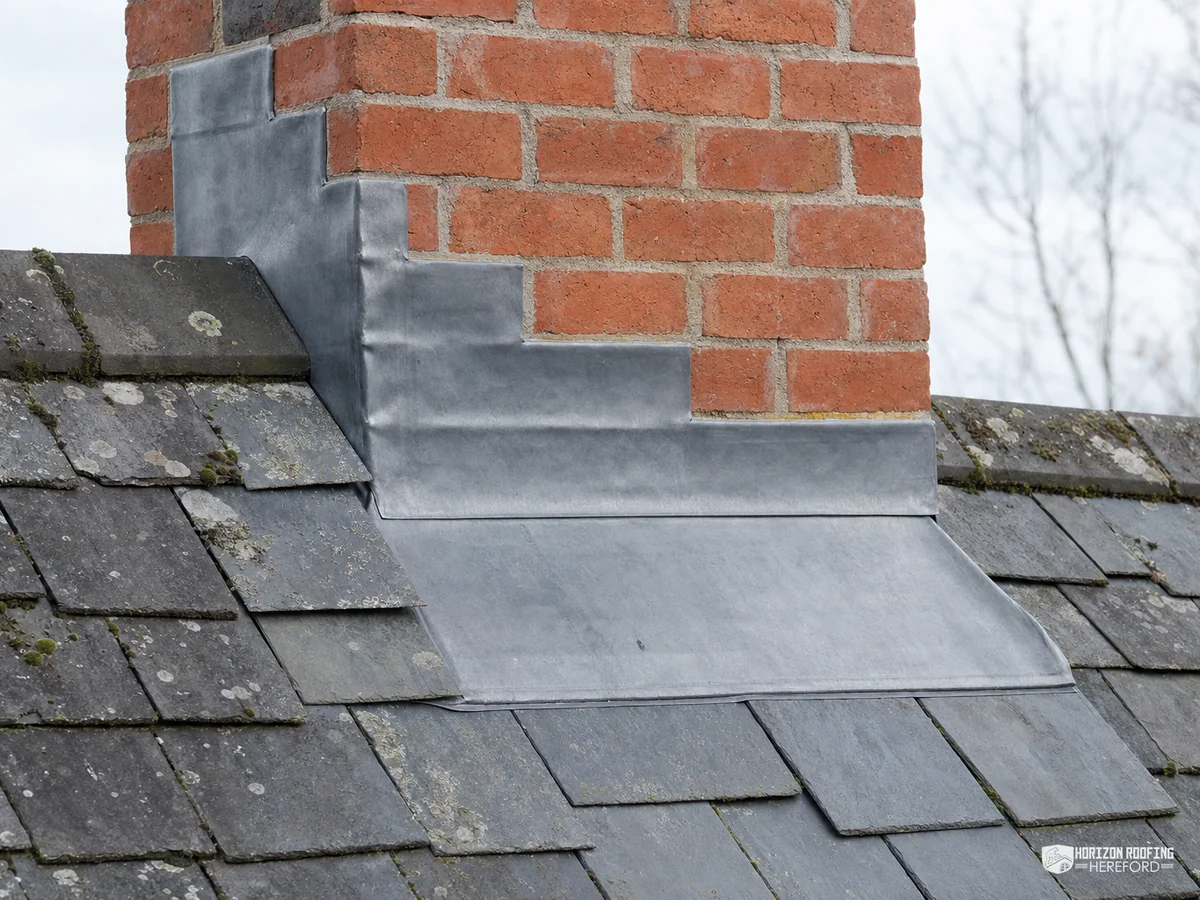
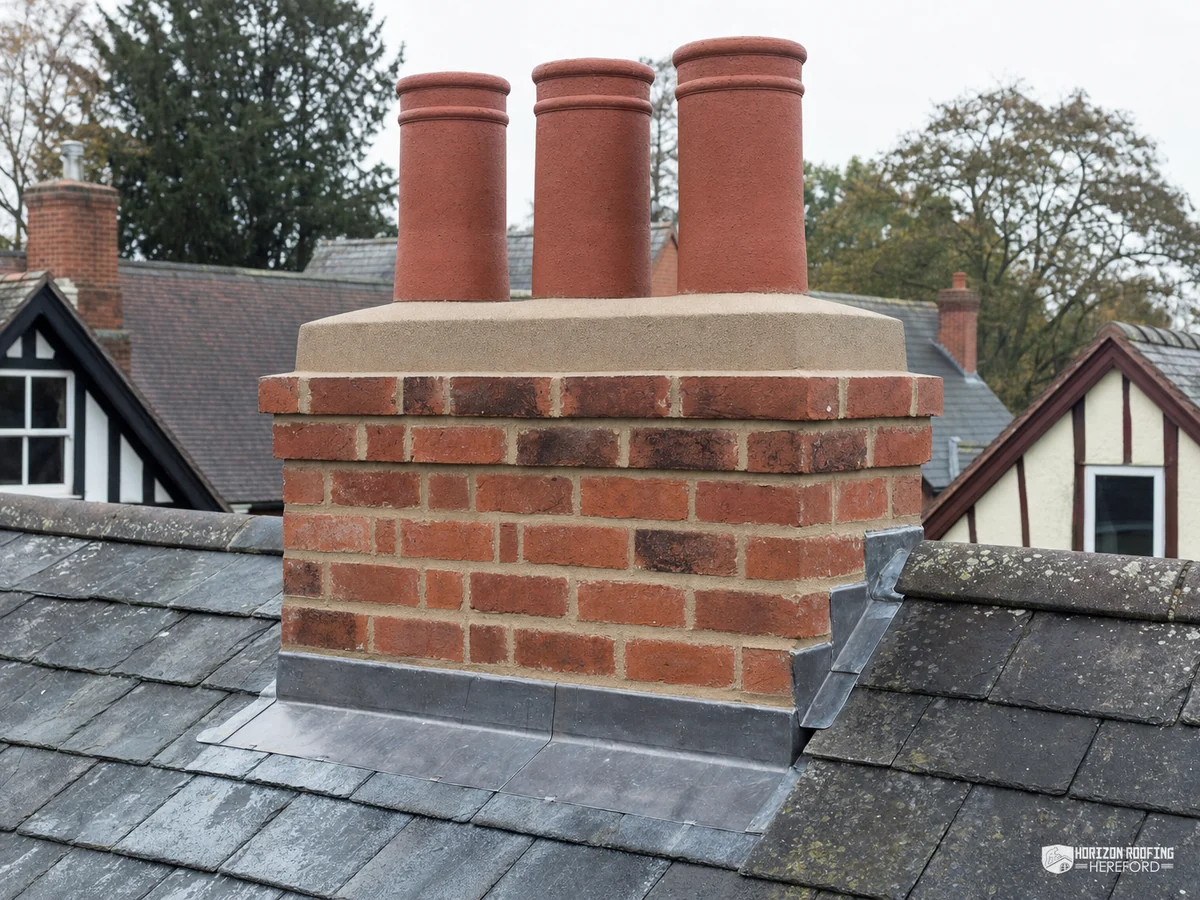
A stack rises through the slope and meets the tiles at its base, and lead seals that meeting. Flashings are strips tucked into the brick joints and dressed down over the tiles, and soakers are small sheets laid beneath each course alongside the stack. Royston Lead's table sets out the thickness codes: Code 3 is "Recommended for lead soakers only", while Codes 4 and 5 both appear against flashings. A higher code means a thicker, stiffer sheet that takes more working, so the code is read off the roll before anything is dressed.

At the stack we check four things in turn. The pointing comes first, then the flaunching, then the lead, then the pots. Flaunching is the cement collar that seats each pot and throws water outward. When it cracks, water reaches the flue, and when pointing opens, water reaches the brickwork. MyJobQuote's line is that lead flashing, if correctly installed, can last for over 80 years. The hedge sits on the installation, and nobody can promise it for a particular stack.

Taking a stack down raises questions inside the house. The Planning Portal states that Building Regulations approval will always apply when chimney breasts are removed, because they are part of the structure. Where a neighbour's house shares the wall the breast sits in, the Party Wall etc. Act 1996 may come into play as well, and the notice is the building owner's to serve. These are separate steps from the roof repair, and mentioning them during the survey keeps them from stalling the job afterwards.

A sound stack with failed flashings needs new lead and nothing more. Where the old lead was dressed over the tiles and has lifted at its upper edge, we show you the gap in close-up, because a flashing that has curled back from the brickwork shows as a dark line in the photograph. A stack that leans, or has open joints through its whole depth, needs rebuilding. The photographs show which one you have, from pot to shoulder, and they record the state of the pointing course by course up the brick. Our chimney repairs page sets out the work.

Lead at the stack

Which lead code goes on the chimney flashings?

Royston Lead's table lists Codes 4 and 5 against flashings, and Code 3 for soakers only. A flashing cut from Code 3 would be too light for the job, so the code is chosen before the sheet is cut.

Fig. 3 Chimneys, drawn close

Callout 3 of 3

St Peter and St Lawrence and Powick's protected walls

The Church of St Peter and St Lawrence is listed Grade I (list entry 1166920, first listed 25 March 1968). Its services are published through its Anglican benefice, the Old Hills group, and that places roof work under the faculty system until worship there ends; the church's governing body hears from us before any scaffold goes up. Nothing ranks above Grade I, and the same care carries on into the houses nearby. Photographs taken from the ground show slipped tiles and open joints without anyone climbing, which gives the church's governing body something concrete to read.

Several Powick houses are listed at Grade II, and a listed roof gets slower, more careful handling than an ordinary repair. They include 42, 43 and 44, the Village (list entry 1301100, first listed 8 May 1979), The Coachmans Cottage and Stable Cottage (list entry 1098747, first listed 9 February 1988) and The Old Vicarage (list entry 1167121). Section 7 of the Planning (Listed Buildings and Conservation Areas) Act 1990 requires consent where works would change a listed building's special character. Permitted development rights stay with the house, so the two sit alongside each other, and Malvern Hills District Council takes the enquiry.

The council's conservation area list includes a Powick conservation area, so an address near the village centre should be checked on the council's own map. In England, a conservation area weighs on a dormer extension, which Malvern Hills District Council should see first; the planning guide for roof windows sets out the detail. Malvern Hills District Council states that no Article 4(2) Directions are in force at present.

Works beyond a repair go to South Worcestershire Building Control, which Malvern Hills District Council, Worcester City Council and Wychavon District Council operate jointly, or to a registered building control approver. Worcestershire County Council, the highways authority here, grants the licence for any scaffold that stands in the road. Our listed and heritage roofing page covers protected buildings in more depth, including how old and new material are matched.

Listing vocabulary for a protected Powick roof

List entry
The number under which a building appears on the national list
Grade I
The highest grade of listing, given to a small share of buildings
Section 7 consent
Permission for works that affect a listed building's character
Article 4 direction
An order that withdraws specified permitted development rights in an area
Registered approver
A private firm that can do the building control check

Powick questions on conservation, loads and loft rooms

Do roof repairs inside the Powick conservation area need planning permission?

Replacing like with like is a smaller step than changing the covering, and the person to put either question to is at Malvern Hills District Council. A covering that matches the old one in look and material is the easier case to argue. Its list includes a Powick conservation area, and its own statement is that no Article 4(2) Directions are in force. Check your address against the council's map first, then pass us the reply, and we will match the repair to what it says.

How much heavier can a new Powick covering be before the structure is checked?

The Planning Portal sets the trigger for Building Regulations approval once a covering makes the roof 15 per cent or more heavier, while AD A puts it at a loading rise of more than 15%. Both are building control matters, not planning ones. Swapping slate for concrete tile, or the reverse, is the classic case. The rafters and walls get a structural look before a heavier covering is priced.

Which insulation and escape rules shape a Powick loft room?

A roof upgraded for a loft room in England meets AD L 2021 Table 4.3, with a threshold of 0.35 and an improved figure of 0.16. A storey more than 4.5 m up then calls on AD B paragraph 2.5, which allows a protected stairway or an alternative escape route. AD L 2026 arrives on 24 March 2027, and building control confirms which edition covers your start date.

Can the old asbestos cement roof on a Powick garage simply be lifted off?

HSE advises owners of any building constructed or refurbished before 2000 to work on the basis that it contains asbestos, and warns that "AC roofs are always fragile". Lifting whole sheets off with care, unbroken, falls within non-licensed work; sheets already broken up, or substantially damaged, turn it into notifiable non-licensed work. HSE wants asbestos waste in a skip that locks, and an open skip will not do, and the survey notes which sheets are cracked before anything is lifted.

What comes first when a storm lifts tiles on a Powick roof?

Phone your insurer before any permanent repair, cover an open gap with something temporary, and keep photographs and receipts. The Financial Ombudsman Service usually looks at photos and expert reports to judge a property's condition, and it says "Rain, hail or snowfall by itself can constitute a storm." Our survey adds dated photographs of whatever is loose, which are good evidence to hand over.

Who holds the safety duties on a Powick home's roof job?

A homeowner who hires a roofer is a domestic client, and regulation 7(1) of the CDM Regulations 2015 moves the client's duties onto the sole contractor, or onto the principal contractor when several firms are on site. With a single contractor on the job, regulation 15(5) has that contractor prepare the construction phase plan before setting up the site. Ours is written before the scaffold goes up, so access, open edges and the waste route are agreed in writing beforehand.

Ask for a Powick ridge-to-eaves survey

Give us the road and whatever you can spot from the pavement, and our visit will cover the whole roof, photographed from ridge to gutter.

10-year workmanship guarantee, in writing