
01432 610152 Get a quote Call 01432 610152

Roofers in Stretton Sugwas

Roof repairs and re-roofs for Stretton Sugwas cottages, farmhouses and the houses beside them.

Starting at the verge, the survey works down the roof, each fault is photographed, and a single written total price follows.

Get a free quoteCall 01432 610152

What a Stretton Sugwas cottage roof needs checked

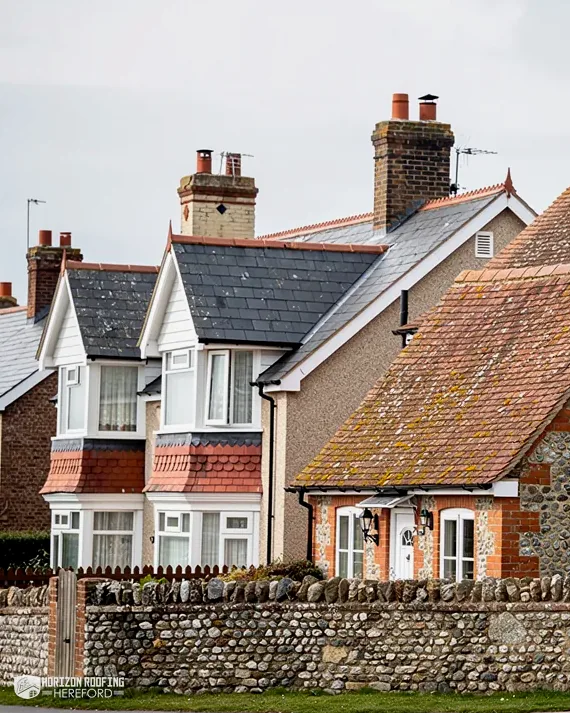
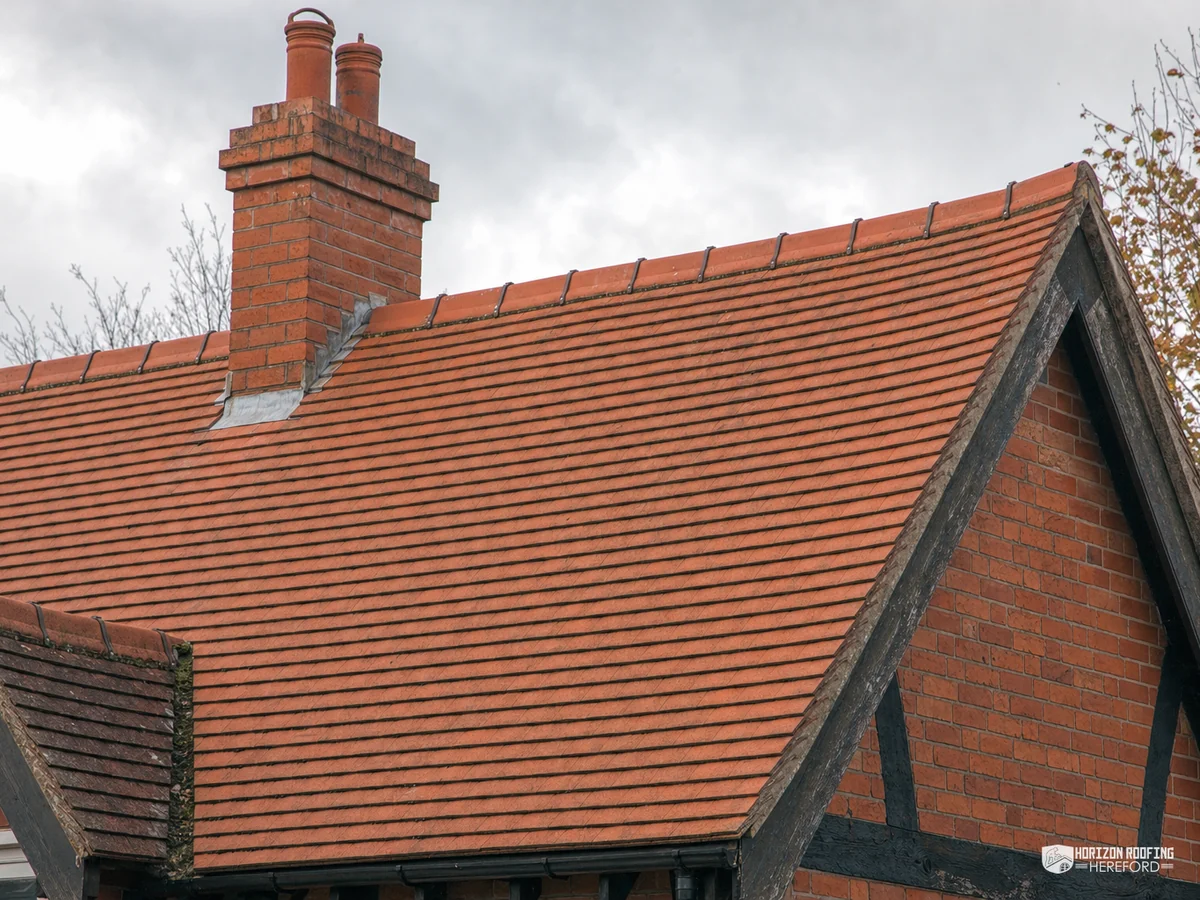
  • Older cottages with weathered clay tile roofs and brick chimneys behind a flint wall
    Thatch beside tileThatch goes to a specialist thatcher; the tile and lead beside it are ours.
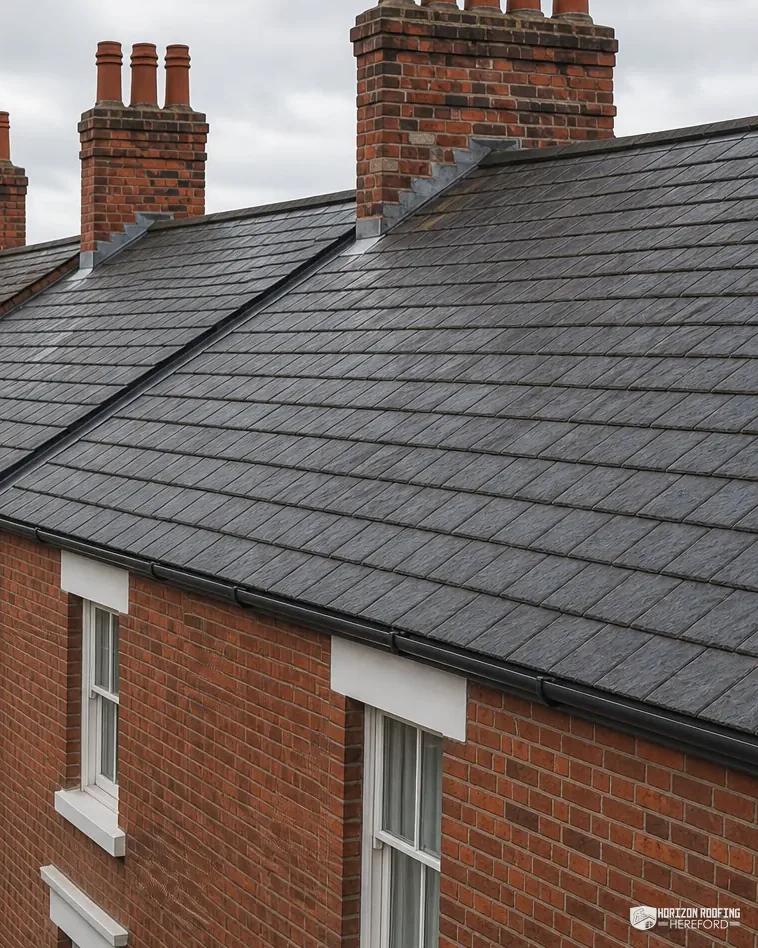
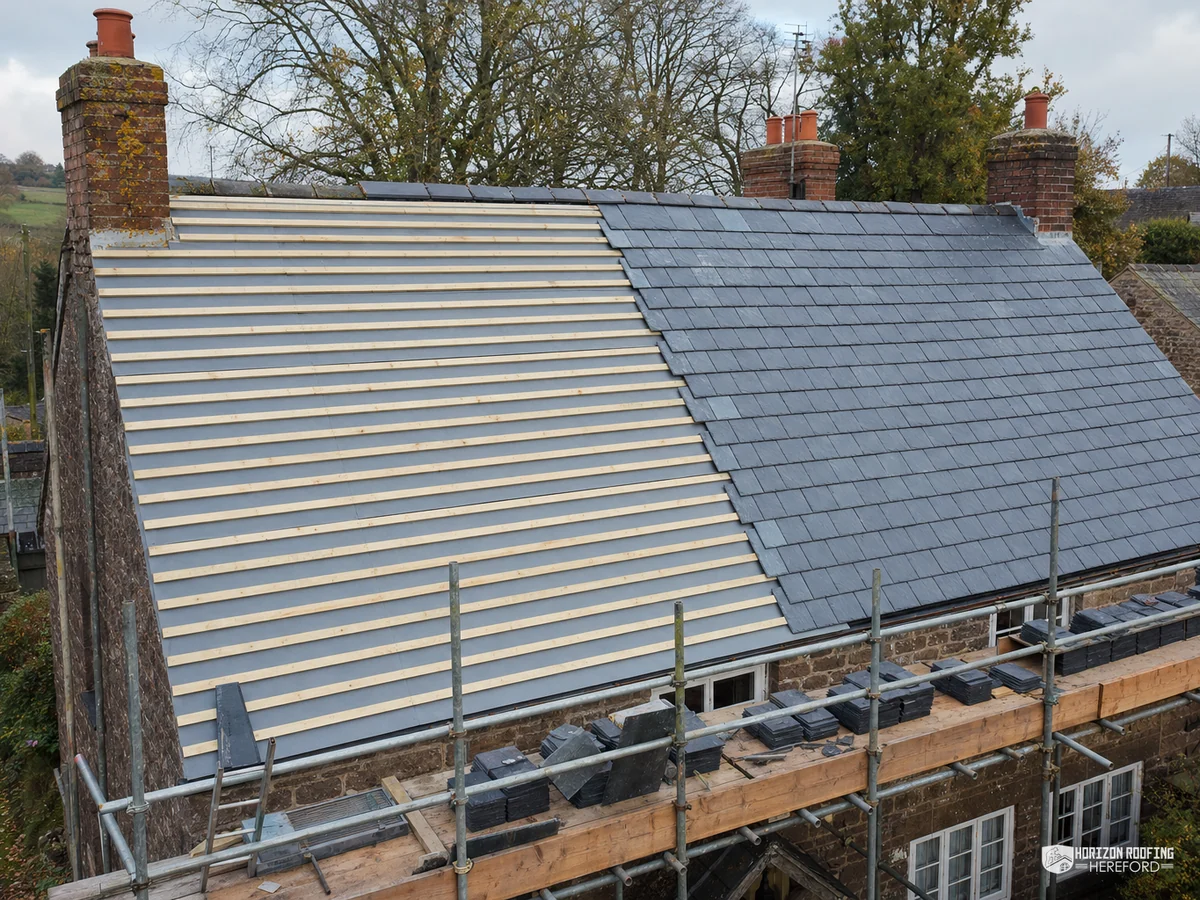
  • Slate roofs and chimney stacks along a red brick Victorian terrace
    Listed Grade II neighboursWorks that change a listed house's character need consent before a tile moves.
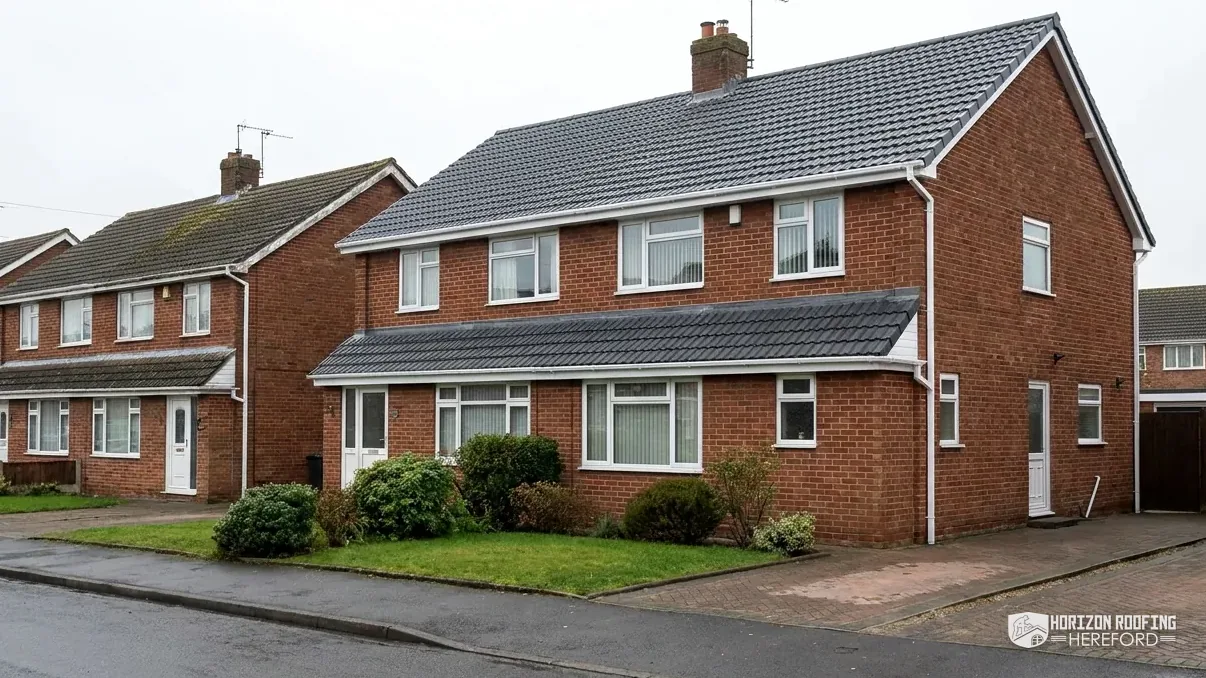
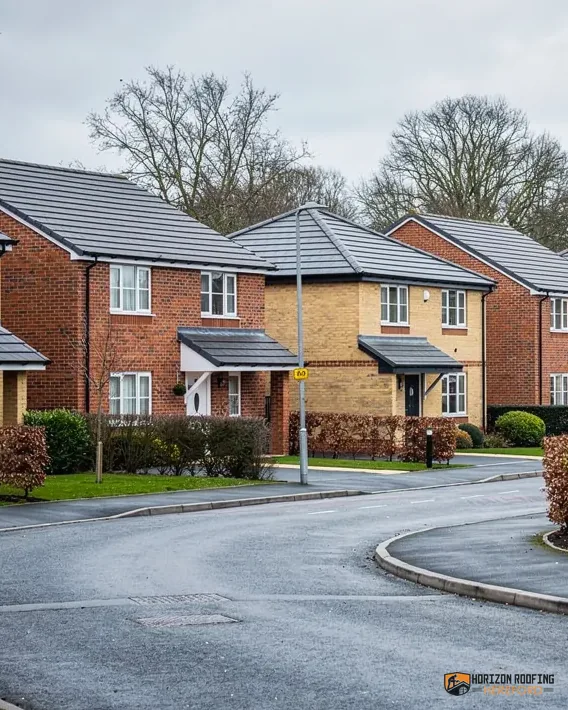
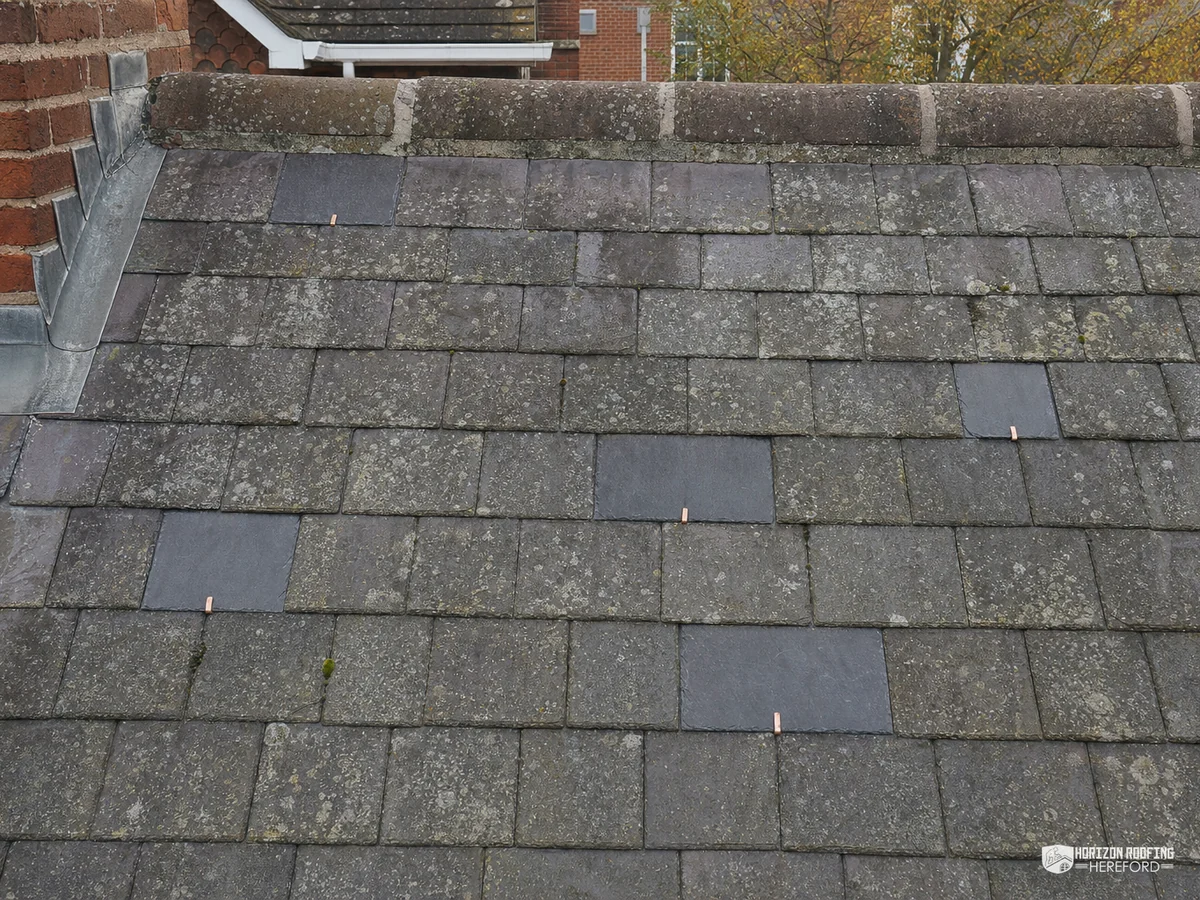
  • Newer homes with grey concrete tile roofs along a curving estate road
    Timber frames under old coveringsVerges and lead beside a moving frame open up before a ceiling shows it.

Stretton Sugwas at a glance

Stretton Sugwas on a street map, with a dashed circle around the town and the nearest towns we cover. Tiles © Esri; map data © Esri, HERE, Garmin, OpenStreetMap contributors.

Reading a Stretton Sugwas roof from the verge

Verge, lead and frame: three callouts on a Stretton Sugwas house

Our order of work: first the verge at the gable end, next the lead that keeps each junction dry, and last the timber frame together with the rules protecting listed cottages.

A drawn cut-away section through a Herefordshire border house: the front of the main roof is cut open to show the rafters, underlay, battens and slates, beside a black-and-white timber-framed gable. Numbered, from the ridge down: 1 Gable verge; 2 Lead work; 3 Framed cottages.

Fig. 1 One house cut open, with the three Stretton Sugwas callouts numbered along its roof.

Callout 1 of 3

Verges, thatched neighbours and mortar that let go

At a gable wall the roof stops, and the outermost tiles or slates overhang the brickwork or stone; that overhang is the verge. The gap under it is sealed with mortar, or closed by a dry-fix unit: a trim of plastic or metal screwed down through the covering. Stretton Sugwas parish features in the 1932 inventory of Herefordshire from the Royal Commission on the Historical Monuments of England (RCHME), which records a cottage with two storeys, a timber frame and "a thatched roof". Thatch is another trade, and a specialist thatcher is the right call for a thatched roof. Our work is the roof around it: the tile, slate and lead on a house beside a thatched neighbour, on an extension, an outbuilding or a porch.

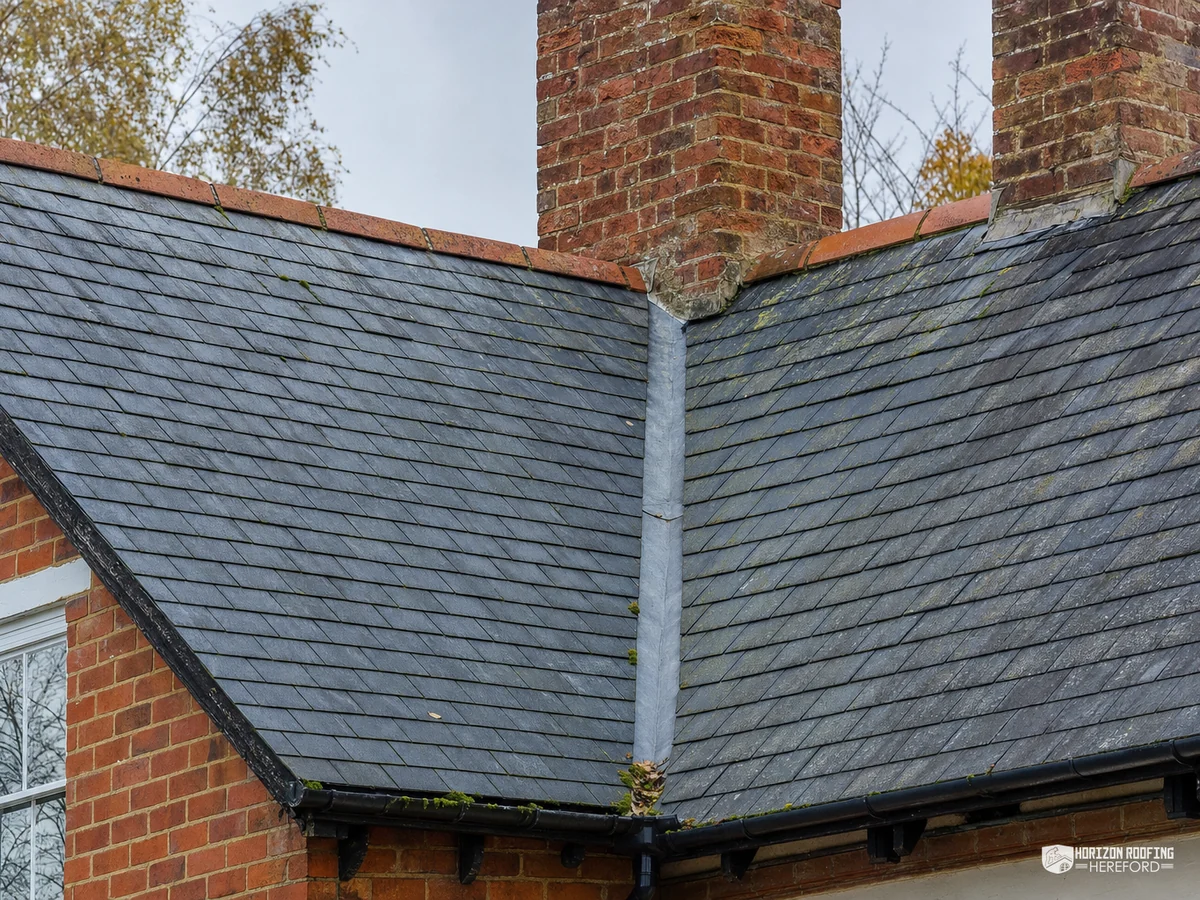
Along a verge we press on the mortar bed to find hollow patches, look at the end tiles for slip, and check the bargeboard or rafter ends beneath for staining that tells us damp has been getting in behind. A verge whose mortar has gone can be rebedded without touching the main slopes, where the tiles and battens behind it are sound. Marley, the tile maker, writes that "Installing to BS 5534 isn't required by law", yet since the 2015 amendments "mortar could no longer be relied upon as the only means of securing the roof covering". BS 8612 sets out how a dry-fix verge or ridge system should perform. A rebedded verge on our roofs gets a mechanical fixing too, and a house that was built with a bedded edge keeps the bedded look.

A loose verge is a small repair. If the entire covering proves worn out, England's Planning Portal test sets two limbs, and no application is normally needed only if "Less than 25 per cent of the total 'building envelope'" and "Less than 50 per cent of the roof is affected" both hold. A new covering that "increases the weight of the roof covering by 15 per cent or more" calls for Building Regulations approval and a structural check beforehand. Our roof repairs page covers the small jobs, and pitched roofing covers a full re-cover. Every verge we open is photographed, so you see the fault, the mortar and the bargeboard before you agree the fix.

Checked along a Stretton Sugwas verge

  • Mortar bed cracked, hollow or missing
  • End tiles that have slipped or rock
  • Bargeboard and rafter ends for damp stains
  • A mechanical fixing under each verge tile
  • The seal where the verge meets the ridge

Lost verge mortar means a repair, and the price says repair.

Fig. 2 The verge, drawn close

Callout 2 of 3

Stack and valley lead, and when bats matter

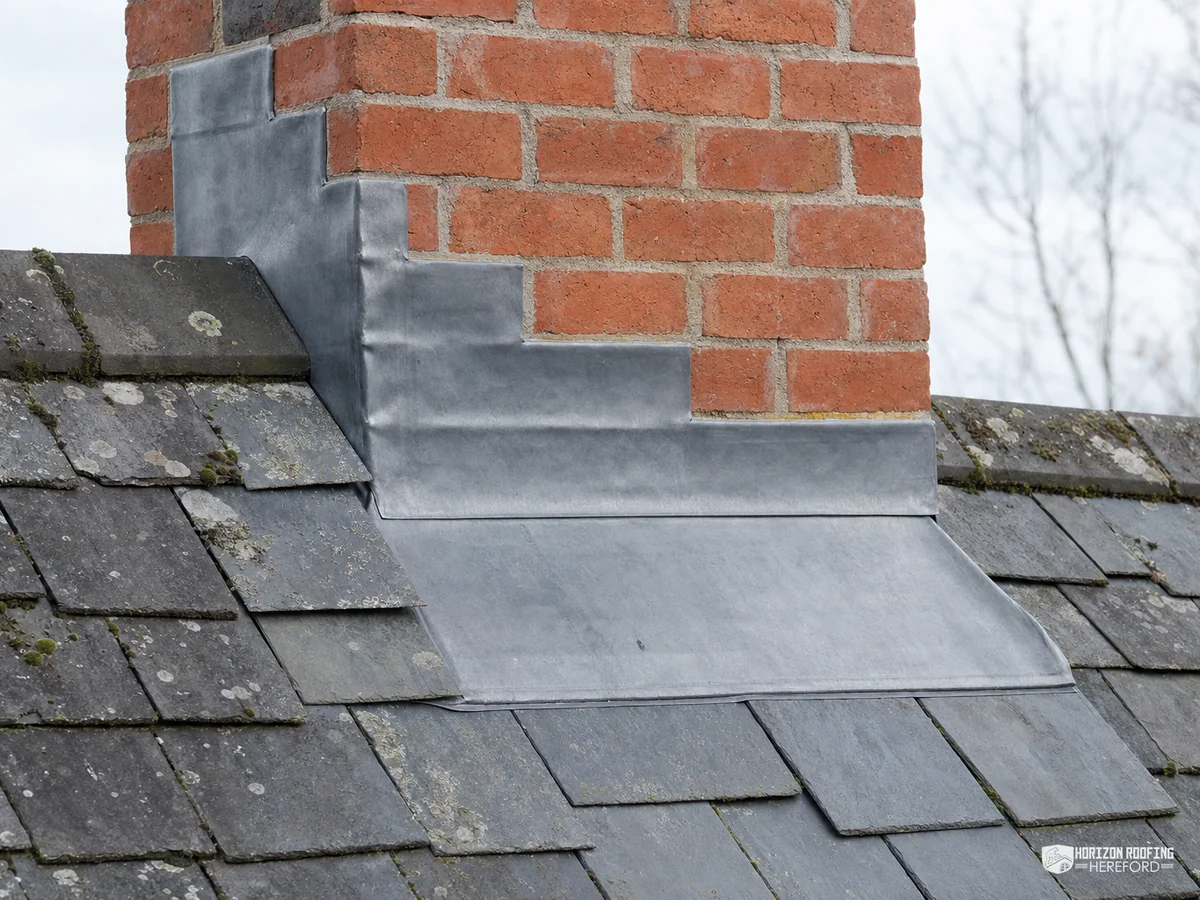
Lead is what keeps the awkward junctions dry: the flanks of a chimney stack, the trough where two slopes meet, and the joint where a roof climbs into a taller wall. Flashing here means a strip of lead let into a joint of the wall masonry and turned down over the covering. A soaker is a small piece of lead worked into the courses at the side of a stack. The valley is the trough itself, and lead lines it. Royston Lead numbers its sheet thicknesses as codes: Code 3 is "Recommended for lead soakers only", while Codes 4, 5 and 6 are listed for flashings. The thickness suits the position, and the folds leave room for the metal to expand in warm weather without splitting. Lead fixed rigidly across a corner can crack as it moves, so stack corners are checked first.

MyJobQuote says correctly installed lead flashing "can last for over 80 years", so lead that is still in good condition is not replaced for the sake of it. Split or raised lead is replaced and is never hidden under sealant. At a chimney we also inspect the pointing, the flaunching (the mortar that sets the pots and is sloped to throw rain off) and any lean in the stack, and photograph each face. Taking a stack and breast out entirely is different work: the Planning Portal is plain that "Building regulations approval will always apply when removing chimney breasts as they are part of the building's structure." Where the breast shares its wall with the neighbouring house, the building owner serves the party wall notice, and in Stretton Sugwas at least two months must then pass before the shared wall is opened up.

A village roof near barns and mature gardens can shelter wildlife. GOV.UK says "All bat species, their breeding sites and resting places are fully protected by law", and names roof repair and replacement as work liable to harm them. If a roost turns up, work stops and a licence from Natural England comes first. Section 1 of the Wildlife and Countryside Act 1981 is breached by anyone who acts intentionally against a bird's nest while it is still being built or in use, whether the act is to take it, to damage it or to destroy it. Tiles that look sound from the ground can hide a nest or a roost under the ridge, which is one more reason the survey starts at the top.

Bats in a roof

Do bats stop a repair on a Stretton Sugwas roof?

Only if a roost is found. Bats and their roosts are protected; work that could disturb them needs a licence from Natural England first. The job pauses, you are told what was found, and the repair is planned around the licence.

Fig. 3 Leadwork, drawn close

Callout 3 of 3

Grade II cottages, Huntington nearby and the rules

The last callout is the junction where a covering meets an old timber frame. Historic England lists The Thatched Cottage and Brook Cottage in the village as Grade II, both first listed on 19 January 1987 (list entries 1099257 and 1099256), and Stretton Court is Grade II as well (list entry 1172766). Section 7 of the Planning (Listed Buildings and Conservation Areas) Act 1990 puts any work that would affect "its character as a building of special architectural or historic interest" under a consent requirement. A listed house keeps its permitted development rights; consent is a further requirement, which is why the covering, the lead and the method are settled with Herefordshire Council before any tile comes off.

On a framed house the survey continues in the loft. The wall plate is the timber that sits on top of the wall and takes the rafters, their feet resting on it; damp in an old frame tends to show there well before a bedroom ceiling is stained. Outside, we look for daylight between the frame and the covering and for verge mortar that has dropped away. Any patch is made from the stuff the house was put together with, so it sits with the frame instead of pulling against it. Where a leak has been tracked to the frame, we say which timber is damp and how far the staining runs. Photographs of the loft timbers go into the report with the roof shots.

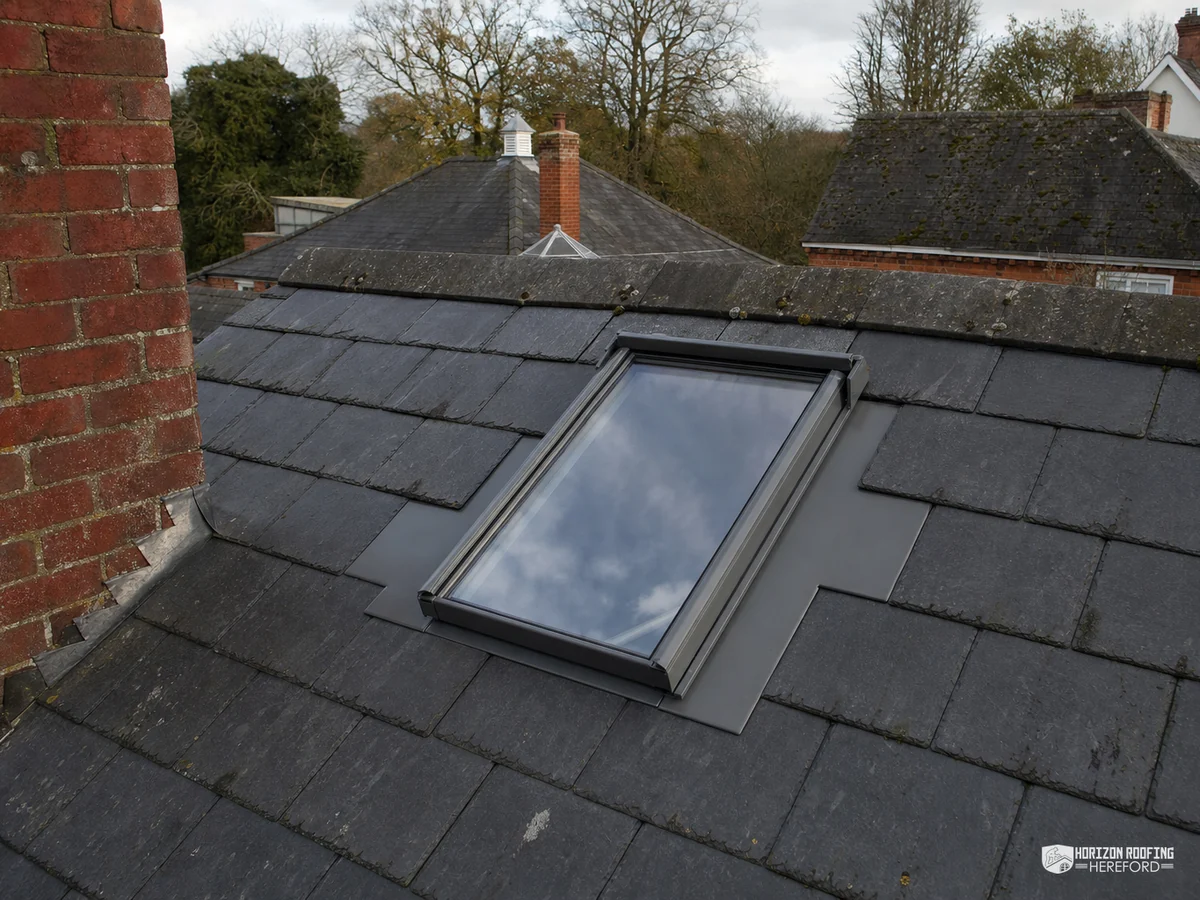
Huntington is a conservation area close to the village. Herefordshire has 64 conservation areas in all; Herefordshire Council keeps the list with its boundaries, and your own address is best checked against it. Ask Herefordshire Council whether an Article 4 direction applies as well. New roof windows and dormers raise their own planning questions, and our planning guide for roof windows lays the conditions out. For Building Regulations questions, Herefordshire Council runs building control itself, on 01432 261938, and a registered building control approver is the alternative. Our listed and heritage roofing page shows how we handle protected houses from first photographs to the last dressing of lead.

Where a covering meets the frame

SoundCovering lies close to the frame with the verge bedded and dry
Needs workDaylight at the frame, verge mortar gone, timber stained below

Stretton Sugwas roofs: thatch, listing and lead

Which roof jobs next to a thatched Stretton Sugwas cottage are yours?

A thatched roof needs a specialist thatcher. Our work is the tile, slate and lead on the rest of the house, on extensions and outbuildings, and the flashings and verges where a pitched roof meets a thatched neighbour. Which parts are ours is shown by the survey photographs, and the written price covers that work alone. If a roof turns out to be thatch under a later covering, you are told at once and pointed to the right trade, and nothing is priced until that is settled.

Can a Grade II cottage in Stretton Sugwas be re-covered?

Yes, with listed building consent. Section 7 of the 1990 Act requires it for works that affect a listed building's character, and the consent sits on top of the permitted development rights the house keeps. The material, the fixings and the lead detail are agreed with Herefordshire Council before any covering comes off. Where sound slates can be reused, they are sorted and refixed.

Do I need Building Regulations approval to re-roof in Stretton Sugwas?

The village is in England, so the Planning Portal's envelope test governs. The England test sets two limits, less than 25 per cent of the building envelope and less than 50 per cent of the roof, and within them an application is not normally needed; anything larger goes to building control. Adding insulation brings in Part L, where AD L 2021 Table 4.3 gives a threshold of 0.35 and an improved figure of 0.16 until AD L 2026 starts on 24 March 2027.

What will Herefordshire Council charge to licence scaffold on a Stretton Sugwas road?

A licence under the Highways Act 1980 s169 is required for scaffold standing on the highway. Herefordshire Council's charge is £167 for a licence whose maximum period is 1 month, then £123 per month if it is extended, and the council wants the form at least 10 days before erection day. We arrange the licence with our scaffolder, and your single written total already carries the scaffold.

Does a conservation area or an Article 4 direction affect roof work here?

The nearest conservation area to Stretton Sugwas is Huntington, and Herefordshire has 64 in all. The list is held by Herefordshire Council, so look up your address there before the roof's appearance is altered. An Article 4 direction can withdraw permitted development rights within a set area, so ask Herefordshire Council whether one applies. A repair that matches what is there prompts fewer questions than new roof windows do, and the survey notes which of the two your plans fall under.

What happens when a chimney stands on a wall shared with next door?

Cutting away a chimney breast on a shared wall is work to a party wall. The notice is served by the building owner, and next door can consent in writing. A surveyor is appointed only if they dissent or do not reply within 14 days. Building Regulations approval also applies to a breast removal. For the notice itself, ask a party wall surveyor and not building control.

Book a verge-to-frame survey in Stretton Sugwas

Add a short note on the roof, or a picture, and a written price follows a survey that opens at the verge.

10-year workmanship guarantee, in writing