
01432 610152 Get a quote Call 01432 610152

Roofers in Clehonger

Stone slate, slate, valley and roof window work for Clehonger, 4.8 road miles south-west of Hereford.

Each slope and each valley is read, the faults are photographed, and a written total follows once the survey is complete.

Get a free quoteCall 01432 610152

Stone slate, valleys and windows in Clehonger

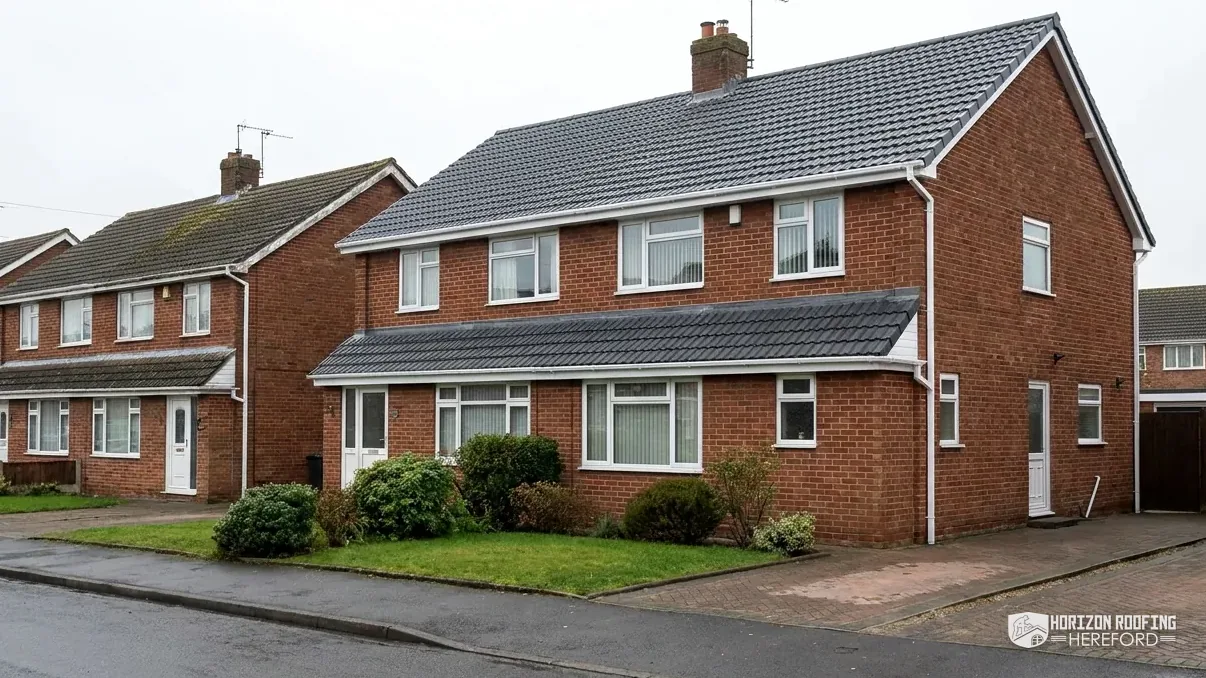
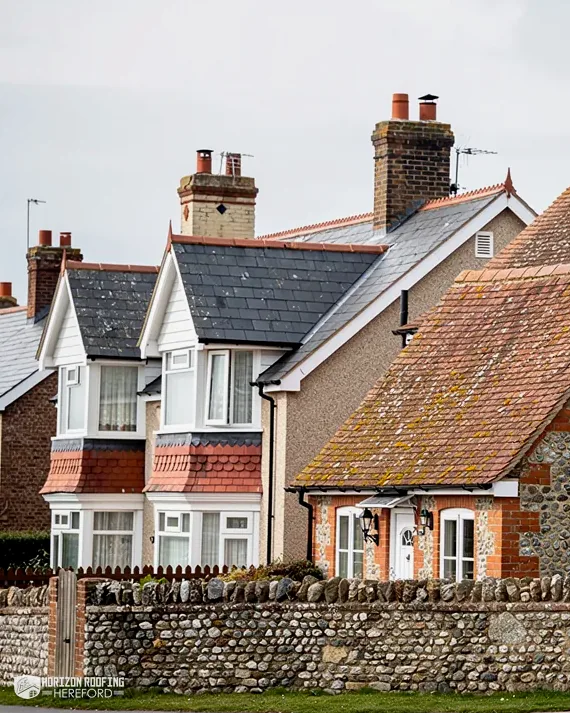
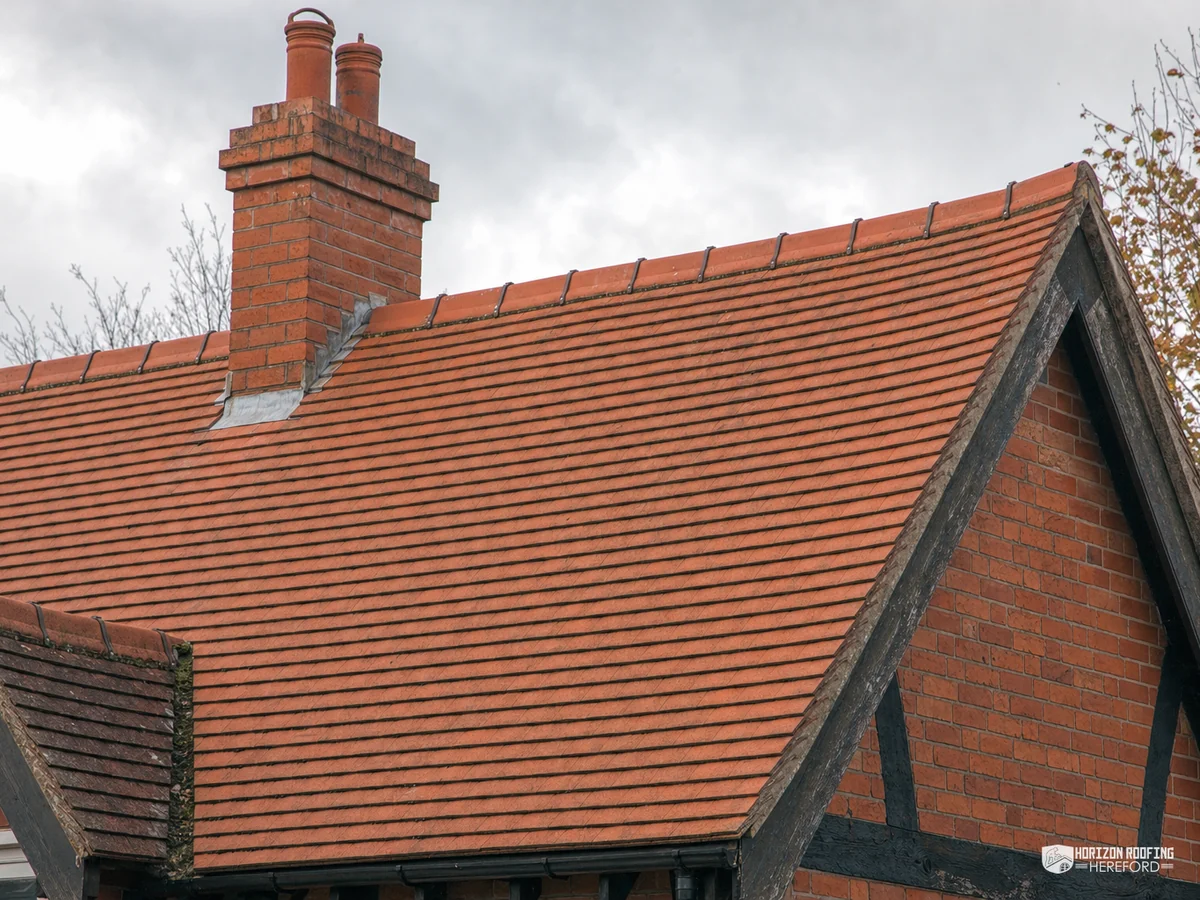
  • Older cottages with weathered clay tile roofs and brick chimneys behind a flint wall
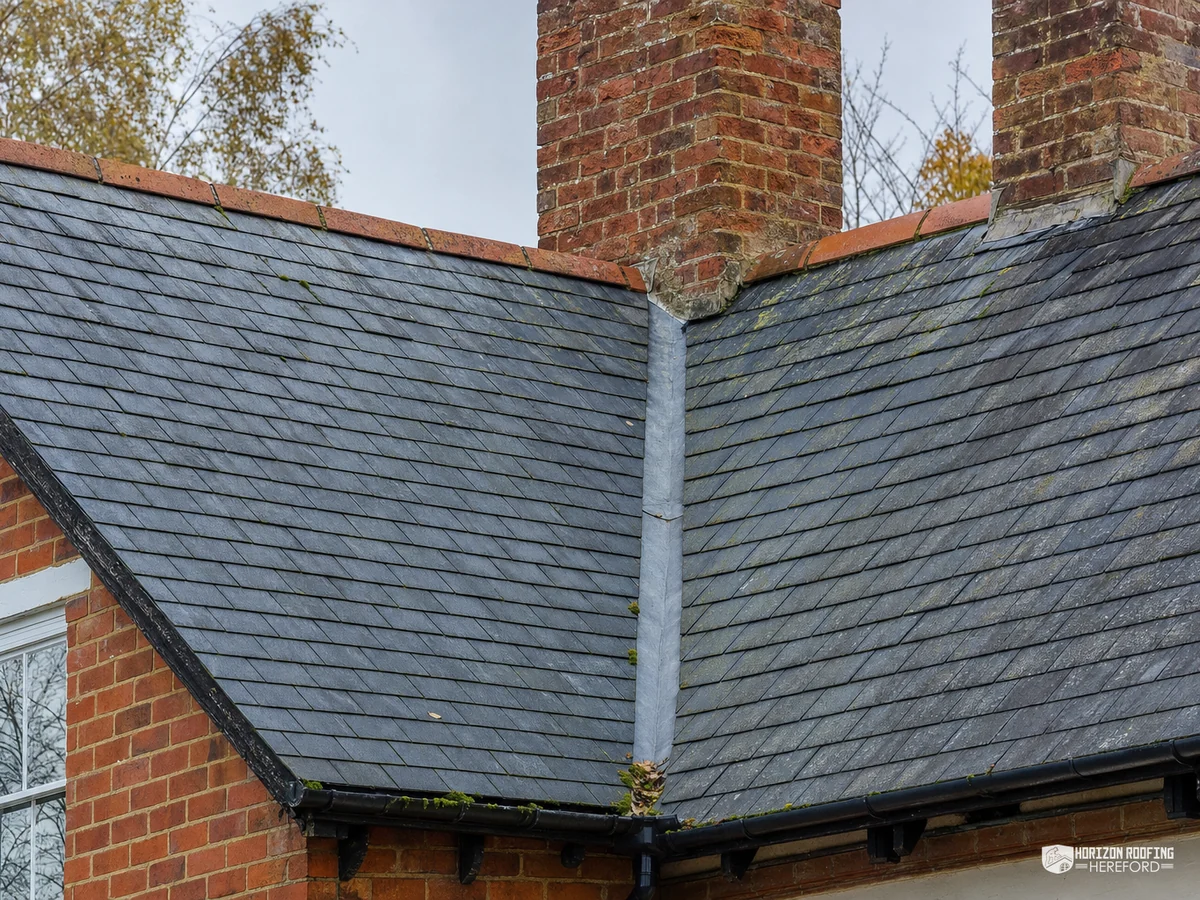
    Stone slates and slatesA cracked stone slate or a loose slate leaves the battens open to rain.
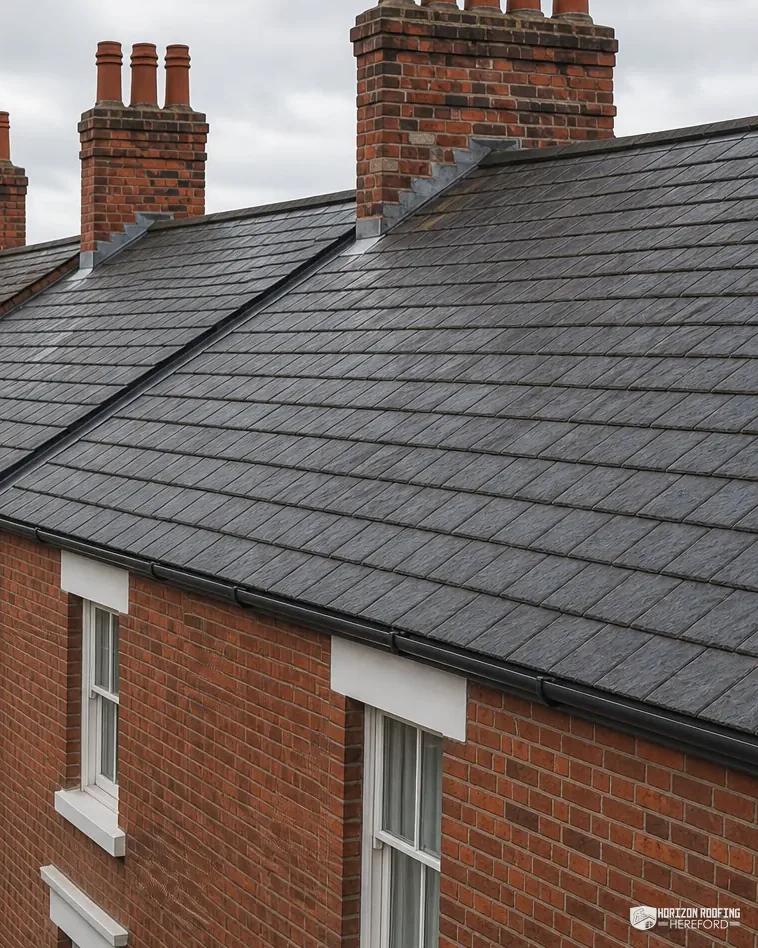
  • Slate roofs and chimney stacks along a red brick Victorian terrace
    Valley guttersWater from two slopes meets in a valley, so its lead is checked closely.
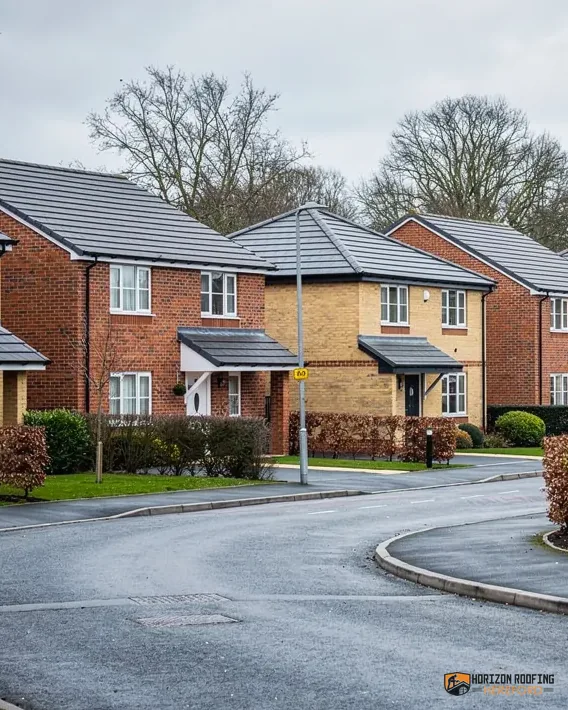
  • Newer homes with grey concrete tile roofs along a curving estate road
    Roof windowsA new roof window changes the opening, the flashing and the rules.

Inside our 30 miles: Clehonger

Clehonger on a street map, with a dashed circle around the town and the nearest towns we cover. Tiles © Esri; map data © Esri, HERE, Garmin, OpenStreetMap contributors.

Clehonger roofs, stone slate and valleys

Stone slate, valley lead and roof windows on a Clehonger house

Our Clehonger survey runs from the broad slopes to the valley where two of them meet, and ends at the roof window, where Building Regulations and planning questions arrive together.

A drawn cut-away section through a Herefordshire border house: the front of the main roof is cut open to show the rafters, underlay, battens and slates, beside a black-and-white timber-framed gable. Numbered, from the ridge down: 1 Stone and slate; 2 Valley lead; 3 Roof windows.

Fig. 1 The drawn border house in section, with Clehonger's three callouts numbered on it.

Callout 1 of 3

Stone slates and slates on Clehonger roofs

The 1931 Herefordshire inventory of the Royal Commission on Historical Monuments gives two short roof entries for Clehonger parish. Of the Parish Church of All Saints it says that "the roofs are covered with stone slates." Of a cottage it says that "the roof is covered with slates." Two buildings, two coverings, and the difference matters when you stand under either kind. Stone slates and slates are fixed, repaired and matched in different ways, so we work out which one you have before we say anything about a repair.

The county's traditional stone roofs are of local sandstone tilestones. The Herefordshire building stone atlas calls the St Maughans Formation sandstones "the principal sources of Herefordshire stone roofing", and it notes a small number of quarries still working them, with numerous active permissions in the Golden Valley area at the far west of the county. Matching stone is therefore a supply question to raise early. SPAB, which advises on old buildings, says to put any claim of unavailability to the quarries themselves, and it notes that stone roofs have been changed "to different stones or even to slates or fake stone slates". We ask the quarries before we suggest a substitute.

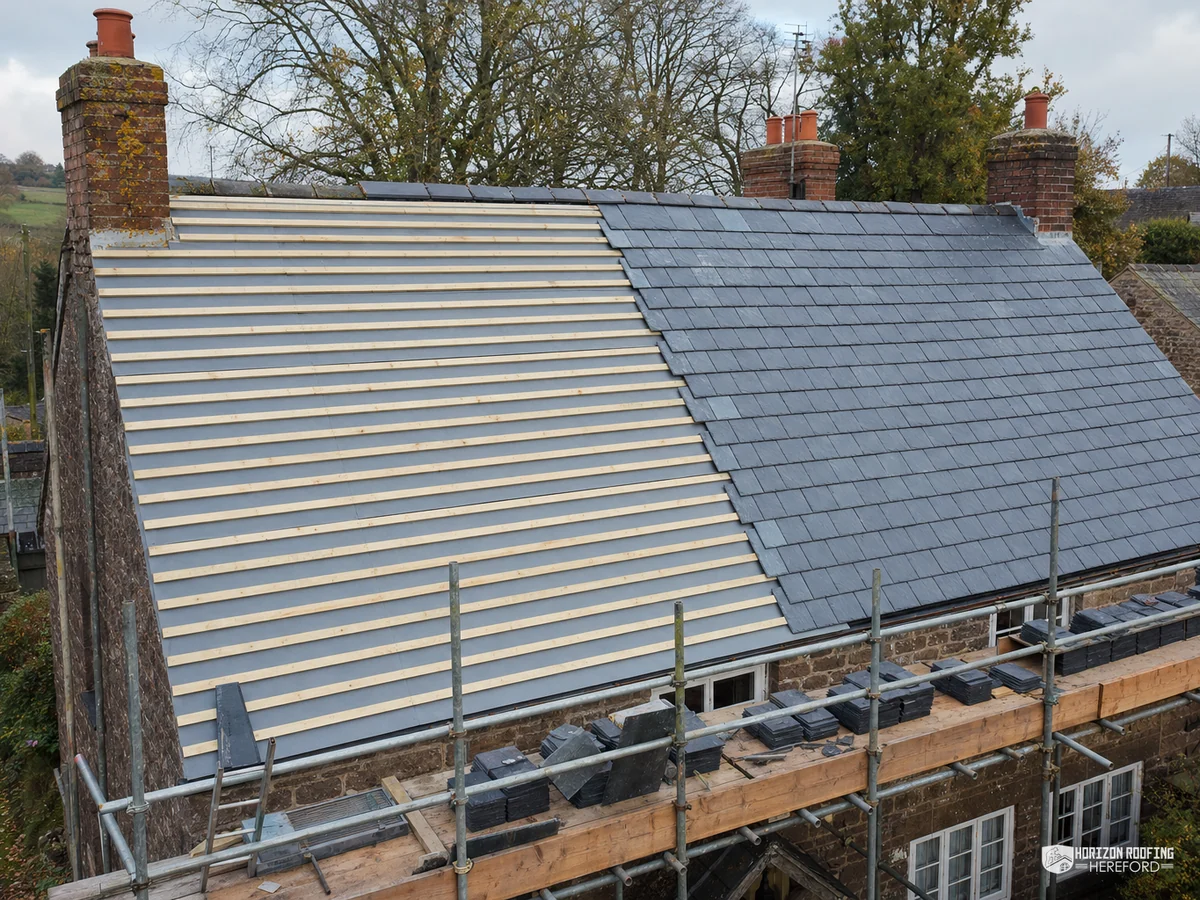
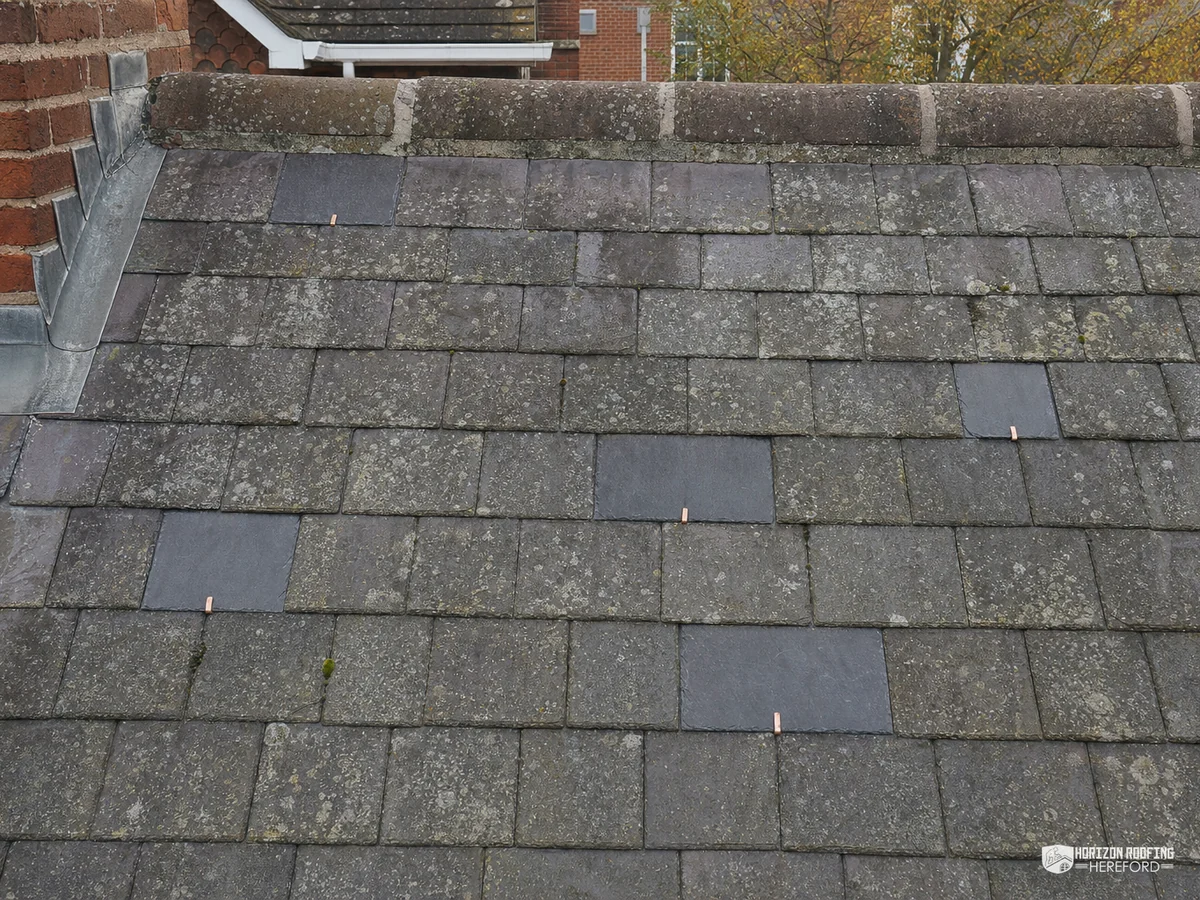
On the roof itself we look at the lower courses, the joints beside chimneys and valleys, and the line of the ridge. A stone slate that has split or shelled leaves a gap, and a slate that has slipped does the same. Either way rain then reaches the battens, the thin timber laths across the rafters, so the report shows each gap on its own course, with the position given from the ridge and the nearest gable so that the repair can be found again on site. We can repair a run of stone slates and sort the sound ones for reuse. Each stone roof is judged on what the survey finds: the thickness of the stones, the state of their fixings and the battens behind them.

If a whole slope is to be recovered, remember the weight test. Under the Planning Portal's guidance, a new covering that "increases the weight of the roof covering by 15 per cent or more" needs Building Regulations approval. Our slate roofing page covers natural slate and stone tiles in more depth.

Checked on a Clehonger slope

  • Split, shelled or slipped stone slates and slates
  • Battens and underlay under any gap
  • Lower courses beside the gutter line
  • Joints at chimneys, valleys and the ridge
  • Weight of any different covering

A stone slate is sorted and refixed where it is sound, and replaced only when it has failed.

Fig. 2 The slopes, drawn close

Callout 2 of 3

Where two slopes meet: the valley and its lead

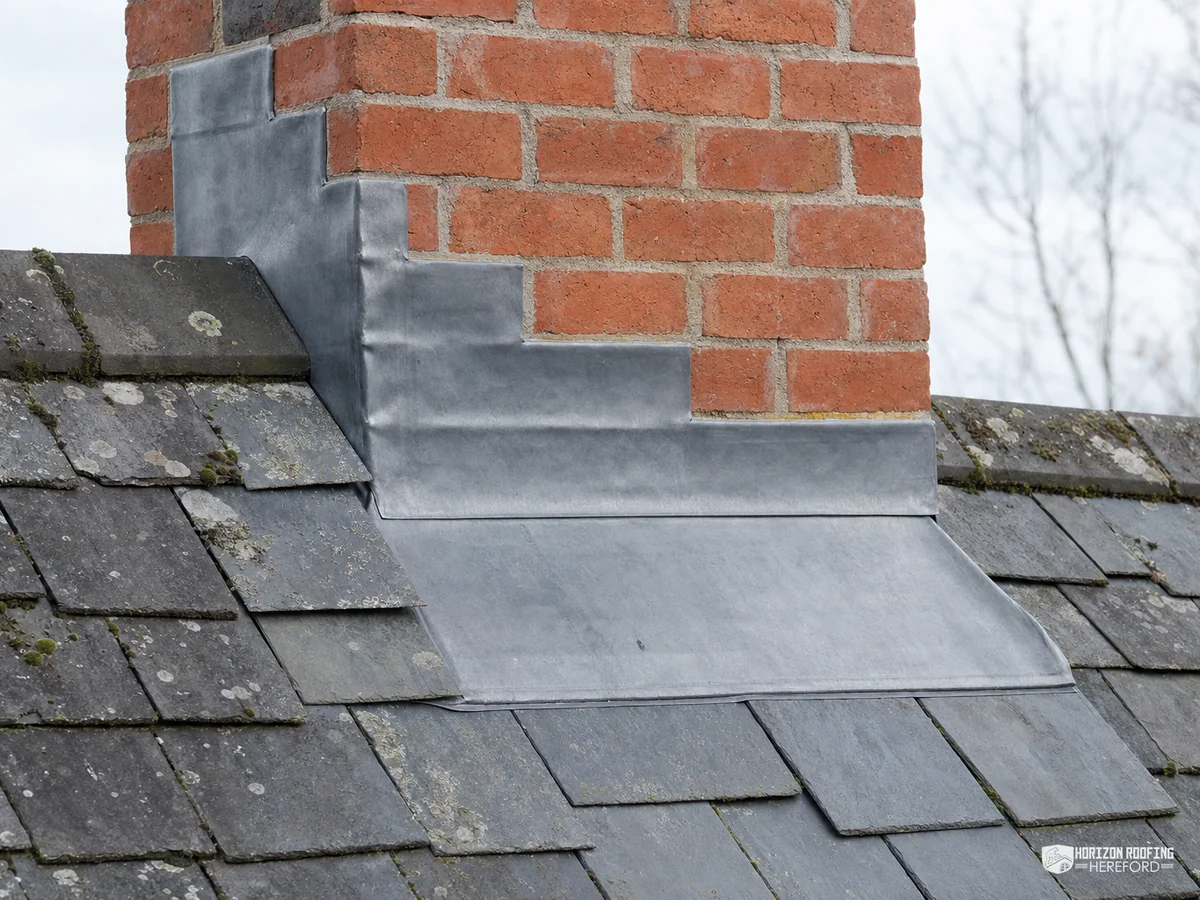
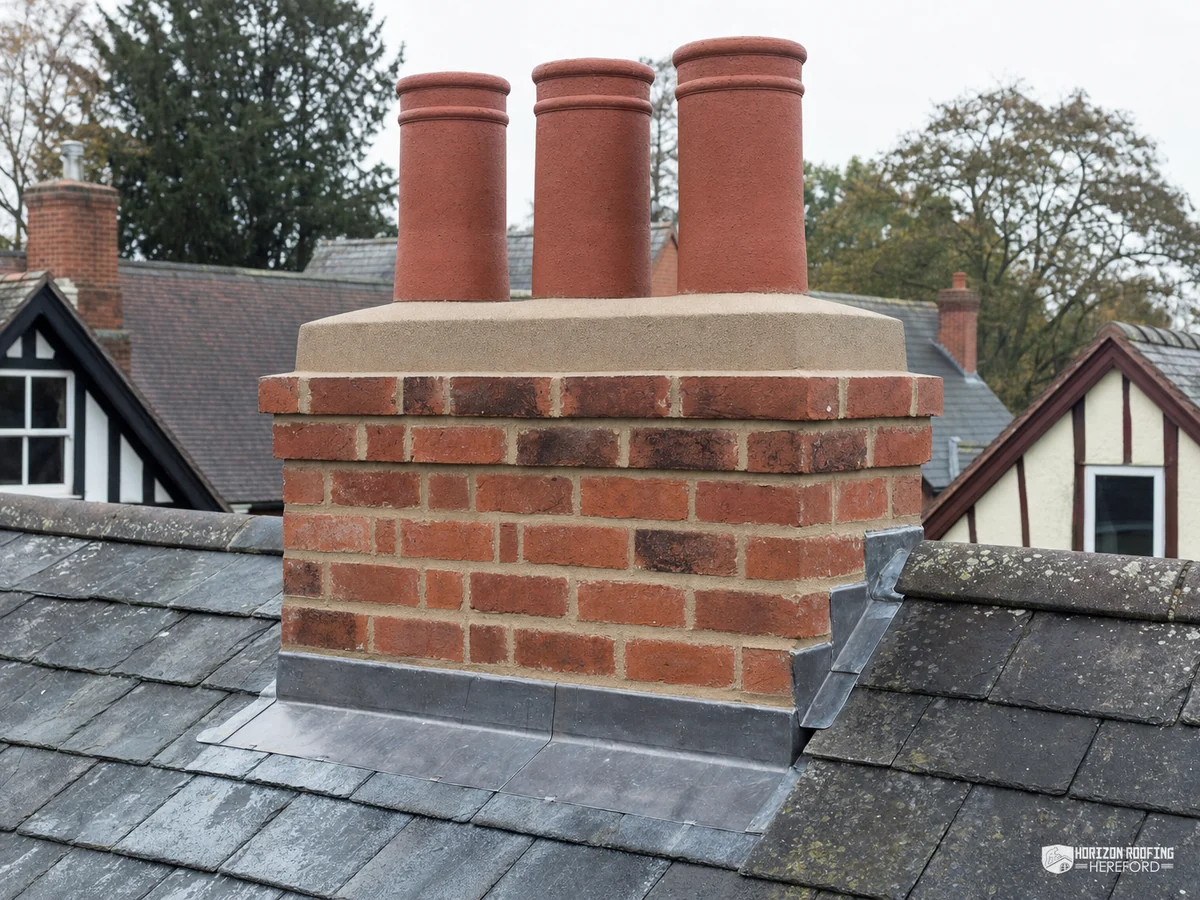
The valley is the angle on the inside where two roof slopes run down towards each other. The rain from both slopes runs into that narrow line, so a valley has to be sound from end to end, and a fault anywhere along it lets water through. Many valleys are lined with lead, laid as a trough under the edges of the stone slates or slates on each side. Royston Lead's table lists Codes 4, 5, 6, 7 and 8 for pitched valley gutters, and Code 3 is "Recommended for lead soakers only", so the thinnest sheet is not used for the trough.

Faults in a valley are easy to miss from the ground. Leaves and moss build up in the channel and hold water against the edges. Lead can split along a fold where it has moved with the weather, or lift where a fixing has pulled. The covering beside the lead can crack at the cut line. In the loft we look under the valley for staining on the timber boards and for damp patches on the rafters on both sides, because a leak here may not stay in one place. Where an old valley board has gone soft, that is noted separately from the lead, so you can see which of the two needs work.

We lift the edges of the covering to see the lead beneath, photograph the channel along its full length, and clear what has built up. Where the lead is sound we leave it and say so. Where it has split, a patch can be a proper repair if the sheet around it is in good order, and a full relay is the answer if the sheet has failed along its length. MyJobQuote says that lead flashing which is correctly installed "can last for over 80 years", so lead that is in sound order argues for repair and not stripping.

The same survey notes how the valley meets the ridge at the top and the gutter at the bottom, since both ends decide where the water goes next. Our lead roofing page sets out valleys, flashings and soakers in detail, including the codes and what each is used for.

Patch or relay?

When is a split in valley lead a patch job?

When the sheet either side of the split is sound and lying flat, a patch repair can be right. If the lead has failed along its length, or has been patched before and split again, a full relay is the better answer. The photographs show which of the two you have.

Fig. 3 The valley, drawn close

Callout 3 of 3

Roof windows, a listed neighbour and Clehonger's rules

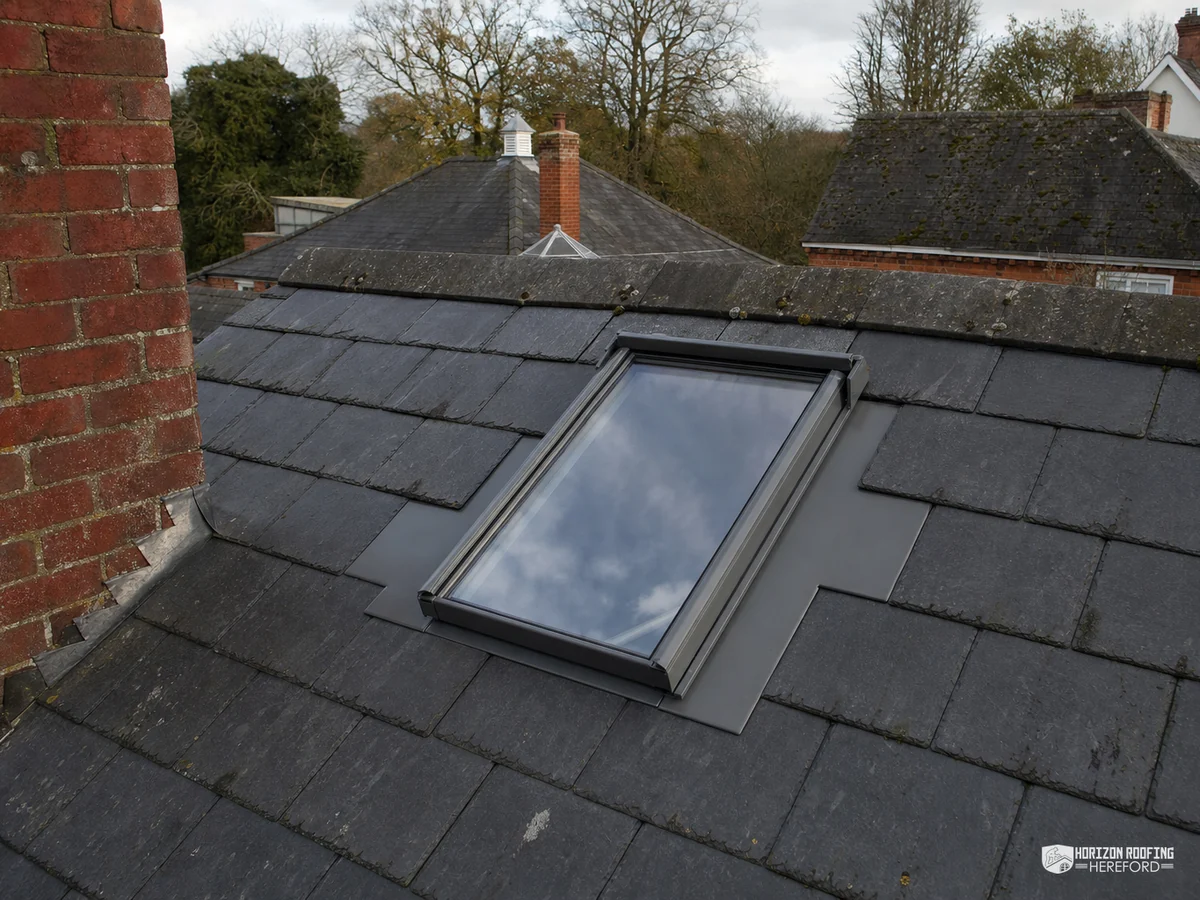
A roof window cuts a new opening in the slope, so it touches structure, weather-proofing, energy rules and planning all at once. Fitting one means trimming the rafters, setting the frame in the roof plane and sealing it with a flashing kit that suits your covering. For a straight swap of an existing window the opening is already there. For a window in a new place, the job begins with a hole.

Under AD L 2021 Table 4.2, which applies in England until AD L 2026 Table 3.2 takes over on 24 March 2027, a roof window in an existing dwelling needs Window Energy Rating Band B or a figure of 1.4, while a rooflight needs 2.2. Those two are not the same thing, so the specification must name which you are buying. A straight swap is the simpler job because the opening is already in place. Planning is a different question, and it depends on the position of the window and on designations around the house. Our planning guide for roof windows sets out the conditions for a window on each side of the border.

On the heritage list near Clehonger is Cagebrook House, Grade II (list entry 1167317, first listed 22 October 1986). Any listed house in the parish falls under section 7 of the Planning (Listed Buildings and Conservation Areas) Act 1990, where works touching its special character need consent, so a roof window on one is a consent question as well as a planning one. Look up your address on Herefordshire Council's own conservation area list, and ask the council whether an Article 4 direction applies.

Building control for a Clehonger address is Herefordshire Council Building Control, on 01432 261938 or at bce@herefordshire.gov.uk, and a registered building control approver is the alternative. Our skylights page covers roof windows and rooflights, and where the work needs a scaffold on a public road we arrange the licence with our scaffolder.

What drives the price of a window job

Window size
Larger frames take more to supply and to trim in
Swap or new opening
A new opening means rafter work and extra weather-proofing
Covering type
Stone slates and slates need different flashing kits
Access
Height and ground conditions decide the scaffold
Inside finishing
The lining and plaster round the new light

One written total price, never itemised.

Clehonger roofs: stone, valleys and permissions

Can stone slates on a Clehonger roof be reused after a repair?

Where the slates are sound, yes. We lift a section, sort good stone slates from split ones, and relay the good ones with sourced matches for the gaps. SPAB advises going to the quarries themselves when stone is said to be unavailable or slow to arrive, and we ask them before any change of material is put to you. The report lists which slates stayed and which went, and shows the reason for each decision beside a photograph, so you can compare the old roof with the new one.

Is a Clehonger house inside a conservation area?

The council decides and publishes conservation area boundaries, so compare your Clehonger address with its own list. Herefordshire has 64 conservation areas in all. Also ask the council whether an Article 4 direction applies; a direction is able to take away rights that a house would otherwise have. Replacing a slate with a slate and fitting a new roof window are separate planning questions.

Does re-roofing a Clehonger house need Building Regulations approval?

Clehonger is in England, where the Planning Portal says a re-roof normally needs no application when under 25 per cent of the building envelope and under 50 per cent of the roof is affected. Larger work than that is handed to building control. Renovating the roof also reaches Part L: AD L 2021 Table 4.3 sets 0.35 and an improved 0.16 until Table 3.3 of AD L 2026 applies on 24 March 2027.

What is the price range for fitting a roof window in Clehonger?

MyJobQuote puts a small Velux FK04 centre pivot window at around £330 as a product price, and a straight swap at around £100 less than a new opening. Checkatrade lists rooflight replacement from £1,000. Those are third-party figures, not ours, and a Clehonger quote depends on the covering, the access and whether a new opening is cut. It arrives as one total after the survey.

Who handles the scaffold licence on a Clehonger road?

A scaffold that obstructs a public road or pavement needs a licence under section 169 of the Highways Act 1980. Herefordshire Council states £167 for a maximum of one month, £123 per month for extensions, and at least 10 days between applying and erecting. We arrange the licence with our scaffolder. For a Clehonger house on a main road, the council is asked who covers it.

Which consent route covers roof work at a Clehonger church or chapel?

Which route applies is set by the denomination, and by whether the building still holds worship. Where Anglican worship continues, repairs are decided through the faculty system. Catholic and Methodist congregations and the United Reformed Church run consent through their own bodies, and a Baptist Union chapel is exempt where one of the Schedule 1 trust corporations is its trustee. Unitarian and Quaker meeting houses are outside the exemption, as is any church that has closed; if listed, each needs listed building consent from the council.

Get your Clehonger roof looked at

Send a photograph of the slope, the valley or the window, or a few lines about it, and we will arrange the survey.

10-year workmanship guarantee, in writing