
01432 610152 Get a quote Call 01432 610152

Roofers in Holme Lacy

Roof windows, eaves and chimney stack work for Holme Lacy, 5.6 road miles south-east of Hereford.

Holme Lacy surveys start at the highest point of the roof, and photographs and one written total price follow.

Get a free quoteCall 01432 610152

Holme Lacy roofs that need a second look

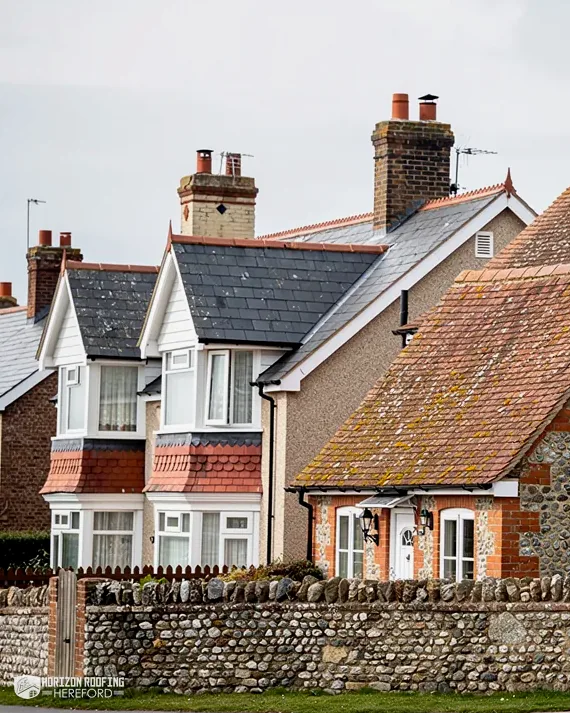
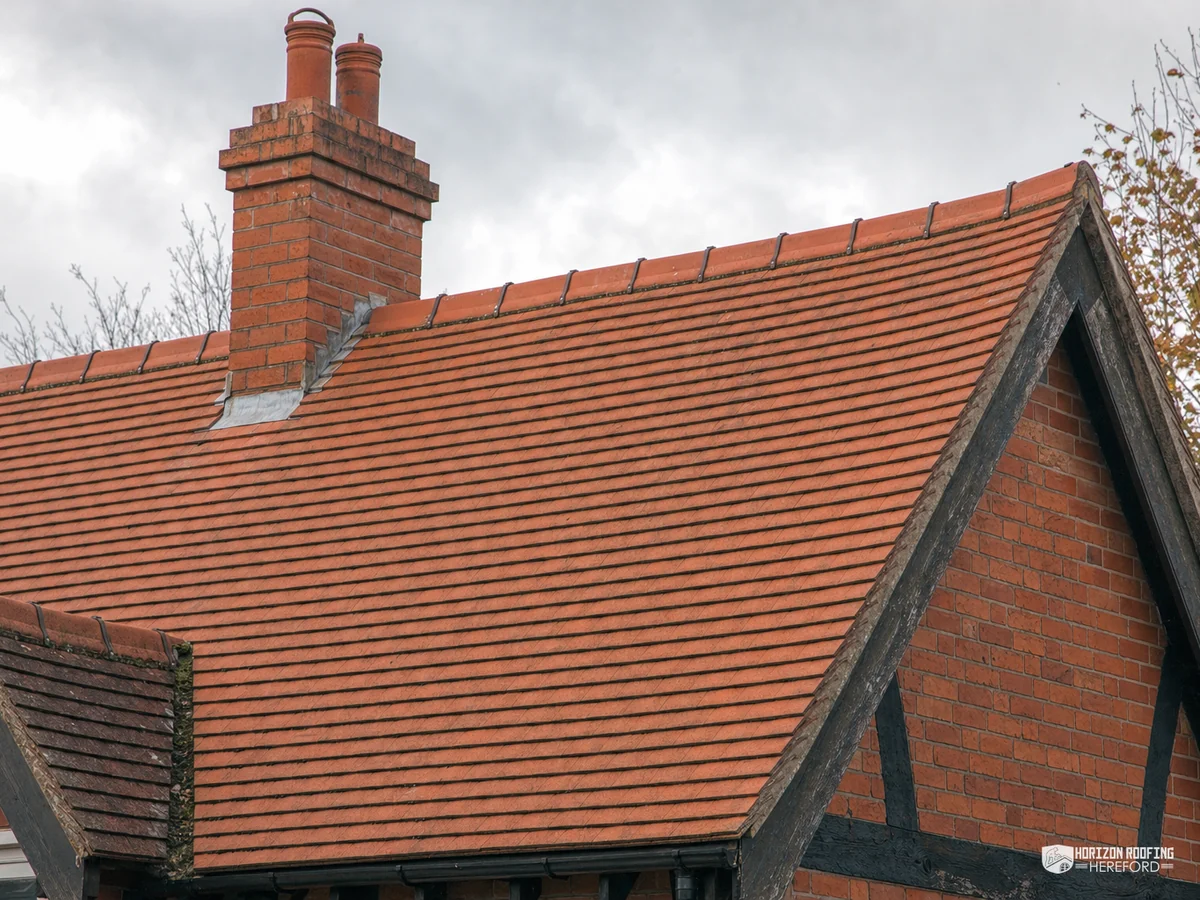
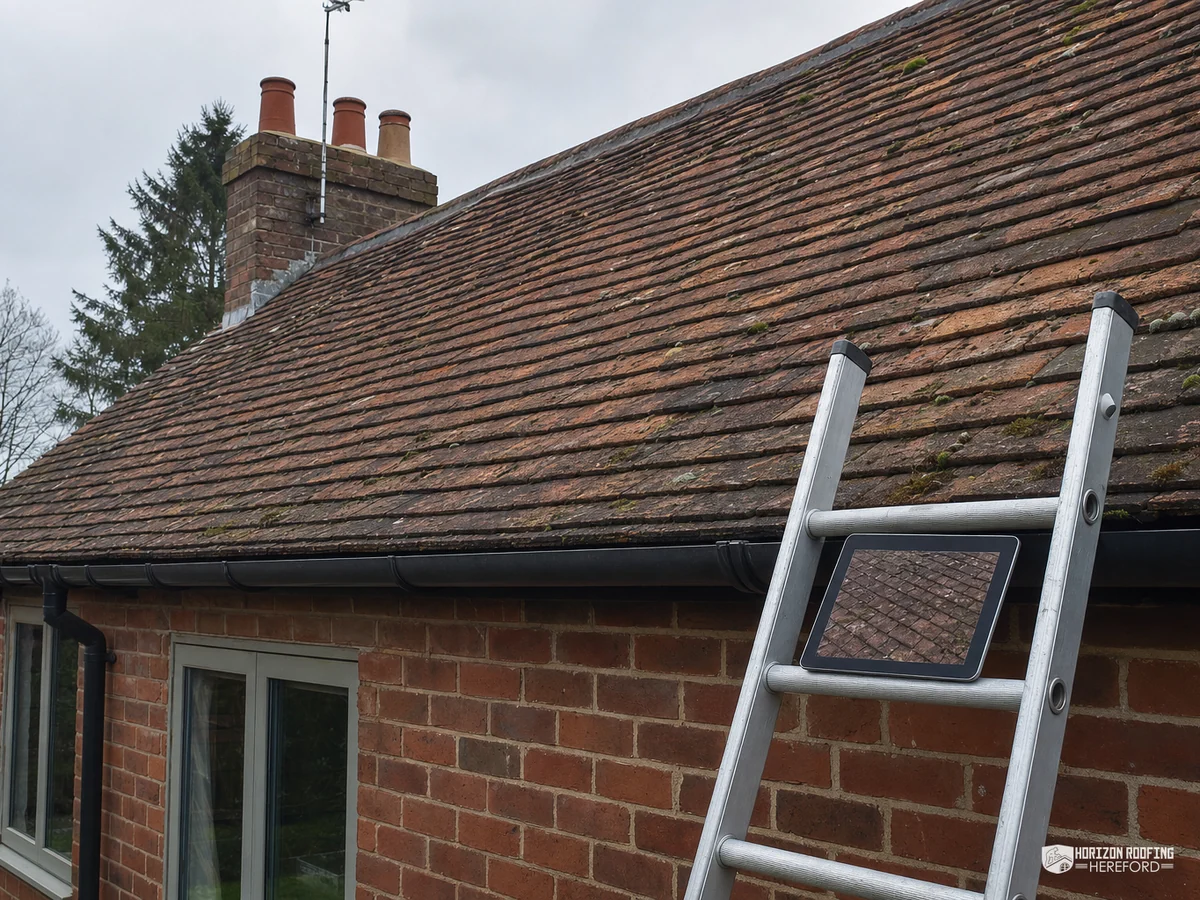
  • Older cottages with weathered clay tile roofs and brick chimneys behind a flint wall
    Roof windows near the landscapeLand inside a National Landscape changes the rules for dormers.
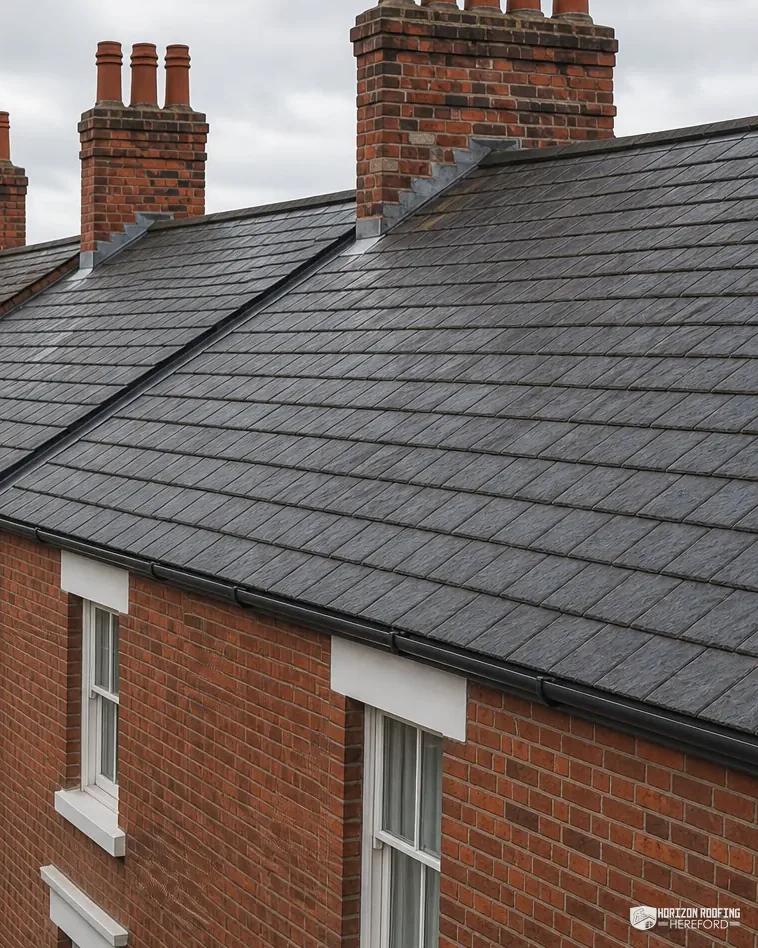
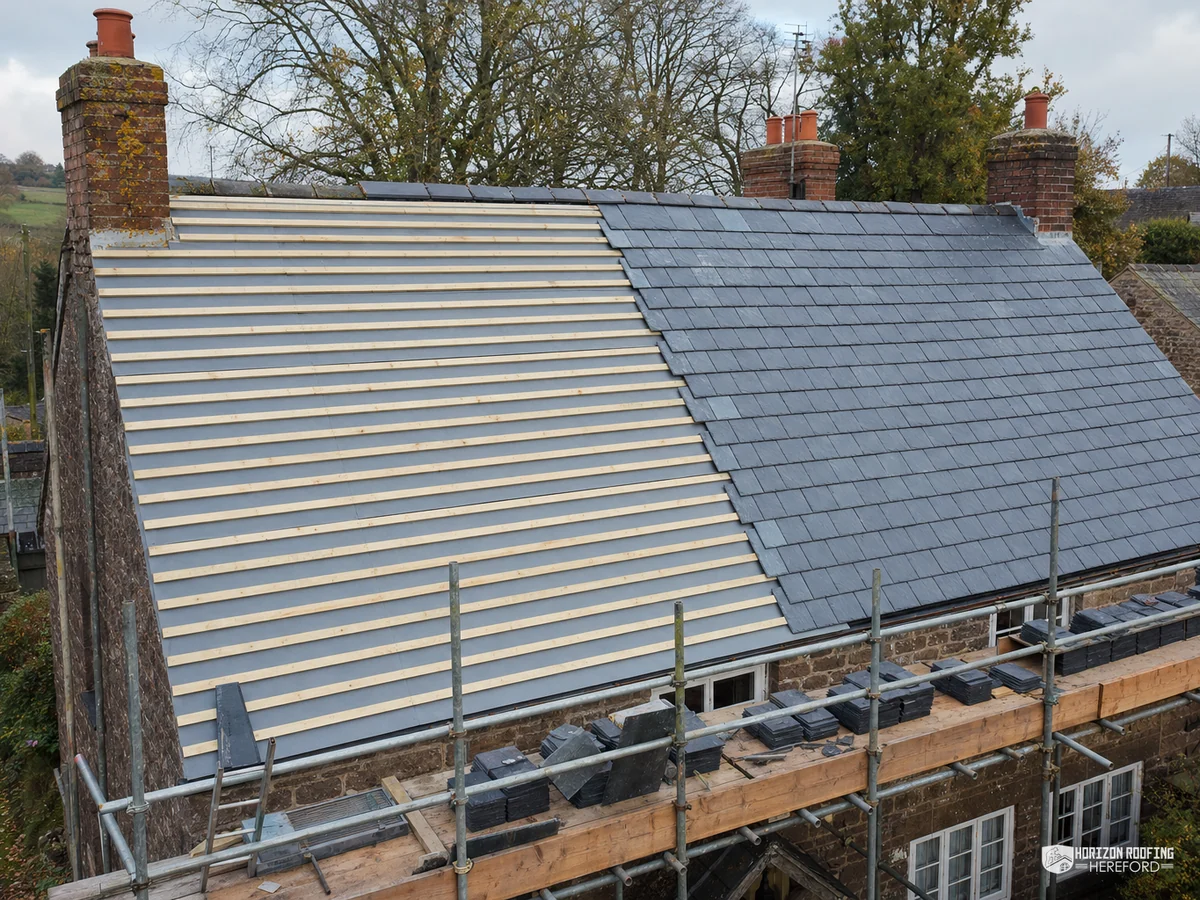
  • Slate roofs and chimney stacks along a red brick Victorian terrace
    Eaves, soffits and ventilationSoffits and fascias carry the gutter and let the roof breathe.
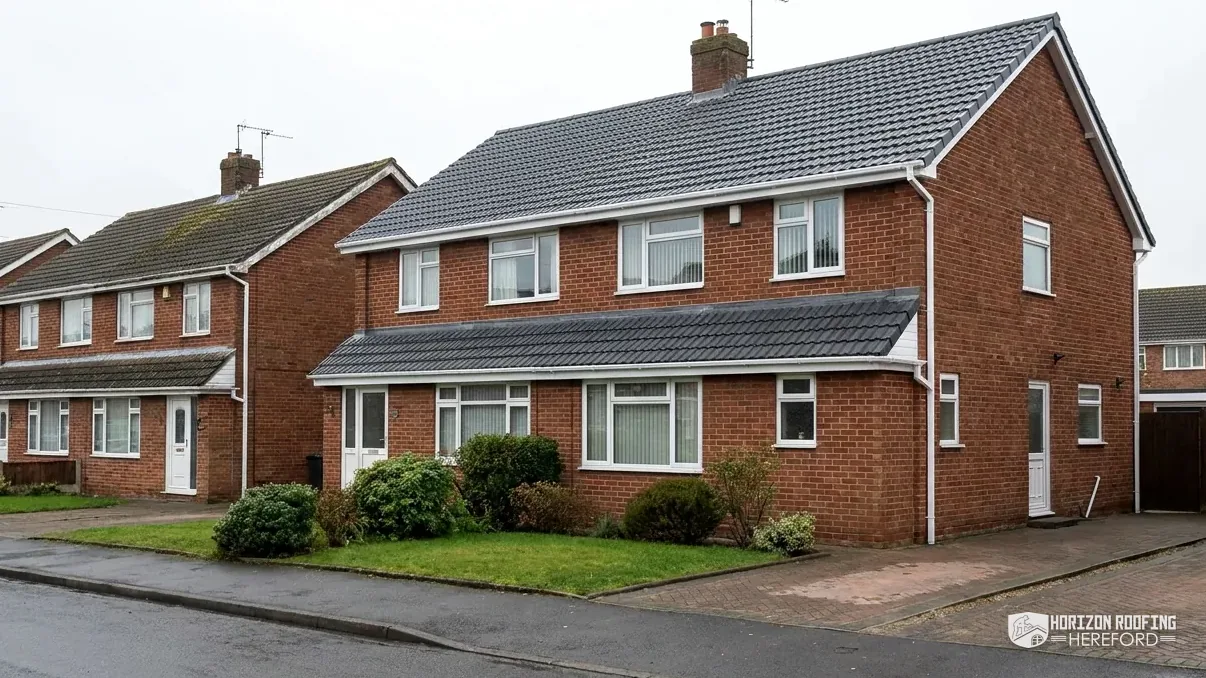
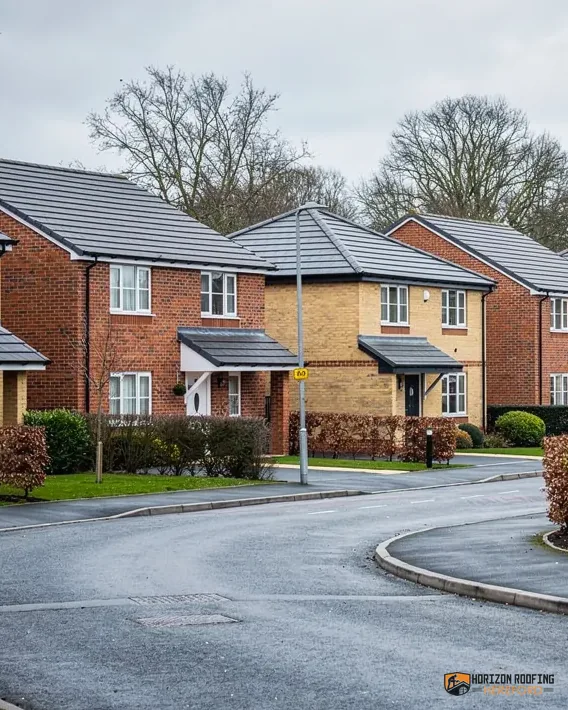
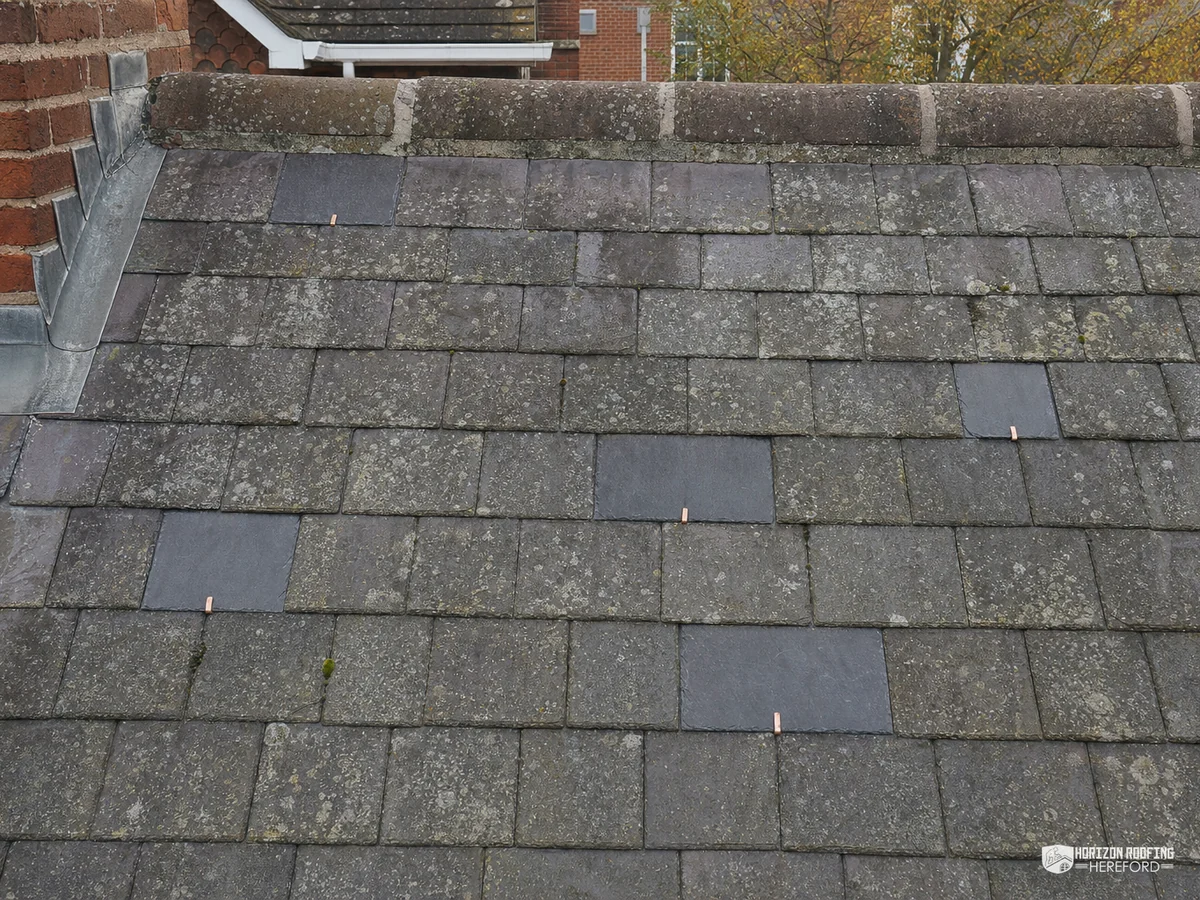
  • Newer homes with grey concrete tile roofs along a curving estate road
    Stacks beside listed housesChimneys on listed houses need lead work and consent weighed together.

Holme Lacy in the Hereford radius

Holme Lacy on a street map, with a dashed circle around the town and the nearest towns we cover. Tiles © Esri; map data © Esri, HERE, Garmin, OpenStreetMap contributors.

Holme Lacy roofs: window, eaves, stack

A Holme Lacy roof read through its window rules, its eaves and its chimney stacks

Here the survey begins with the planning rules for roof windows, drops to the eaves and the roofline that ventilate the roof, and finishes at the chimney stacks of the village's listed houses.

A drawn cut-away section through a Herefordshire border house: the front of the main roof is cut open to show the rafters, underlay, battens and slates, beside a black-and-white timber-framed gable. Numbered, from the ridge down: 1 Windows and rules; 2 Eaves and roofline; 3 Stacks and listings.

Fig. 1 Border house in section, Holme Lacy's three callouts picked out.

Callout 1 of 3

Roof windows and dormers near the Wye Valley

The Wye Valley National Landscape, once called an Area of Outstanding Natural Beauty, reaches part of the ground round Holme Lacy, so whether a given house stands inside it depends on the exact boundary. Herefordshire Council states that since November 2023 these areas have been renamed National Landscapes, and that their legal status is unchanged.

The name describes land and does not name a decision maker. Herefordshire Council takes the planning decisions. The designation alters which rules the council applies. The National Landscape matters most when a Holme Lacy owner wants a dormer, so that plan begins with Herefordshire Council's planning team rather than with a builder. Putting new tiles or slates on a roof is not barred by the designation. The conditions for roof windows themselves are set out in our planning guide for roof windows, and we suggest reading it before anyone commissions a drawing.

Planning is half the question. A new roof window also has to meet energy rules. For a new window in an existing dwelling, AD L 2021 Table 4.2 asks for a roof window with a U-value of 1.4, or a rating of WER Band B, and gives 2.2 for a rooflight. A roof window and a rooflight are different products, so one cannot stand in for the other, and the product sheet is checked before we order. The same figures carry over into AD L 2026 Table 3.2, which takes effect on 24 March 2027.

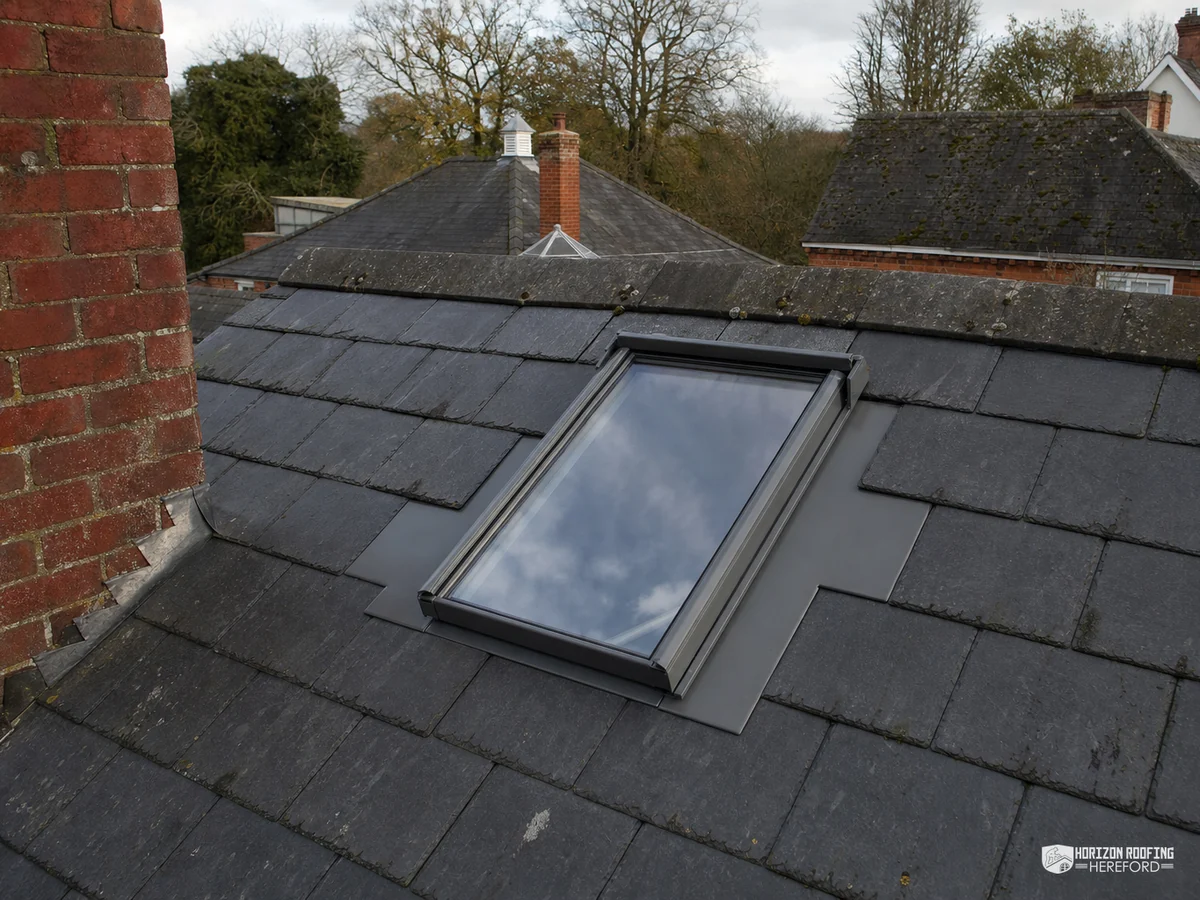
Before a window is chosen, we measure the pitch from inside, look at what lies under the covering and note anything, such as a stack, that limits where an opening can go. Our skylights page covers roof windows, rooflights and the flashing kits that seal them. Mordiford, Fownhope and Hampton Bishop have conservation areas of their own, and Herefordshire Council's list shows whether any boundary reaches a Holme Lacy house.

A new opening in the roof is building work, so it goes to Herefordshire Council Building Control, at bce@herefordshire.gov.uk, or to a registered building control approver. Whether an Article 4 direction covers the house is a question for the council as well. If the house is listed, the consent for the opening is a separate application, and it is wise to discuss the position and the flashing with the council before any quote is accepted.

Energy figures for a new roof opening

Roof window
U-value 1.4, or WER Band B
Rooflight
2.2 W/(m2.K)
Current guidance
AD L 2021, Table 4.2
Next edition
AD L 2026, Table 3.2, from 24 March 2027

The label on the landscape is a designation, and the council still decides the application.

Fig. 2 Roof windows, drawn close

Callout 2 of 3

Soffits, fascias and a roof that can breathe

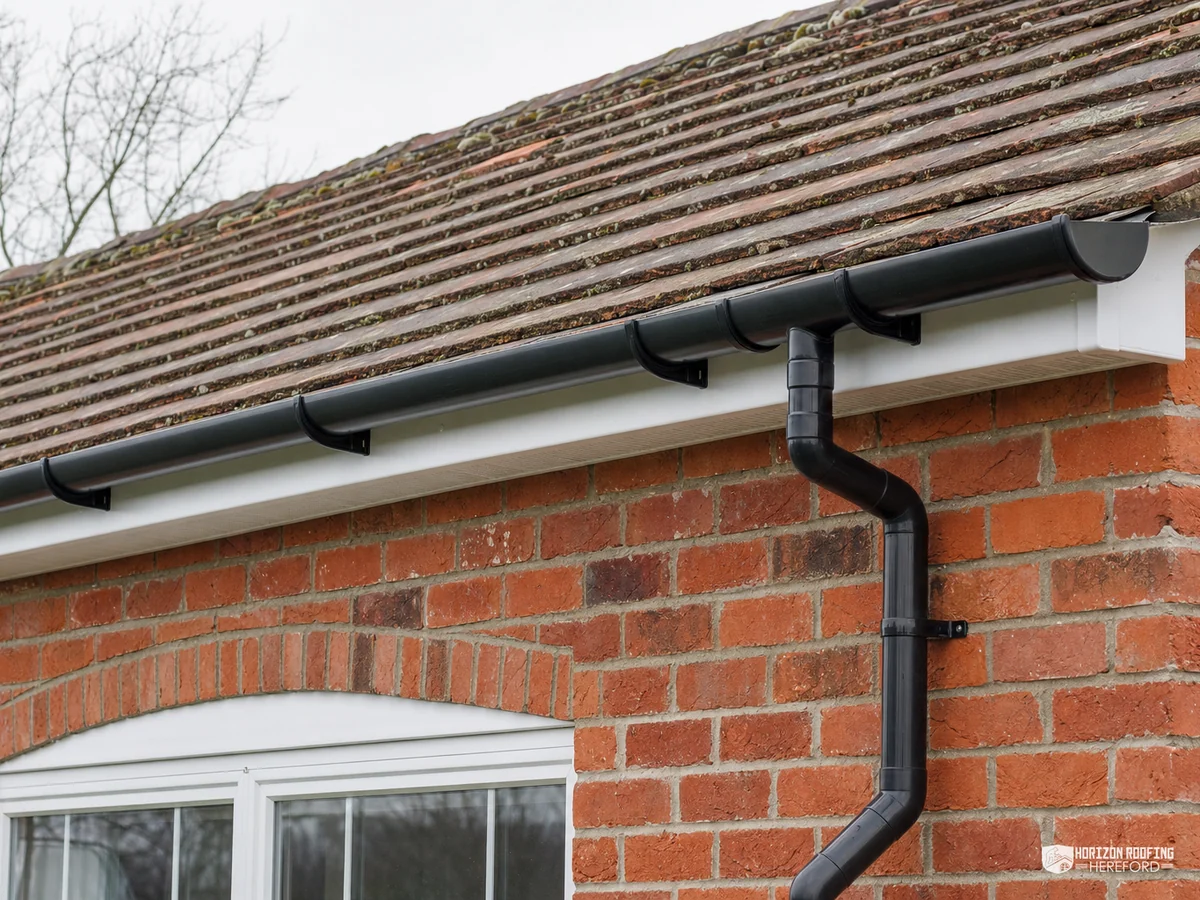
Eaves is the word for the bottom margin of the roof, the line where its slope meets open air over the wall. Along that edge a fascia board closes the rafter ends and holds the gutter, and a soffit panel closes the underside of the overhang. Both do more than tidy the edge. Air moves through the soffit into the roof space, and that movement carries off the damp that rises from a house. Rot in a fascia, or a soffit that has been painted shut, is therefore a fault of the roof, not only of the roofline.

How much air a roof needs depends on its underlay. Marley explains that a high-resistance underlay does not pass vapour, so it must have the eaves openings it specifies. An air-permeable underlay over a well-sealed ceiling is different: Marley says fortuitous ventilation at the eaves through normal eaves construction (3mm) is all that is required, so long as every UKAS third-party certification requirement has been satisfied. We therefore need to know which underlay is in your loft before deciding anything about the soffit. The survey records it with a photograph.

Bats use eaves and roof voids. GOV.UK explains that bats are protected by law, along with their breeding sites and resting places. Roof repair or replacement is one of the activities it names, and Natural England is where a licence may be available. The Habitats Regulations 2017 (regulation 43) make damage to a resting place an offence whether or not you meant to cause it, which is why we stop and ask when droppings, staining or a live animal turns up at the eaves.

Moss that has washed down into the gutters is cleared by hand. Marley advises against high-powered jet washes on slate or tile, since they can damage the surface and shorten the roof's expected life, so we do not ask a pressure lance to do a hand's work.

Replacing a fascia and soffit is a short job when the scaffold is in place, and we arrange the licence with our scaffolder if it has to stand on the road. The work is covered by our guttering, soffits and fascias service. Building control for fascia and soffit work may not be needed, but a question about ventilation can go to Herefordshire Council Building Control on 01432 261938.

Looked at along a Holme Lacy roofline

  • Fascia boards soft, split or pulled away
  • Soffits blocked, painted shut or missing
  • The underlay type, seen from the loft
  • Gutter brackets and sagging runs
  • Any sign of bats or nesting birds
Fig. 3 Eaves and gutters, drawn close

Callout 3 of 3

Chimney stacks beside listed Holme Lacy houses

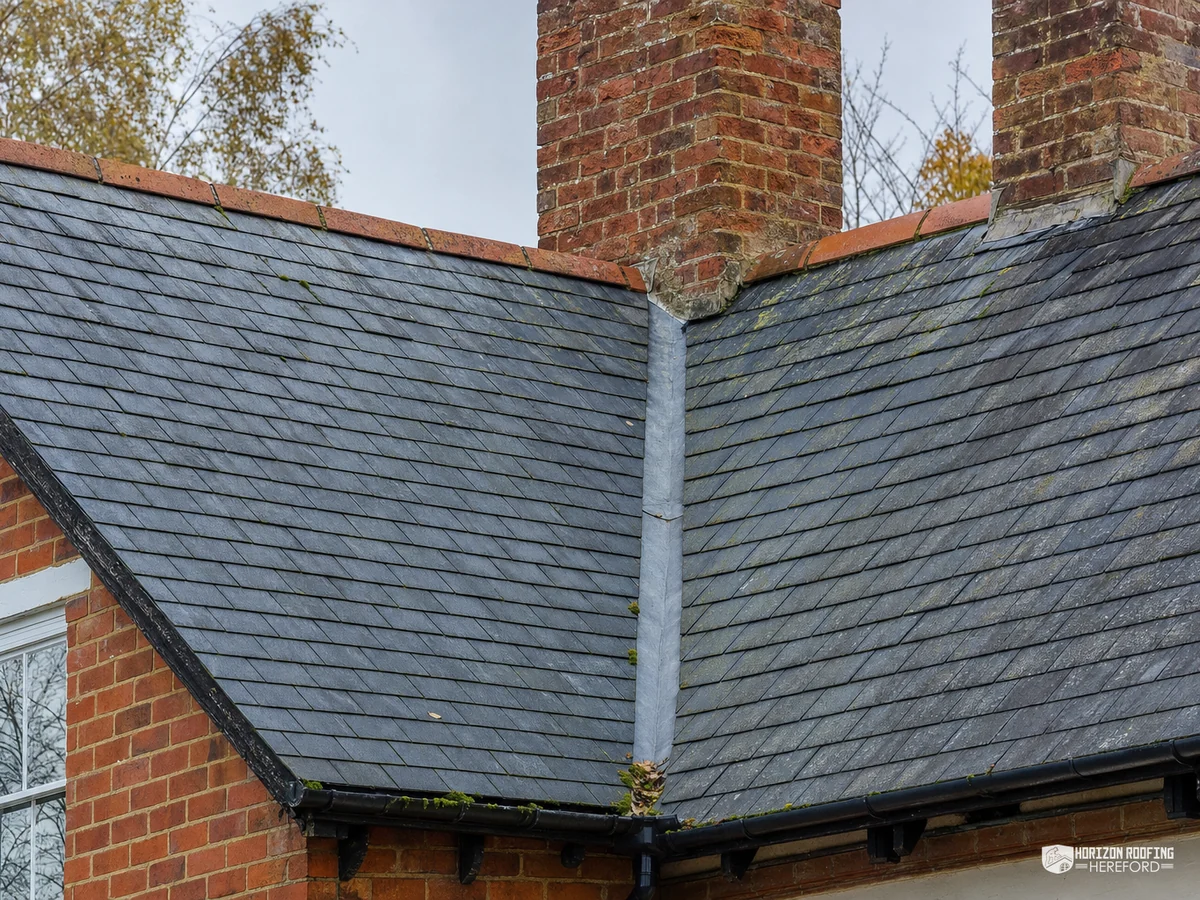
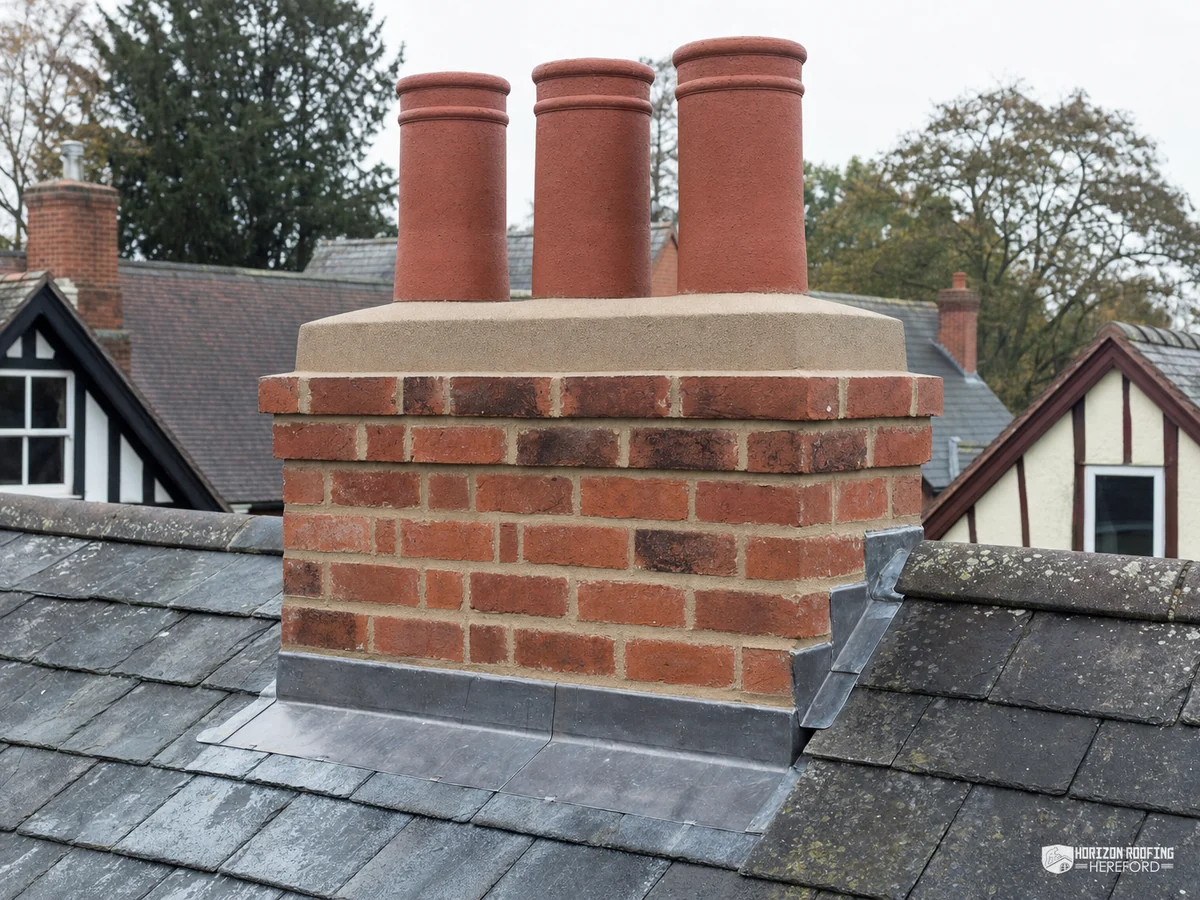
The 1931 inventory compiled by the Royal Commission gives Holme Lacy House roofs "covered with slates." We photograph each face of a stack from the ladder, since much of it is hidden from the lane. Slate meets a chimney stack at a joint that is easy to get wrong, and a stack stands higher than anything else on the house, so it takes the weather on every face. The county's building stone atlas says of timber-framed buildings that their large external chimney stacks are also commonly of local sandstone. Stone wears at the joints first, so we look at the pointing, then at the flaunching, the sloping mortar bed round the pots, and then at the pots. From the loft we follow the breast upwards with a torch and note any damp marks, since they tell us whether the flashing or the head of the stack is the cause.

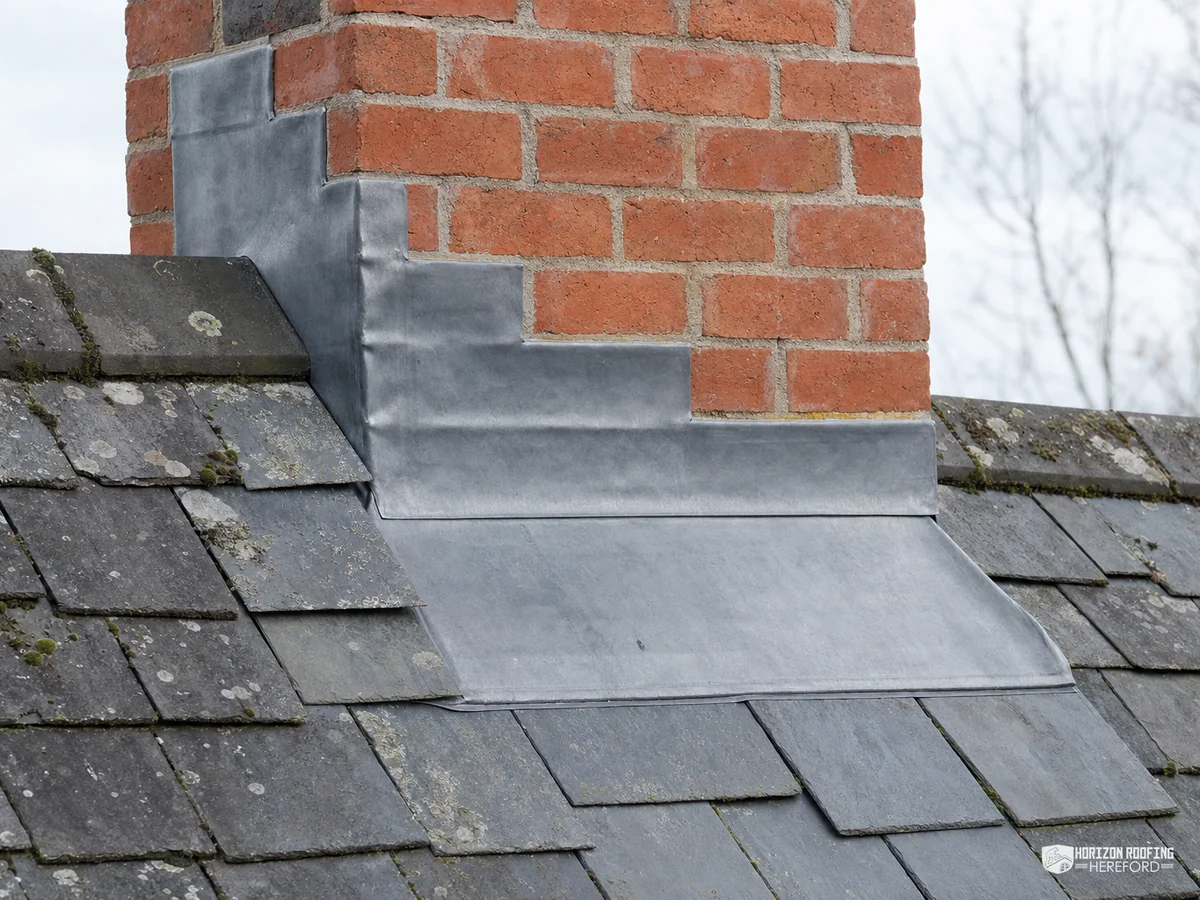
Lead keeps the stack watertight where it passes through the roof. A stepped flashing climbs the side of the stack in line with the pitch, a back gutter turns water round behind it, and soakers lie under the slates at the sides. Royston Lead's table lists Code 5 and Code 6 for flashings and Code 3 for soakers only. A strip that has lifted or split is renewed. Sealant spread over it only hides the fault for a season.

The National Heritage List carries several Holme Lacy buildings. The Thatch is Grade II (list entry 1301595, first listed 21 May 1987), Bower House is Grade II (list entry 1242955, first listed 23 March 2011) and Bower Cottage is Grade II (list entry 1099569). A question about thatch goes to a specialist thatcher. Under section 7 of the Planning (Listed Buildings and Conservation Areas) Act 1990 a listed house calls for consent before any work alters its special interest, while its permitted development rights remain in place.

Taking a chimney out is a bigger decision than repairing one. In the Planning Portal's words, Building Regulations approval "will always apply" where a chimney breast is taken out. Where the breast is shared with next door, section 2(2)(g) of the Party Wall etc. Act 1996 lets the building owner cut it away, with notice given at least two months in advance. Our chimney repairs page describes repointing, rebuilding and removal.

A Holme Lacy stack where it meets the slope

SoundLead tight into the stack, pointing full, pots firm
Needs workLead lifted, pointing open, flaunching cracked

Holme Lacy roofs: landscape, eaves and stacks

Can a Holme Lacy house be re-roofed inside the Wye Valley National Landscape?

Yes. The designation describes land, and Herefordshire Council remains the planning authority for Holme Lacy. Raise any dormer with the council before drawings are made; renewing the covering you already have, in the same material, is a simpler matter. Whether a house lies inside the boundary depends on exactly where it stands, and the council can confirm it, so ask before drawings are made.

Do I need Building Regulations approval to re-roof, or to add a roof window, in Holme Lacy?

Holme Lacy is in England, so for a re-roof the Planning Portal test applies. Normally no Building Regulations application is needed while under 25 per cent of the building envelope, and under 50 per cent of the roof, is worked on. A new roof window must meet WER Band B or a U-value of 1.4 under AD L 2021 Table 4.2, and a heavier covering needs a structural check first.

Which conservation areas lie near Holme Lacy?

Mordiford, Fownhope and Hampton Bishop each have a conservation area of their own, close to the village. Herefordshire has 64 in all, and the council's list and maps show whether a boundary reaches your house. Ask the council too whether an Article 4 direction applies to your address, since a direction can withdraw permissions that a house would otherwise have.

What happens if bats are found at a Holme Lacy eaves?

Work that would disturb them stops until a plan is agreed. GOV.UK explains that the law protects bats and their roosts, and that licences in England come from Natural England. Under the 2017 Habitats Regulations, harming a resting place is an offence even when no harm was meant. We photograph the evidence and talk to you before any board is lifted.

Can the chimney breast come out of a Holme Lacy house?

It can, but it needs approval. Taking out a chimney breast always brings Building Regulations approval into play, according to the Planning Portal. A breast shared with a neighbour also brings in the Party Wall etc. Act 1996, under which the building owner serves a notice at least two months ahead. On a listed house, listed building consent comes on top, so the council hears about it first.

What is the fee for a scaffold on a Holme Lacy road?

Scaffold on the highway is licensed under section 169 of the Highways Act 1980. Herefordshire Council sets the fee at £167 for a maximum of one month, £123 for any further month. The council wants 10 days' notice at the least. We arrange the licence with our scaffolder, so scaffold is accounted for in the single written quote. Trunk roads and motorways are National Highways ground.

Tell us what your Holme Lacy roof needs

Send a photograph of the roof window plan, the eaves or the chimney stack, and a survey follows, then one price in writing.

10-year workmanship guarantee, in writing