
01432 610152 Get a quote Call 01432 610152

Roofers in Brimfield

Roof repairs and re-roofs for Brimfield, 18.5 road miles north of Hereford.

We read the slopes, valleys and eaves in turn, then send photographs and put the total in writing.

Get a free quoteCall 01432 610152

Tile, slate and lead around St Michael's

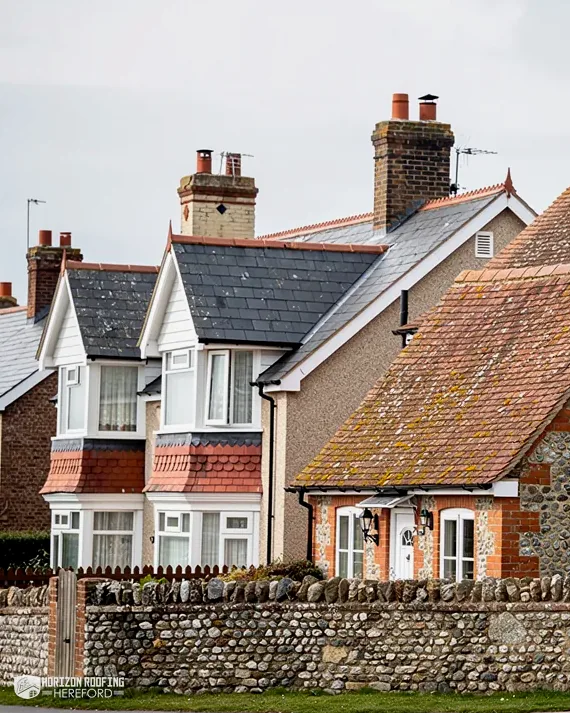
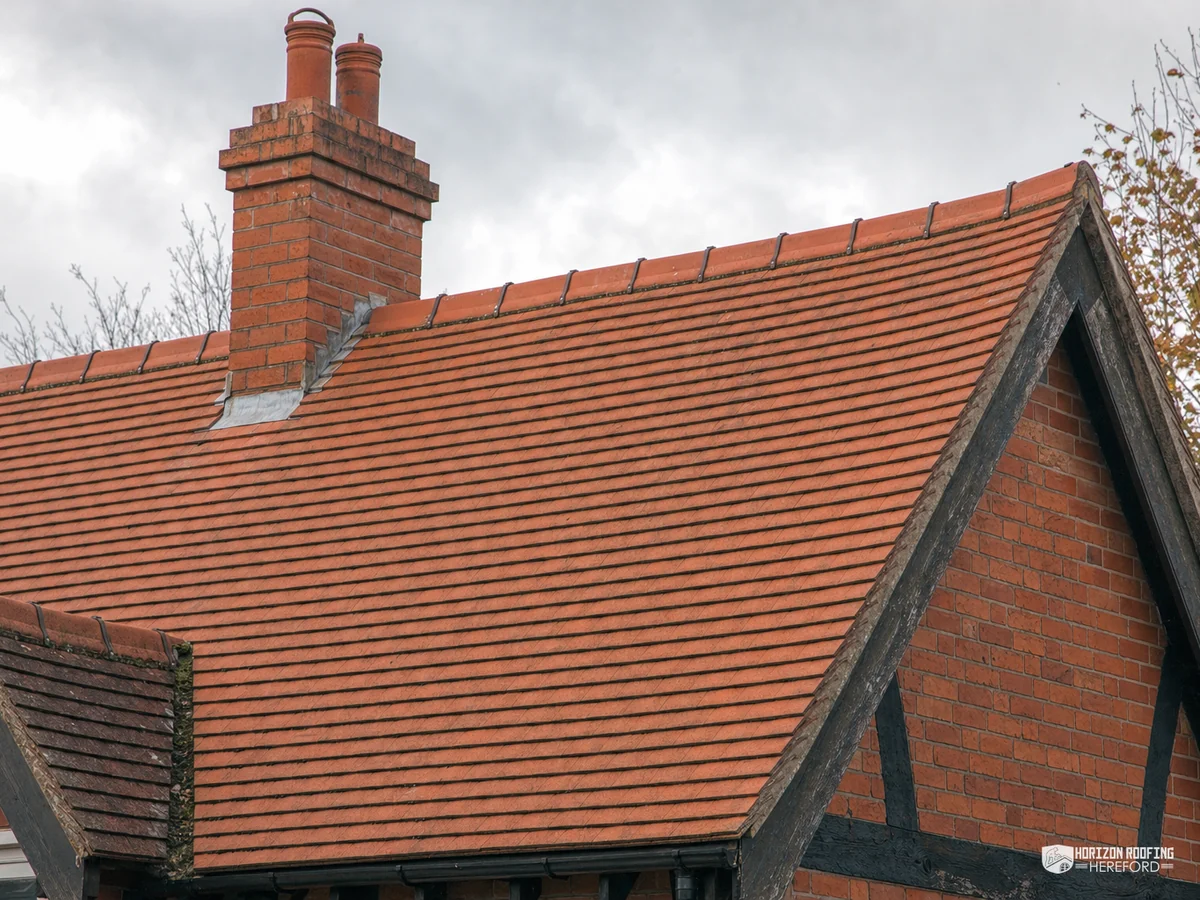
  • Older cottages with weathered clay tile roofs and brick chimneys behind a flint wall
    Slipped tiles and slatesA slipped covering lets rain reach the battens, and the damage spreads indoors.
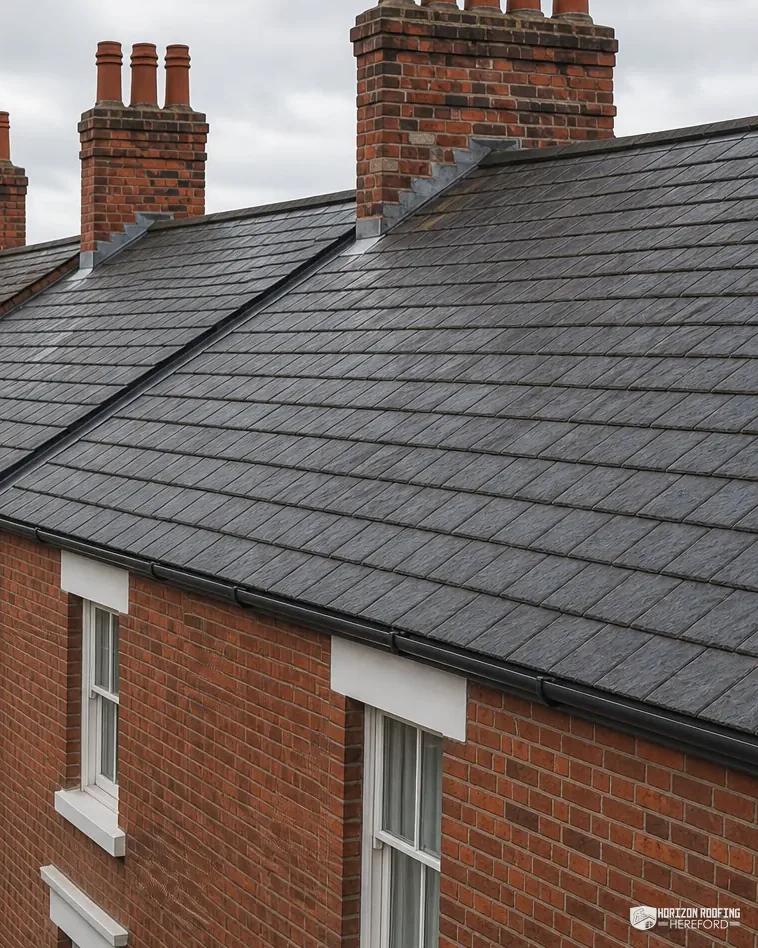
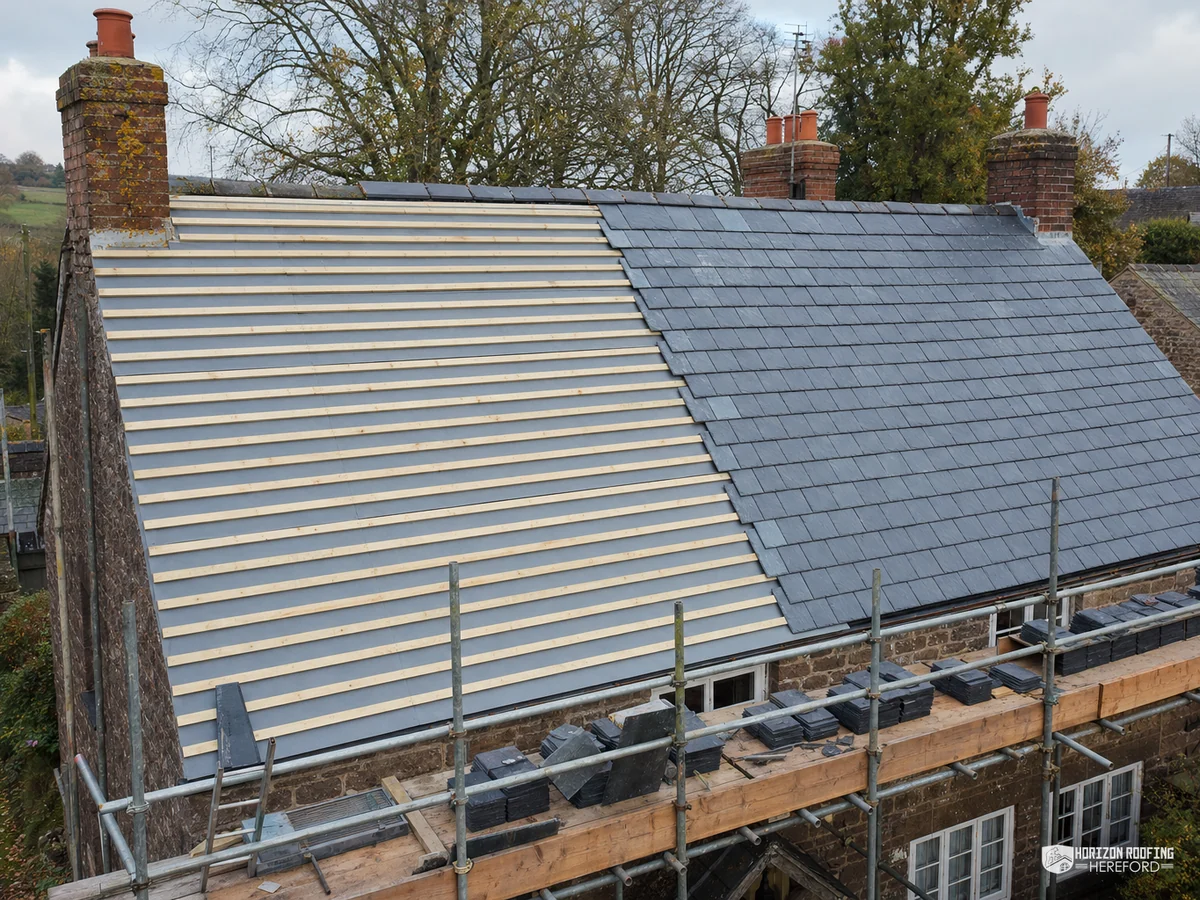
  • Slate roofs and chimney stacks along a red brick Victorian terrace
    Valleys carrying the waterLead valleys take the run-off of two slopes, so splits show up fast.
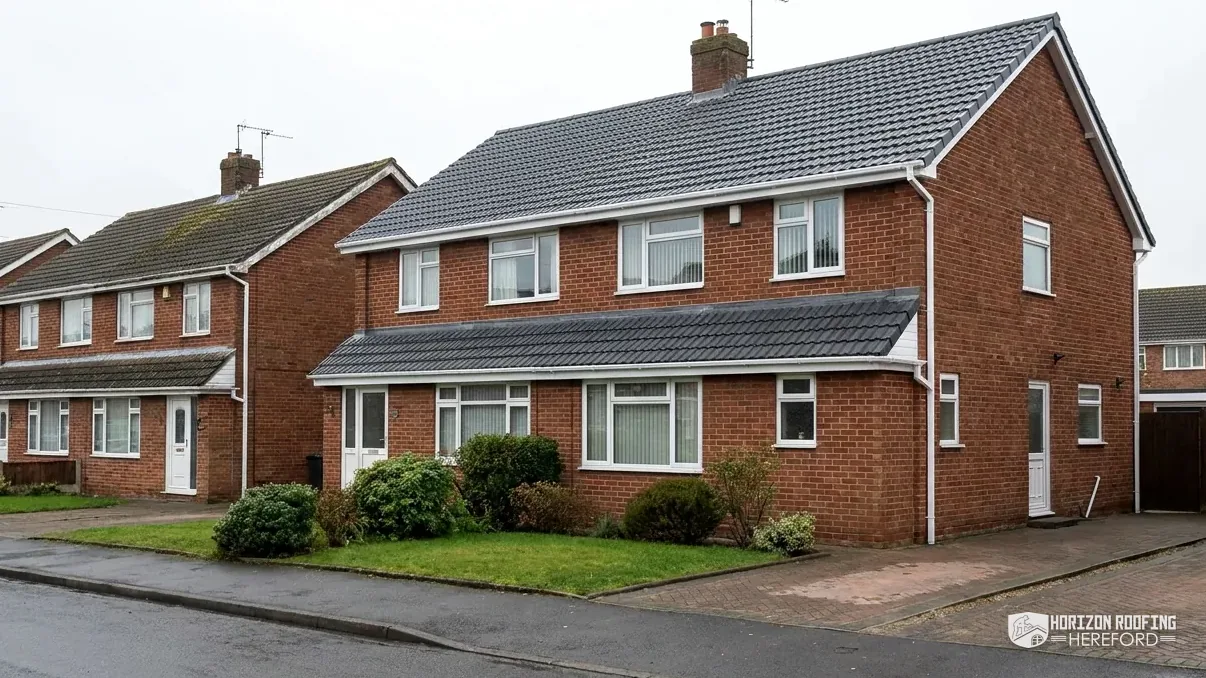
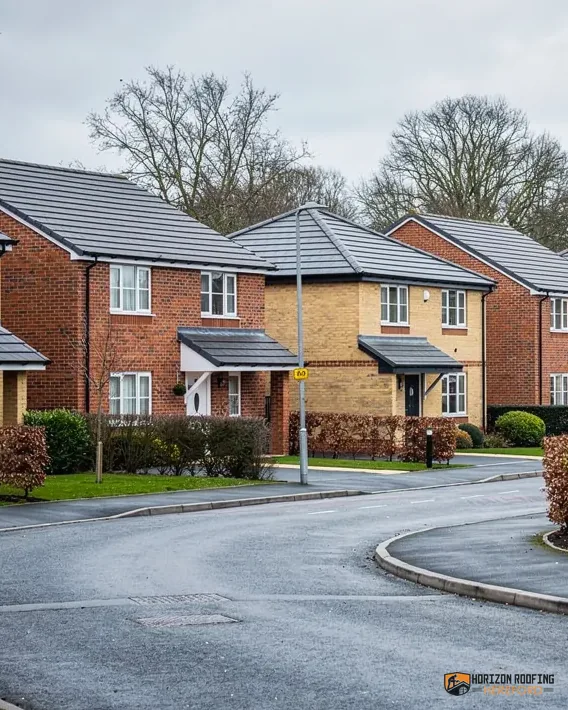
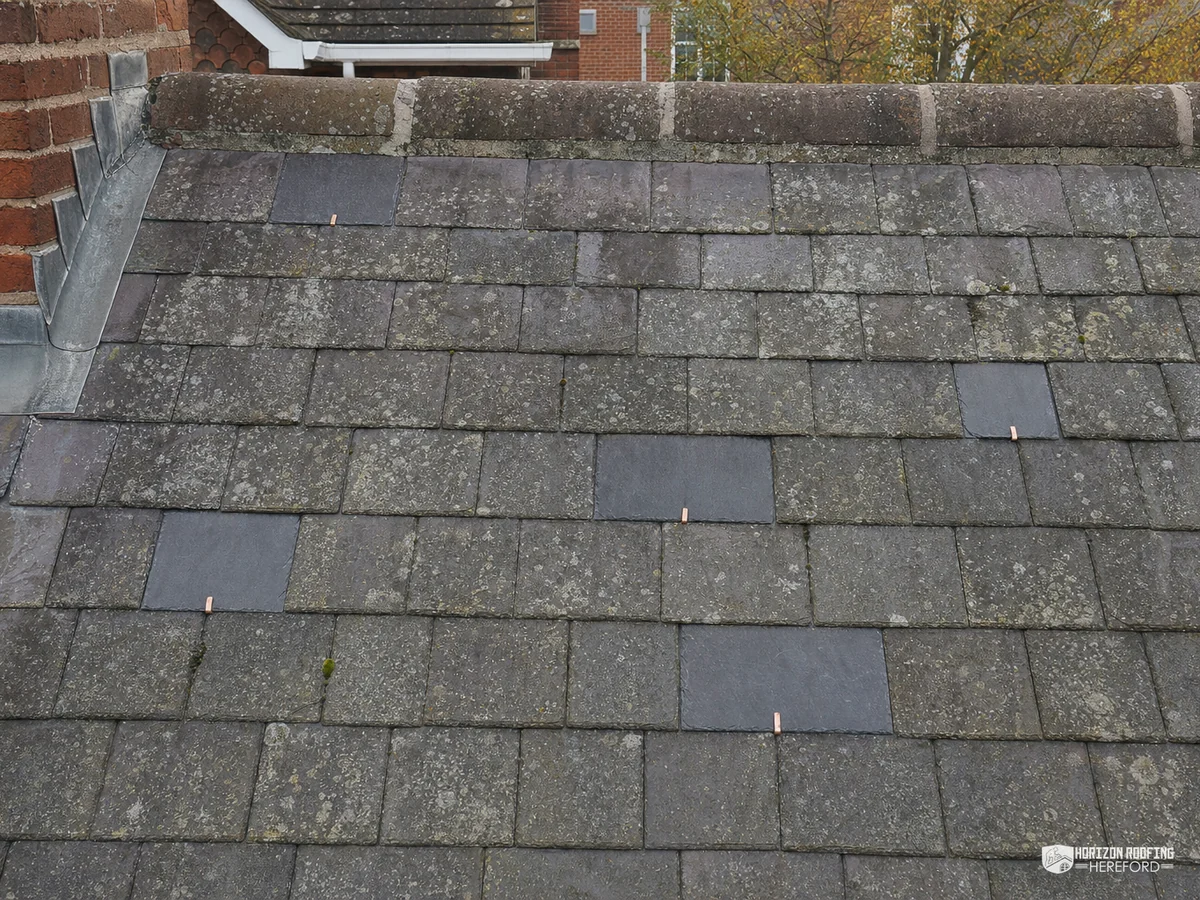
  • Newer homes with grey concrete tile roofs along a curving estate road
    Eaves that need to breatheBlocked eaves vents trap damp in the loft and rot the timbers.

Inside our 30 miles: Brimfield

Brimfield on a street map, with a dashed circle around the town and the nearest towns we cover. Tiles © Esri; map data © Esri, HERE, Garmin, OpenStreetMap contributors.

Brimfield roofs, slope to eaves

Brimfield surveyed from the slope down: tiles, valley lead and ventilated eaves

This read follows the order of a Brimfield survey: the slopes first, then the lead valleys where two slopes meet, then the eaves and the ventilation behind them, with the listed buildings and the nearest conservation area at the end.

A drawn cut-away section through a Herefordshire border house: the front of the main roof is cut open to show the rafters, underlay, battens and slates, beside a black-and-white timber-framed gable. Numbered, from the ridge down: 1 Tile and slate; 2 Lead valley; 3 Eaves and listings.

Fig. 1 Brimfield roof in section, with the slope, the valley and the eaves numbered.

Callout 1 of 3

Slipped tiles and slates on the main slopes

The first callout is the slope, the broadest area of any roof, and the one that shows from the lane. In 1934 the Royal Commission's Herefordshire inventory said of the monuments it listed in Brimfield parish that "the walls are timber-framed, and the roofs are covered with tiles or slate". That tells us how those buildings were first dressed, and nothing about the house you own today. A roof may have been re-covered once or twice since, so the survey reads the slope in front of it, tile by tile.

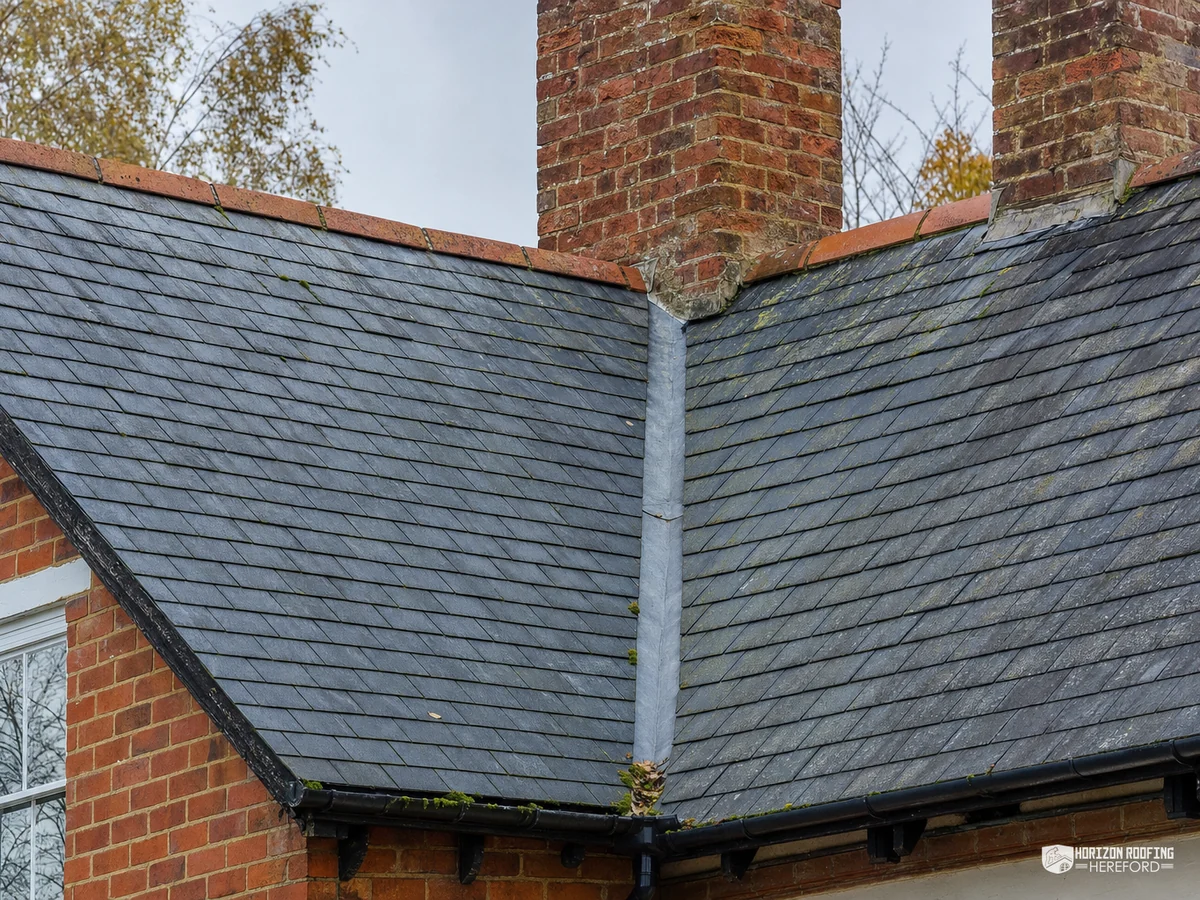
A slipped tile is the kind of fault you can spot from the pavement: one sitting a course lower than its neighbours, a gap with the dark of the batten showing, a broken piece in the gutter. Slates behave in the same way once the nail or hook holding them gives up. Each is a small hole in the roof. We open the courses around the slip and check the batten beneath, because the batten is the thin timber strip a tile hangs from, and a soft one has to be replaced along its length, not only under the tile that moved.

Ladders show only so much. Looking along a slope in raking light can reveal a sag between rafters, a ripple in the courses or a ridge line that dips, and those say more about the timbers than any single tile does.

Lifespan guides the choice between patching and replacing. HomeBuilding gives Welsh slate "100+ years", Spanish slate "75-100 years" and reclaimed Welsh slate "50-80 years", and SPAB writes that the life of a well-slated roof is "likely to be more than 100 years". Marley quotes the BRE's 60-year minimum for clay tiles, and it is for clay only. Those figures describe roofs in good order, never promises, and they are why a sound slope with a dozen failures is treated as a repair, and a slope with failures everywhere is not.

When the work grows into a re-cover, a few things are settled before the first tile comes off: the weight of the new covering against the old, the condition of the rafters, and the fixings the standard asks for. Our pitched roofing page describes tiled and slated roofs from the rafters up. Each fault on your slope gets a photograph taken where it sits, so the report shows which tiles are failing and which are not.

What the survey records on a Brimfield slope

Tiles or slates
Slipped, cracked or missing, counted by course
Battens
Soft or split timbers beneath the failures
Fixings
Nails or hooks that no longer hold
Ridge and hips
Bedding and capping along the top
Loft side
Stains and daylight seen from inside

A dozen failed tiles on a sound slope is a repair; failures across every course is another conversation.

Fig. 2 The slopes, drawn close

Callout 2 of 3

Valleys, where two slopes empty into one channel

The second callout is the valley, the angled channel where two slopes meet and shed their water into a single line. Both slopes drain into it, so a valley carries the water of two slopes, and one split in its lining becomes a steady drip in the ceiling below. Lead is the classic lining, set on a bed of boards, with cut tiles or slates trimmed tidily along either side.

Thickness is a matter of code. The Royston Lead table lists Codes 4, 5, 6, 7 and 8 for a pitched valley gutter, and Code 3 only for soakers. A heavier code costs more to lay, so the report names the code that the valley was laid with and the code we would use. How long a valley serves depends on that code, on the boards beneath and on how each lap was made, and a poorly made joint can give out early.

The troubles in a valley are not mysterious. Leaves and moss pile up in the channel, hold water against the edges of the covering and wear the lead where it stays wet. The cut tiles along the edges slip and let the water creep under. A crack runs along a fold where the lead has been bent too sharply. We clear the channel first, because a clean valley shows its own faults, and then photograph the lead from the top of the slope and from the loft side, where a tide mark on the boards shows where a leak has been. We also follow the valley down to the eaves, since the lead has to discharge cleanly over the gutter edge and not dribble behind the fascia board.

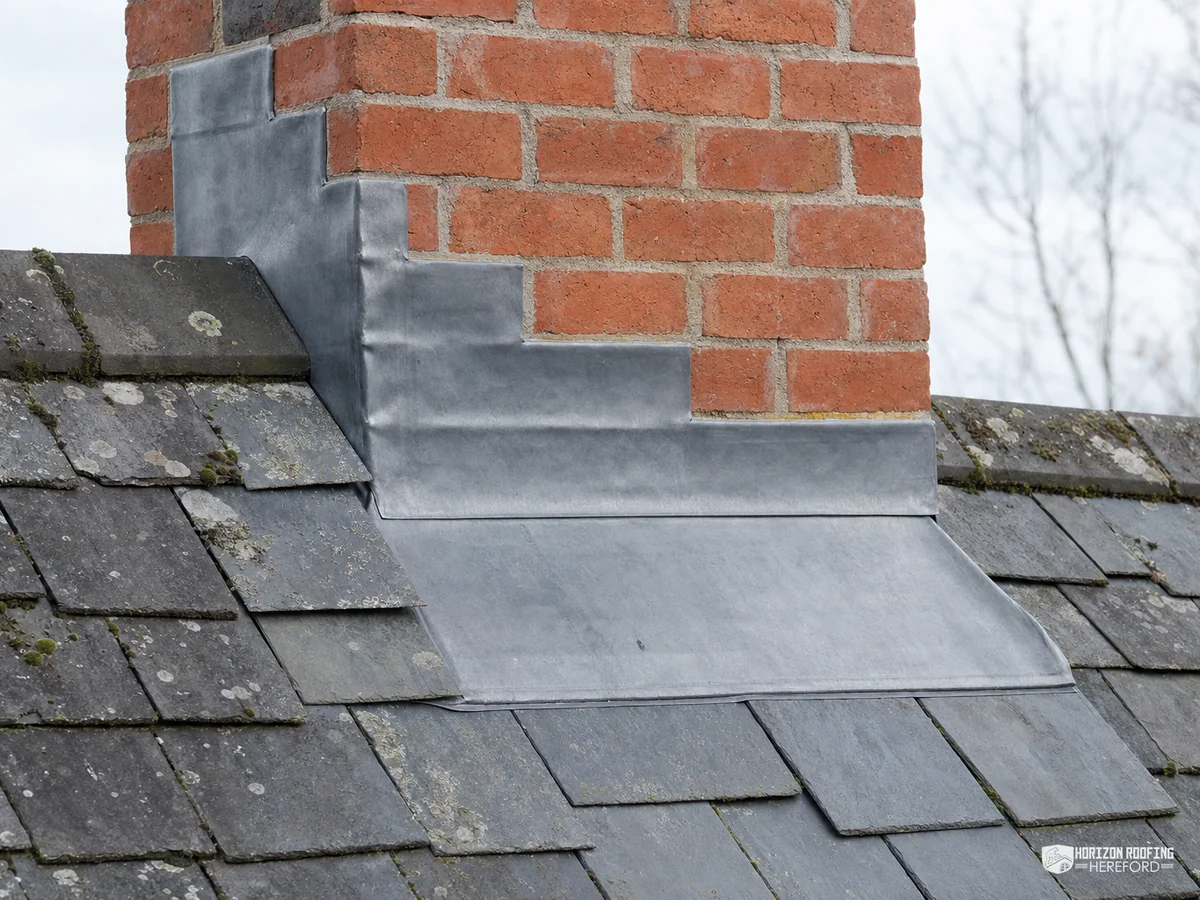
Where one split is the only defect, a lead patch, correctly lapped and bonded, saves the slopes on either side. Where the lining has failed along its length, the tiles at each edge come up and a new lead gutter is laid. Our lead roofing page sets out how we treat valleys, flashings and soakers.

Valley repairs

Can a valley be mended without stripping the slope?

Sometimes. A single split in sound lead can take a patch, and only the tiles beside the split come up. A lining that has failed along its length needs the edge tiles lifted and a new gutter laid, but the rest of the slope stays put.

Fig. 3 The valley, drawn close

Callout 3 of 3

Ventilated eaves, a Grade II* church and the Roebuck

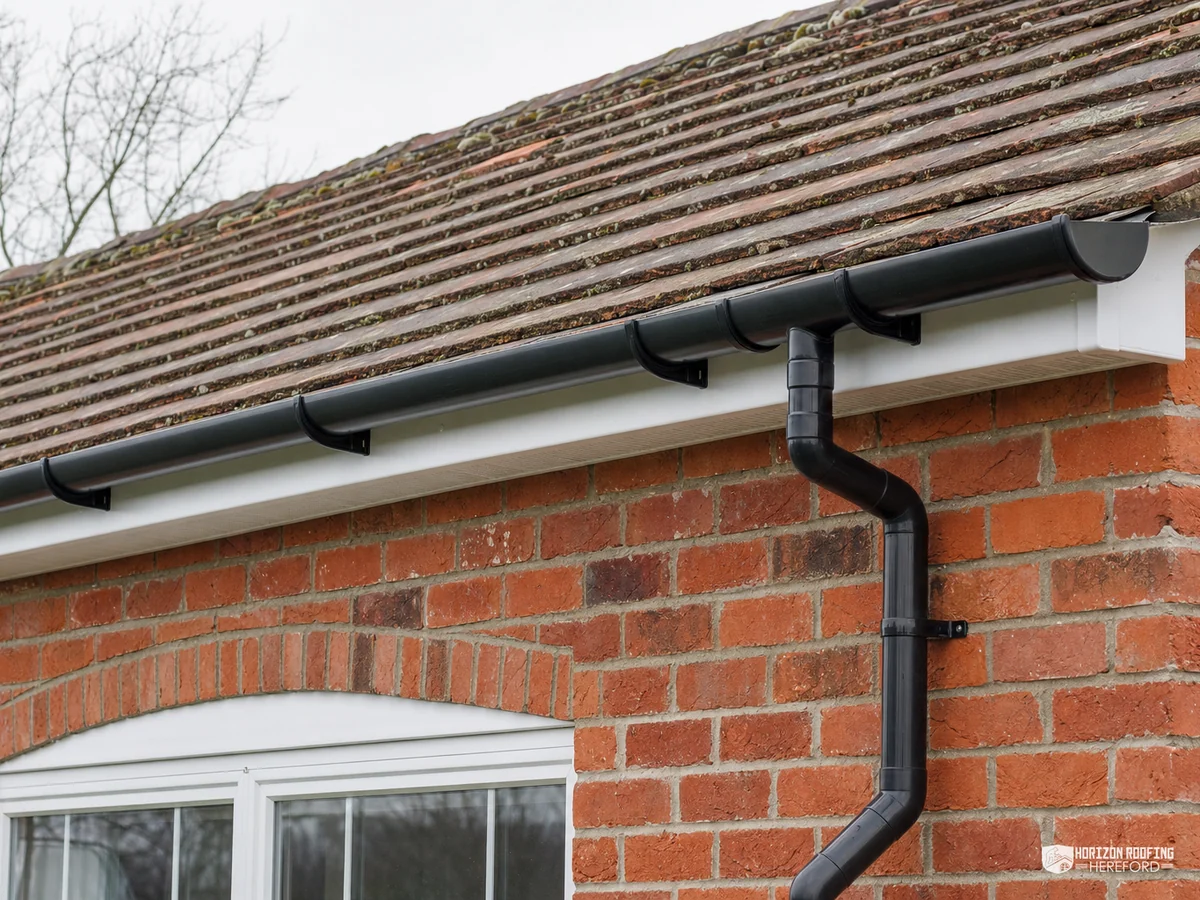
The third callout is the eaves, where a roof meets the top of the wall, and it is where the loft breathes. Marley gives the eaves ventilation for a cold roof under a high-resistance underlay as "25mm along the length of the eaves for pitches of 15° or less; 10mm along the length of the eaves for pitches of more than 15°". High-resistance (HR) underlay lets no vapour through, which is why it leans on that gap at the eaves. When the gap is shut, damp has nowhere to go and the rafter feet can start to decay.

We check the eaves from the loft with a torch, looking for a pale, dry gap at the wall head and for rafter feet that look dark or feel soft. Insulation pushed hard against the roof, a missing eaves tray or a vent choked with old felt can each shut the gap, and any of them can be cleared without disturbing the covering above.

Brimfield has listed buildings of its own. St Michael's church is listed Grade II* (list entry 1349854, first listed 11 June 1959), and The Roebuck is Grade II (list entry 1166611, first listed 11 December 1987). Under section 7 of the Planning (Listed Buildings and Conservation Areas) Act 1990, works that affect a listed building's special character need consent, and St Michael's is Anglican, so while services continue its roof work is a matter for the Church of England's faculty jurisdiction and not for the council.

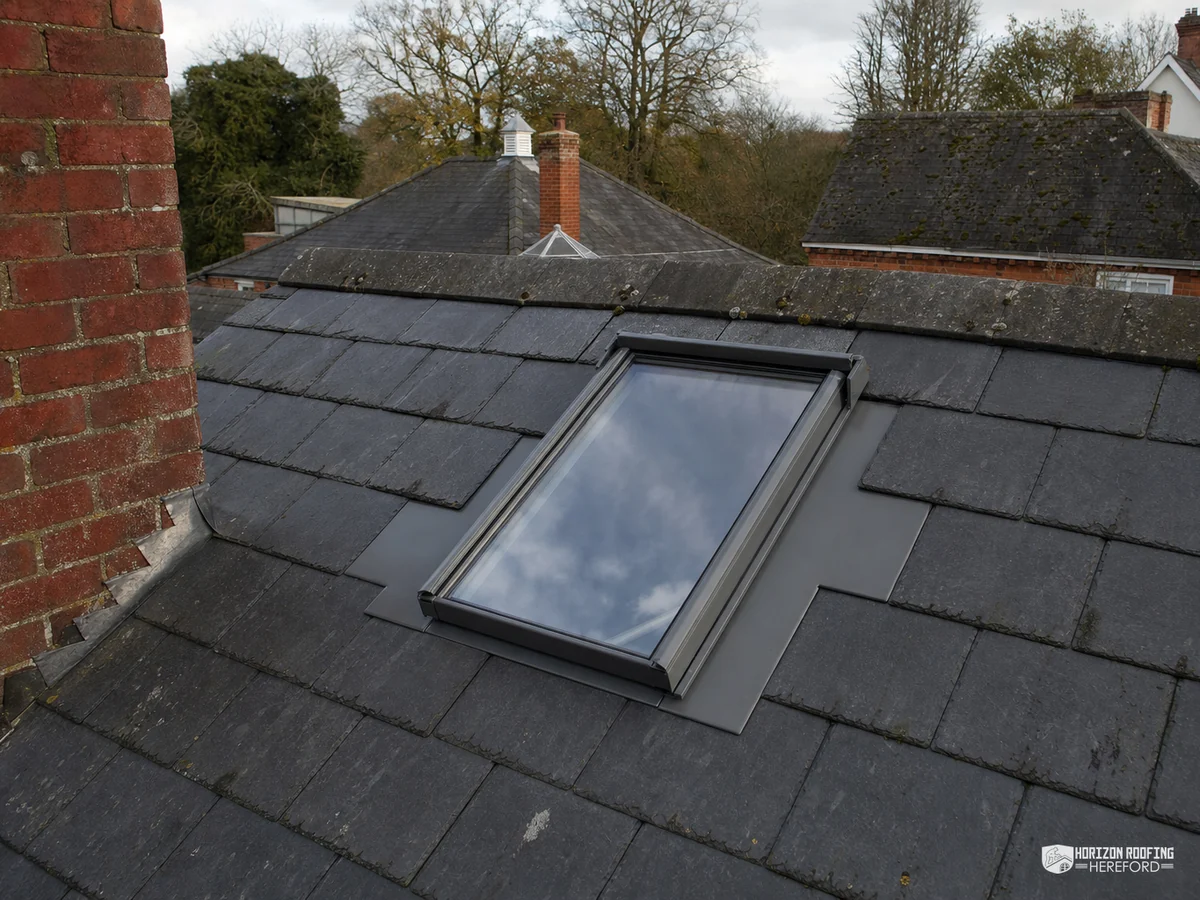
The nearby conservation area at Ashford Carbonell is across the county boundary and belongs to Shropshire Council. For Brimfield itself, Herefordshire Council keeps the register of the county's 64 conservation areas. Find your address on that list, then ask Herefordshire Council whether an Article 4 direction applies. A dormer needs Herefordshire Council's view before any drawing, and our planning guide for roof windows sets out the conditions for each kind of opening.

The condition of the eaves feeds into every quote we write, because the price follows the access, the timbers behind the fascia and the height of the wall. Our listed and heritage roofing page explains how a protected house is approached.

What moves the price of eaves work

Height
How far up the wall the work sits
Reach
Ladder, tower or scaffold access
Extent
One corner or the full run
Timbers
Whether the boards behind are sound
Site access
Room for materials and for waste to leave

One written total price, never itemised.

Brimfield roofs: slopes, valleys and licences

How can I tell whether Brimfield tiles are slipping or failing?

From the ground, look for a tile sitting lower than the course around it, a dark gap, or pieces in the gutter. In the loft, look for daylight or a damp stain on the underside. Slipped tiles are a repair. Tiles that are crumbling or laminating across a whole slope point to the end of the covering. The survey photographs both from the roof, so you can judge which one you have.

Where do I check conservation area rules for a Brimfield roof?

Ashford Carbonell, close by, has a conservation area of Shropshire Council's, but a Brimfield address is a question for Herefordshire Council, whose register covers the county's 64 conservation areas. Look your street up there, and ask whether an Article 4 direction applies. A like-for-like repair is a different matter from a new dormer, which is worth raising with the council before any drawing.

What happens if bats turn up during roof work near Brimfield?

Work stops. Under section 9(4) of the Wildlife and Countryside Act 1981 it is an offence to intentionally or recklessly damage or obstruct a roost used by bats, and under Habitats Regulations reg 43, damaging a resting place is an offence without any intent. Licences come from Natural England in England. We photograph what we find, then wait for advice before any tile is lifted.

Can I swap Brimfield tiles for a heavier covering?

It is a Building Regulations matter, not a planning one. The Planning Portal sets the line at a new covering that is 15 per cent or more heavier than the existing one, and AD A para 4.4 calls a change of "more than 15%" significant. The rafters get a structural check first, and a listed building would need consent to change its material too.

What do tile and slate repairs cost per square metre?

Checkatrade's June 2026 figures, ex VAT, for repairs up to 3 m² are £90 to £120 per m² for concrete, £110 to £160 for clay and £150 to £220 for natural slate. They are per square metre, so no total follows from them, and they are not Brimfield prices. We survey the roof and give one written total for the job.

How should a corrugated roof on a Brimfield outbuilding be handled?

Because HSE tells owners to assume asbestos is present wherever a building went up or was refurbished before 2000, we treat a corrugated sheet roof as asbestos cement until a test says otherwise. Such roofs are always fragile, so nobody steps on them. Lifting whole sheets off without breaking them is non-licensed work, with a lockable skip afterwards. Once sheets are badly broken the job becomes notifiable non-licensed work under HSE's rules, and removing white AIB soffit panels is, in most cases, licensed work.

Get a slope-first survey in Brimfield

Tell us about the fault or send a photo, and we will survey the roof and set the price out as one total.

10-year workmanship guarantee, in writing