
01432 610152 Get a quote Call 01432 610152

Roofers in Kimbolton

Roof repairs and re-roofs for Kimbolton's framed farmhouses, cottages and village homes.

Our survey names the covering first, then the chimney, then any roof window, and ends in one written price.

Get a free quoteCall 01432 610152

Kimbolton roofs: three coverings, one survey

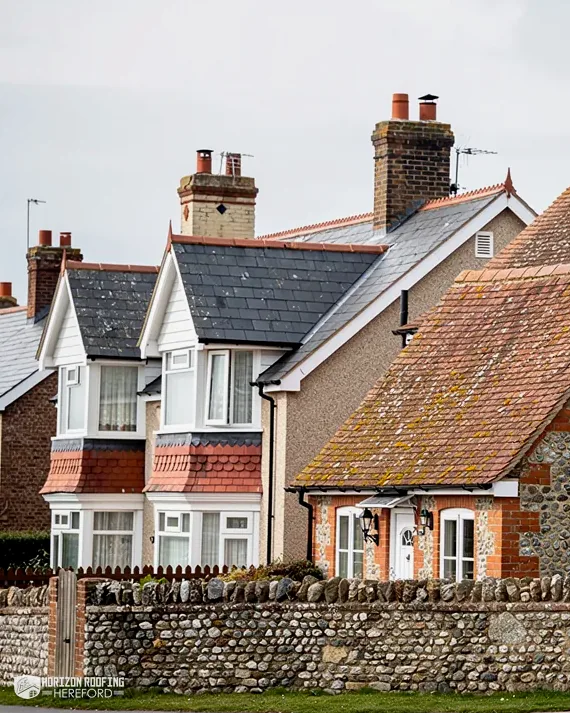
  • Older cottages with weathered clay tile roofs and brick chimneys behind a flint wall
    Tile, slate or stoneA 1934 survey of parish buildings recorded roofs of tile, slate or stone.
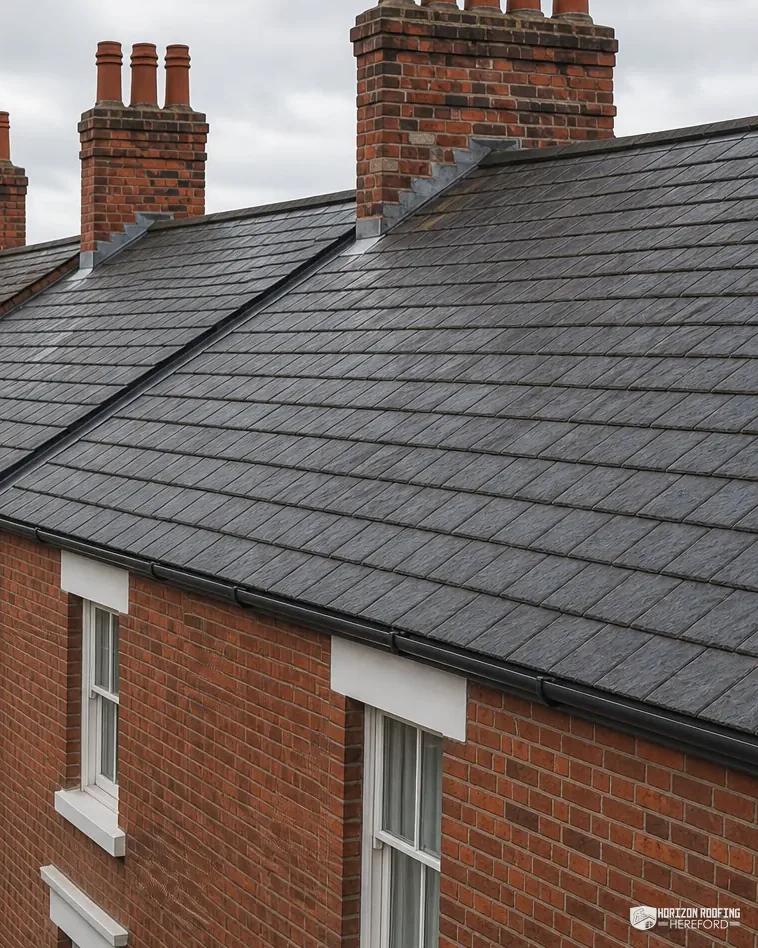
  • Slate roofs and chimney stacks along a red brick Victorian terrace
    Farmhouse and cottage stacksChimneys on older houses need their pointing and lead checked from above.
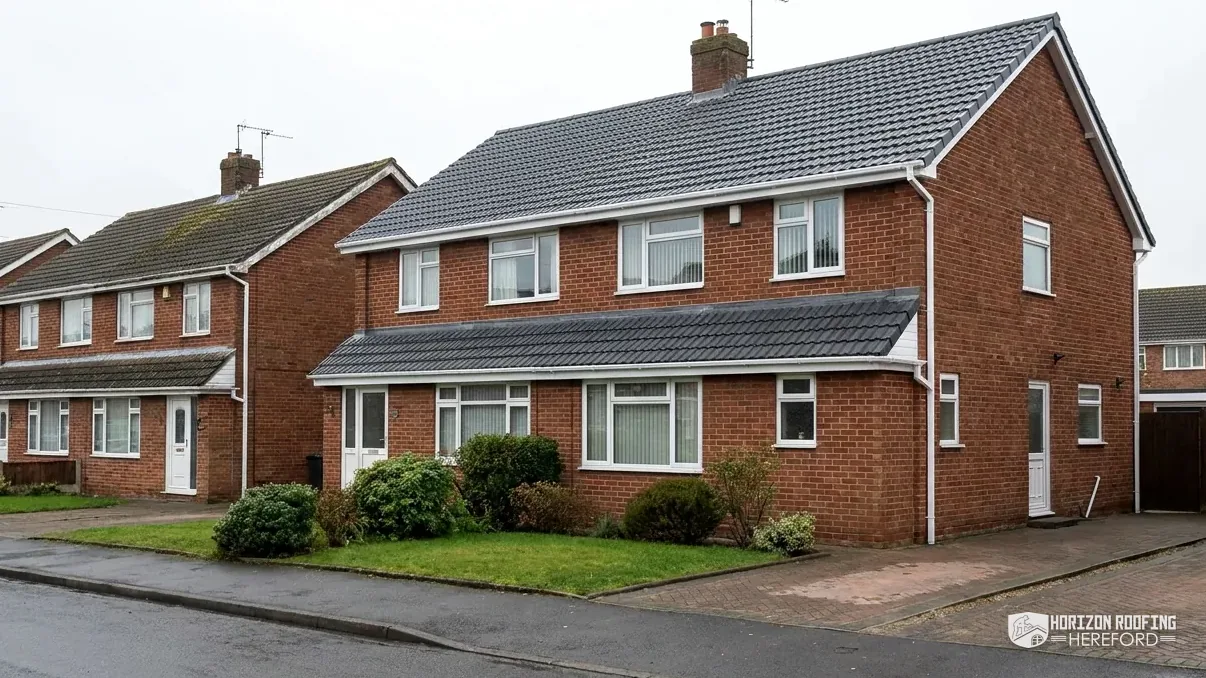
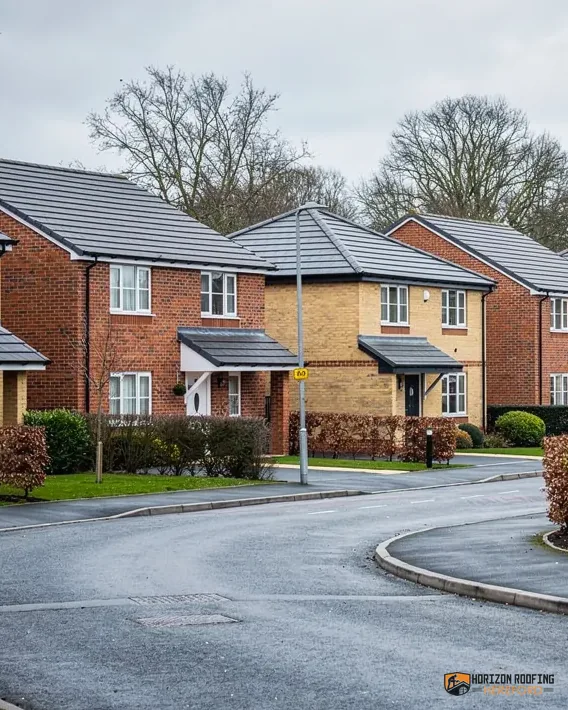
  • Newer homes with grey concrete tile roofs along a curving estate road
    Roof windows and their rulesA new opening in a slope brings Building Regulations and planning questions.

Where Kimbolton lies

Kimbolton on a street map, with a dashed circle around the town and the nearest towns we cover. Tiles © Esri; map data © Esri, HERE, Garmin, OpenStreetMap contributors.

Kimbolton roofs, covering to roof window

Kimbolton roofs in three parts: coverings, stacks and roof windows

We name the covering first, since the parish has been recorded with tile, slate and stone, then climb to the chimney stacks, and finish with roof windows and the listings and conservation areas around them.

A drawn cut-away section through a Herefordshire border house: the front of the main roof is cut open to show the rafters, underlay, battens and slates, beside a black-and-white timber-framed gable. Numbered, from the ridge down: 1 Three coverings; 2 Stacks and breasts; 3 Roof windows.

Fig. 1 Kimbolton's covering, stack and roof window callouts on one border roof.

Callout 1 of 3

Tile, slate or stone: naming the covering first

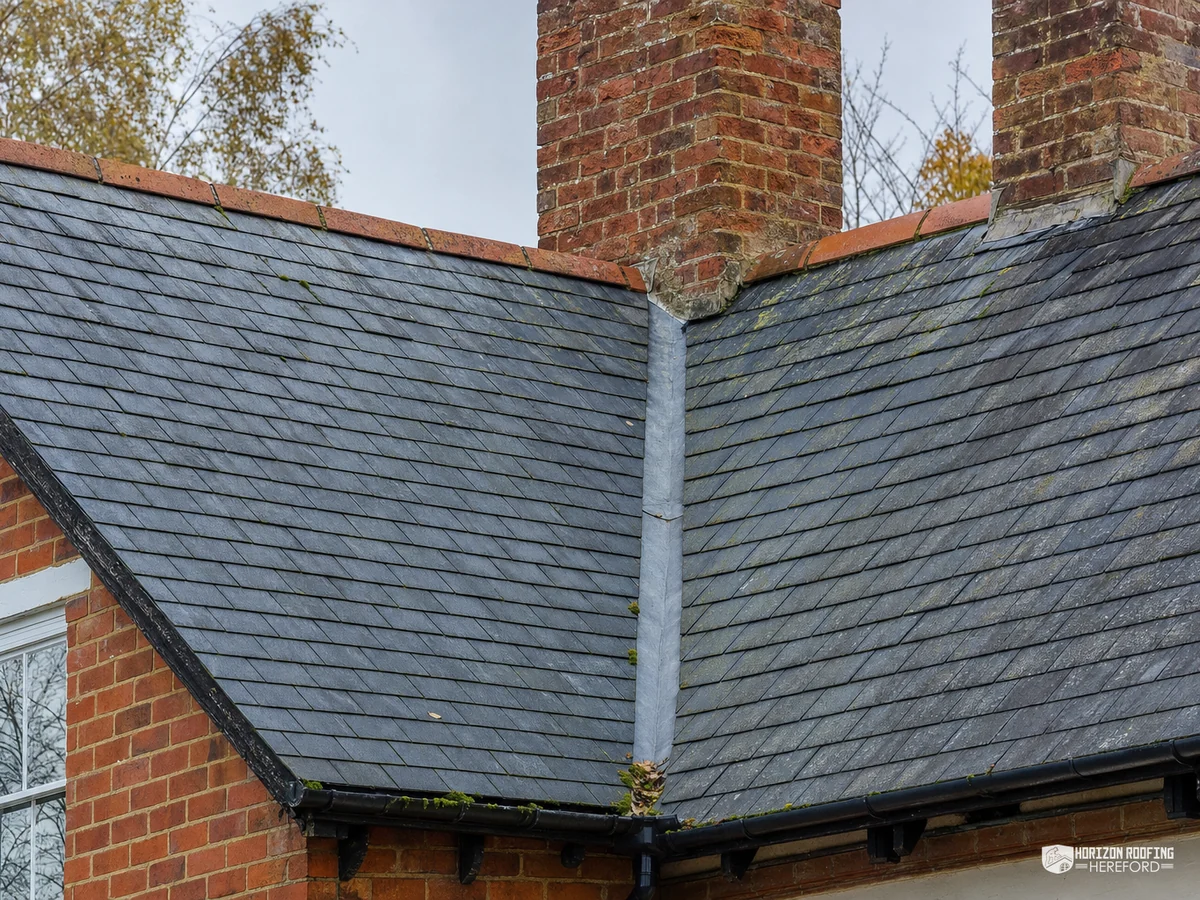
The Royal Commission's 1934 inventory of Herefordshire grouped monuments 4 to 21 in Kimbolton parish and, unless it said otherwise, described them as buildings of the 1600s, timber-framed, with roofs of tile, slate or stone. Three coverings in one line means a survey cannot assume. The first task on a Kimbolton roof is to name what is there, because the repair, the weight on the frame and the supplier all follow from that answer. Each covering also leaves a different pattern of wear under the surface, so we look at the underside from the loft as well as the top from the slope, and the report shows both views of any fault.

Stone needs the closest reading. Local sandstone tilestones are the traditional stone roofing of Herefordshire, and the county's atlas of building stone points to the St Maughans sandstones as the principal source. SPAB notes purple stone slates in Herefordshire among the usual greys and browns, so colour alone will not tell you the stone. Its advice is to put any story of shortage or delay to the quarries directly. That phone call comes before any talk of another material, since a substitute alters the look of the roof.

Tile and slate fail in familiar ways. A tile slides when its nib snaps or the nail rusts. A slate slips when its fixing corrodes or the slate cracks across. Moss and lichen collect on all three coverings. Marley does not recommend pressure washing a slate or tile roof, as the surface is easily damaged, so we brush and treat, and we photograph the surface before and after.

A roof repaired over the years can carry patches of different material: a run of tiles set into slate, say, or new stone beside weathered stone. We mark each patch on the photographs, because it shows where earlier repairs were needed and what the roof was repaired with, and that history helps decide whether the next job is a patch or a larger one.

Changing one covering for another alters the load on the frame. The Planning Portal puts the line at a covering that increases the weight by 15 per cent or more, and AD A, paragraph 4.4, calls an increase of more than 15% a significant change in roof loading. Either way, a structural check comes before an order. In a timber-framed house with a stone or tile roof, the frame is old and the survey says what it can carry. Our pitched roofing page covers re-covering in tile, slate and stone.

Three coverings, three checks

Tile
Nibs, nails and battens at every gap
Slate
Corroded fixings and slates cracked across
Stone
Weight on the timbers and the source of any match

Three coverings in one parish means the survey cannot assume.

Fig. 2 The slopes, drawn close

Callout 2 of 3

Stacks, breasts and the lead round a farmhouse chimney

Brook Farmhouse is listed Grade II (list entry 1082531, first listed 23 September 1987), and so is Moss Cottage (list entry 1082532, first listed 23 September 1987). A farmhouse and a cottage of that age share a feature that every Kimbolton survey climbs to: the chimney. Whatever a stack is built of, it stands clear of the roof and catches weather on every face.

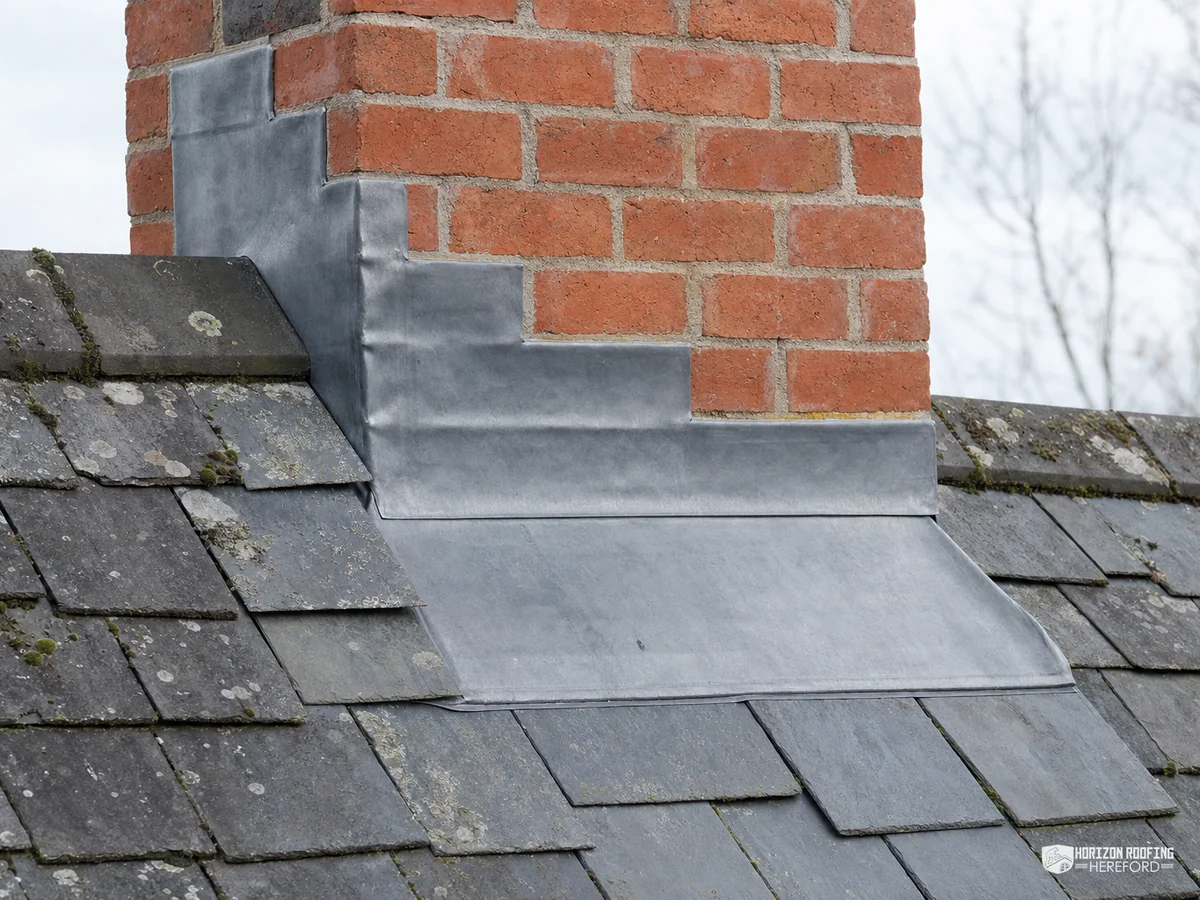
We check the pointing, the joints between the bricks or stones of the stack, and the flaunching, the shaped cap of mortar on top that holds each pot and sheds rain. We check each pot for cracks and the lead at the base. A flashing is lead lapped over the covering and wedged into a joint, a soaker is a folded piece set beneath each course alongside the stack, and a back gutter is the lead channel that runs behind it. Royston Lead lists Code 3 for soakers only and Codes 4, 5 and 6 for flashings. MyJobQuote reckons that correctly installed lead flashing "can last for over 80 years", so lead that has only lifted is refixed and not replaced.

Taking a stack or breast away is a larger step. The Planning Portal is clear that Building Regulations approval will always apply to a chimney breast being taken out, since it is part of the structure. Where a breast belongs to a party wall, a notice goes from the building owner to the neighbour, with at least two months' notice given before the wall is touched, and a surveyor comes in only after a dissent or 14 days of silence. On a listed house the work needs consent from Herefordshire Council as well. Where a stack leans or has moved at its base, the survey judges between a repair and a rebuild from the roofline down, and the cracks that decide it are in the photographs. Pots are checked as well, since a pot that rocks needs rebedding and repointing will not cure it.

Photographs of each face, taken from above, are placed in the report so the cracks and the lifted lead are in front of you when you decide. Our chimney repairs page deals with repointing, rebuilding and releading.

A word from the stack

What does flaunching do at the top of a chimney?

It is a sloped bed of mortar surrounding the pots, shaped so that rain runs off. Once it cracks, water can get into the flue, so we photograph it from above.

Weather reaches all four faces of a stack, so all four get looked at.

Fig. 3 Chimneys, drawn close

Callout 3 of 3

Roof windows, St James' church and the Leominster areas

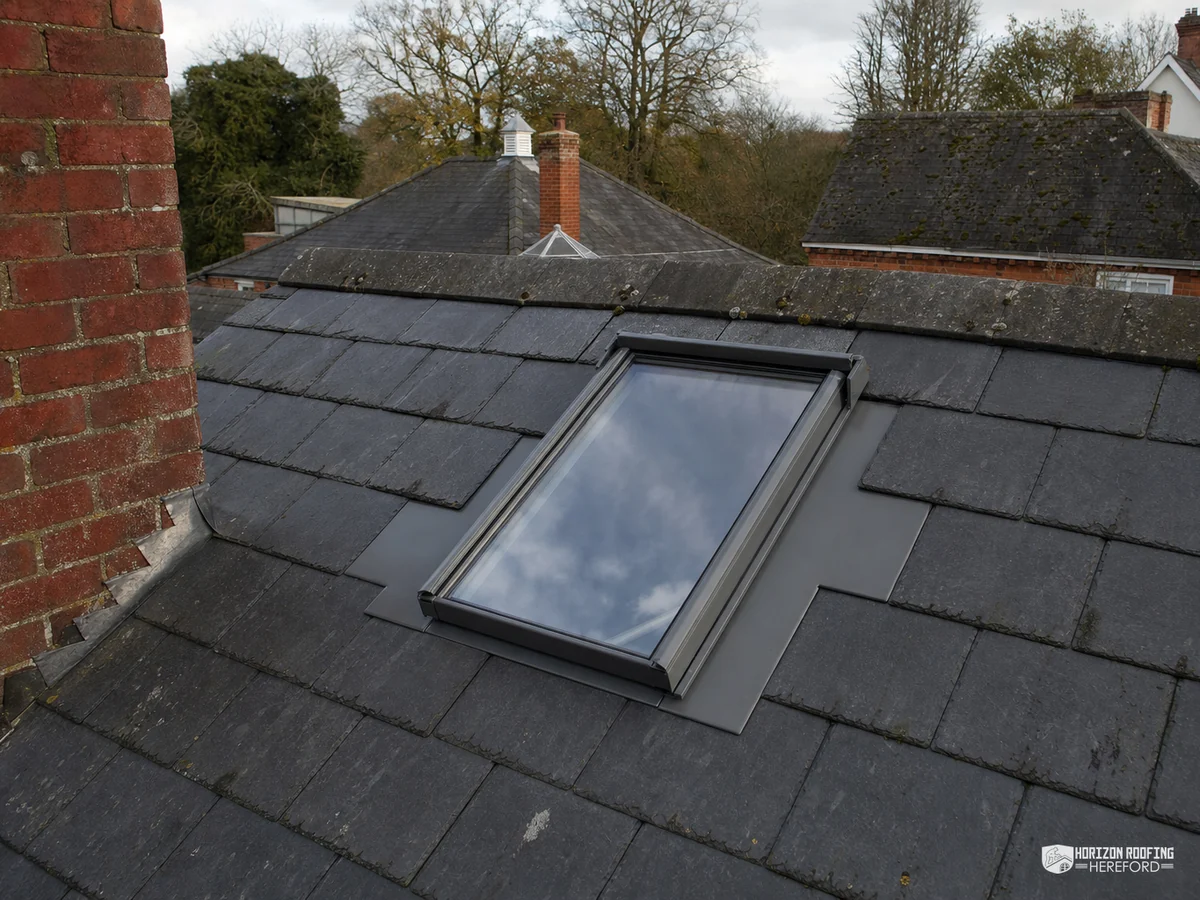
A roof window is glazing fitted within the slope of the roof, and the energy rules treat it like any other window and not like a rooflight. In England, AD L 2021 Table 4.2 gives roof windows 1.4 or WER Band B, and the 2.2 figure is for rooflights. Before any opening is cut we look at the rafters and the ceiling below, because the opening needs a trimmed frame round it, and the rafters either side carry the load the cut ones used to. In a listed or framed house that check is made from the loft, with a torch and a tape, before a drawing is made. Our planning guide for roof windows sets out the planning side, and our skylights page covers fitting.

Near Kimbolton, Herefordshire Council's list of conservation areas includes Leominster River Meadows and Leominster Town. Ask the council whether any boundary touches your address, and whether an Article 4 direction applies. Herefordshire has 64 conservation areas in all, so get the reply in writing before an opening is drawn on a front slope.

St James's church holds a Grade II* listing (list entry 1082568, first listed 11 June 1959). The route for work on a church follows from the denomination and from whether services still run, which its governing body can confirm. Brook Farmhouse and Moss Cottage are Grade II; section 7 of the 1990 Planning (Listed Buildings and Conservation Areas) Act asks for consent where works affect a listed house's character, and permitted development rights stay.

Kimbolton is 14.3 road miles north of Hereford, about 21 minutes by road, and England's rules apply. Herefordshire Council Building Control, on 01432 261938 or at bce@herefordshire.gov.uk, deals with Building Regulations, and a registered building control approver is the private route.

Where a roof window replaces an old one on the same opening, the survey looks at the flashing kit round it and the lining inside it, and the job is smaller than cutting a new opening. Where the window is new, the rafters, the ceiling below and the approvals above all come into the price. We photograph the opening from the loft side as well as from the slope, so the framing you are paying for is on record.

To the energy rules a roof window is a window and a rooflight is something else.

A roof window in a Kimbolton slope

SoundFrame sealed, flashing lapped over the tiles, glazing clear
Needs workRotten timber, lifted flashing, damp staining at the lining

Kimbolton roofs: stone, stacks and the rules nearby

How can you tell a stone slate roof from a slate one at Kimbolton?

Stone slates are thick, uneven slabs laid in rough courses, in greys and browns, with some purple stone in Herefordshire according to SPAB. Natural slate is thin, flat and regular. The 1934 inventory recorded tile, slate or stone in Kimbolton parish, so the covering on your roof is identified from the slope and the loft, and a sample is photographed before any proposal.

Is the Church of St James at Kimbolton exempt from listed building consent?

The answer starts with the church itself. St James is Grade II* (list entry 1082568, first listed 11 June 1959), but exemption follows the denomination and the building's current use, so the answer cannot be read from the listing alone. The church's own governing body can confirm the route. Where a church has closed, or belongs to Quakers or Unitarians, the council's listed building consent applies.

Which conservation areas lie near Kimbolton?

Herefordshire Council's list includes Leominster River Meadows and Leominster Town, both near the village. That leaves open whether your own house lies within a boundary, so ask the council, which also answers questions on Article 4 directions. Herefordshire has 64 conservation areas in all. Put the question to the council before you plan changes to a front slope, and keep the reply on file.

Does a listed cottage like Moss Cottage need consent for new gutters?

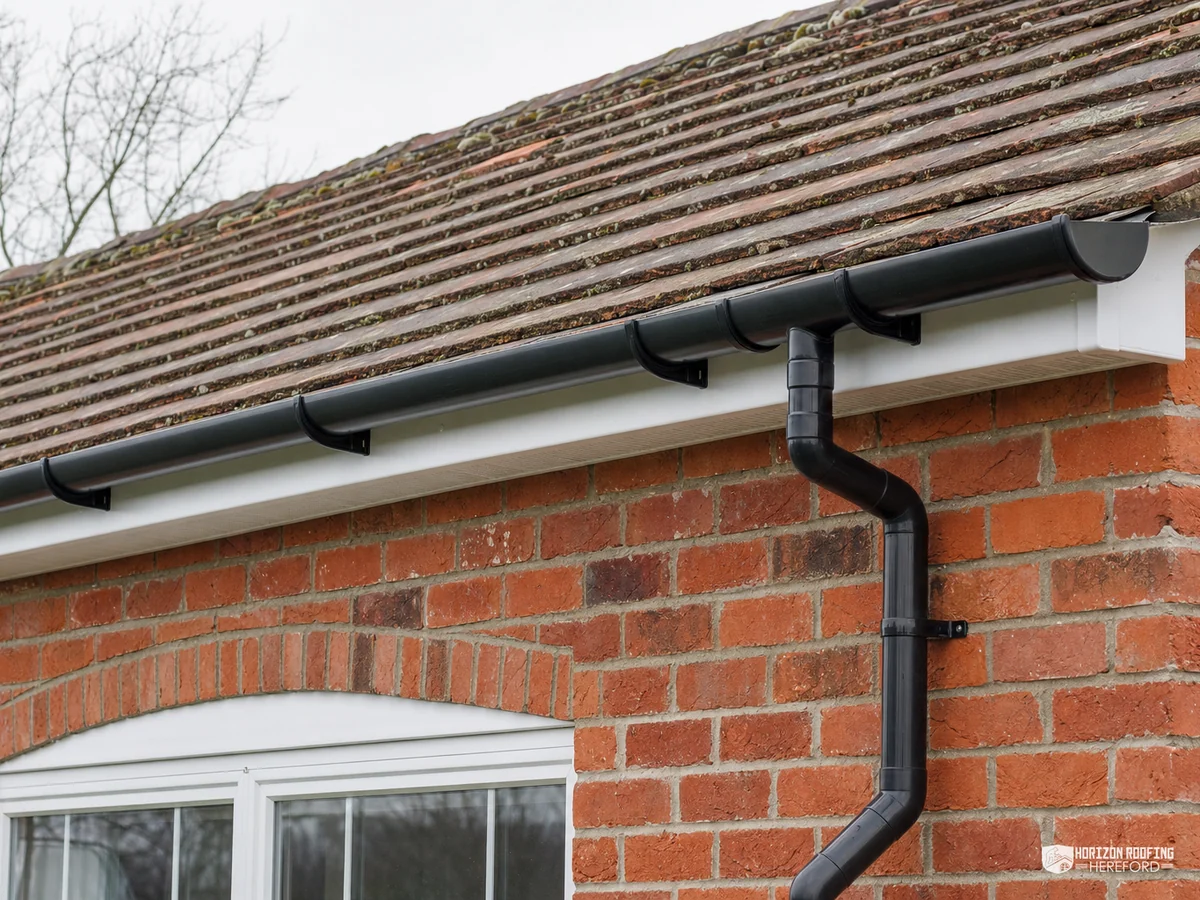
It can. Moss Cottage is Grade II (list entry 1082532, first listed 23 September 1987), and section 7 of the 1990 Act requires consent for works that affect a listed building's character. Whether a change of gutter material does so is for Herefordshire Council to say. A like-for-like replacement is the lighter case, and photographs of the existing run come first.

What U-value must a new roof window in a Kimbolton house reach?

In England, AD L 2021 Table 4.2 sets rooflights at 2.2, while a roof window must reach 1.4 or WER Band B. Tables 3.2 and 3.3 of AD L 2026 replace Tables 4.2 and 4.3 on 24 March 2027. The window figure holds even when the roof window sits in a loft conversion, though the roof itself is then a renovation under Table 4.3.

How soon must scaffold be applied for near a Kimbolton lane?

At least 10 days before it goes up, if it will obstruct the highway, because Highways Act 1980 section 169 requires a licence for that. Herefordshire Council's fee is £167 for a maximum of one month, £123 a month for any extension, and its highways licensing team can be reached on 01432 261800 about scaffold licences. We arrange the licence with our scaffolder. Trunk roads and motorways sit with National Highways.

Get a Kimbolton roof surveyed and priced

Tell us about the house and send a photograph or two, and we will name the covering, check the stacks and write the price down.

10-year workmanship guarantee, in writing