
01432 610152 Get a quote Call 01432 610152

Roofers in Presteigne

Roof repairs and re-roofs for Presteigne's town-centre houses, under the Welsh rules.

Presteigne is a 39-minute drive from central Hereford, 23.1 road miles north-west. Every survey closes with one written total.

Get a free quoteCall 01432 610152

Presteigne's listed streets and roof rules

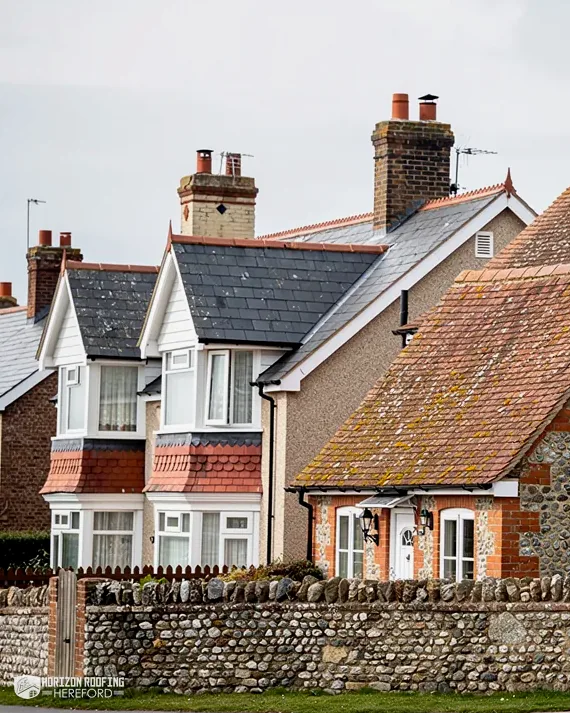
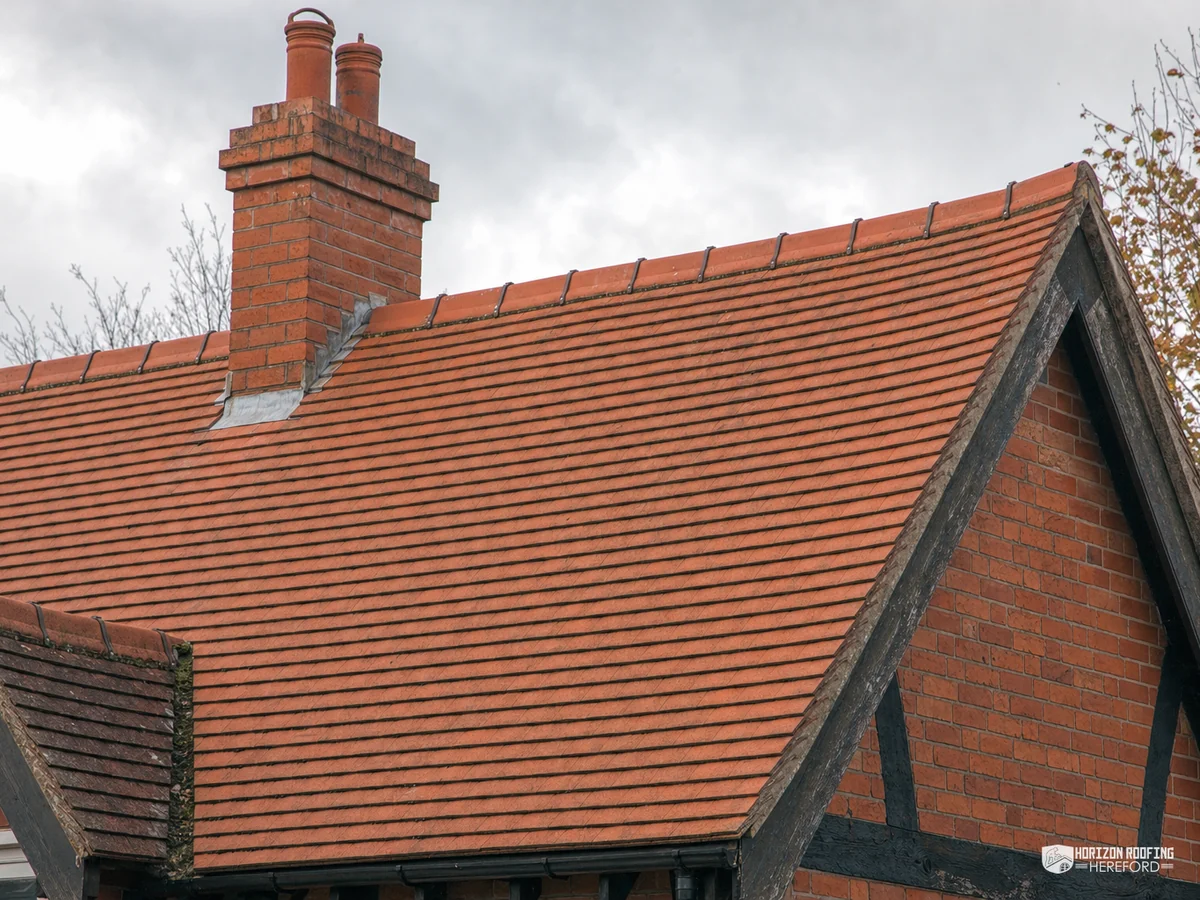
  • Older cottages with weathered clay tile roofs and brick chimneys behind a flint wall
    A Grade I church roofSt Andrew's is Grade I and Church of England: a faculty covers its roof.
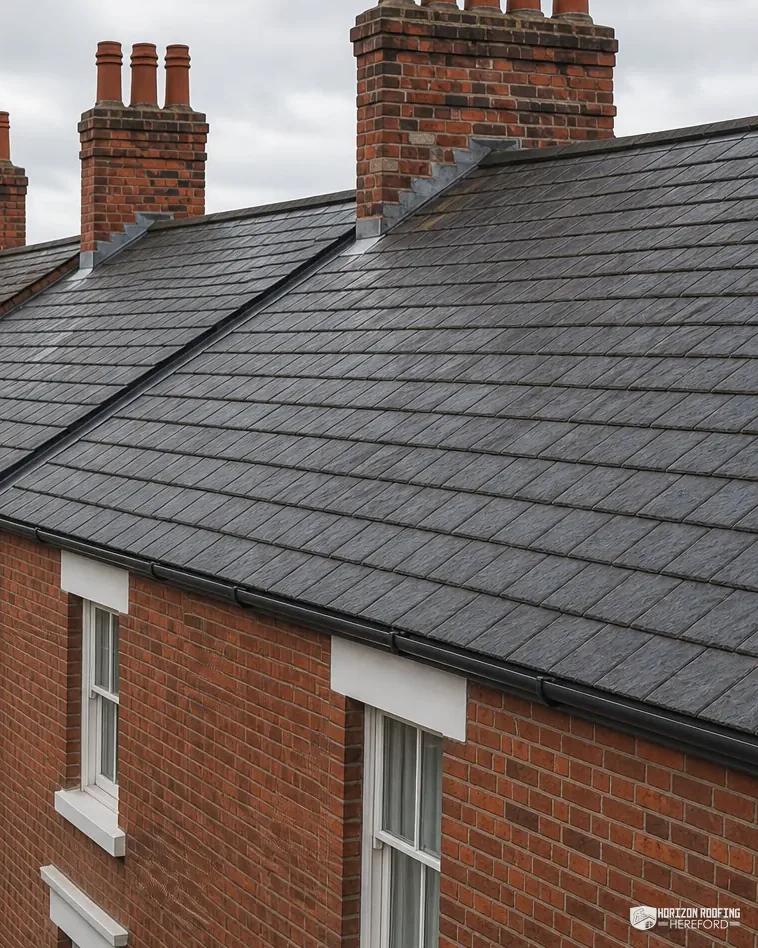
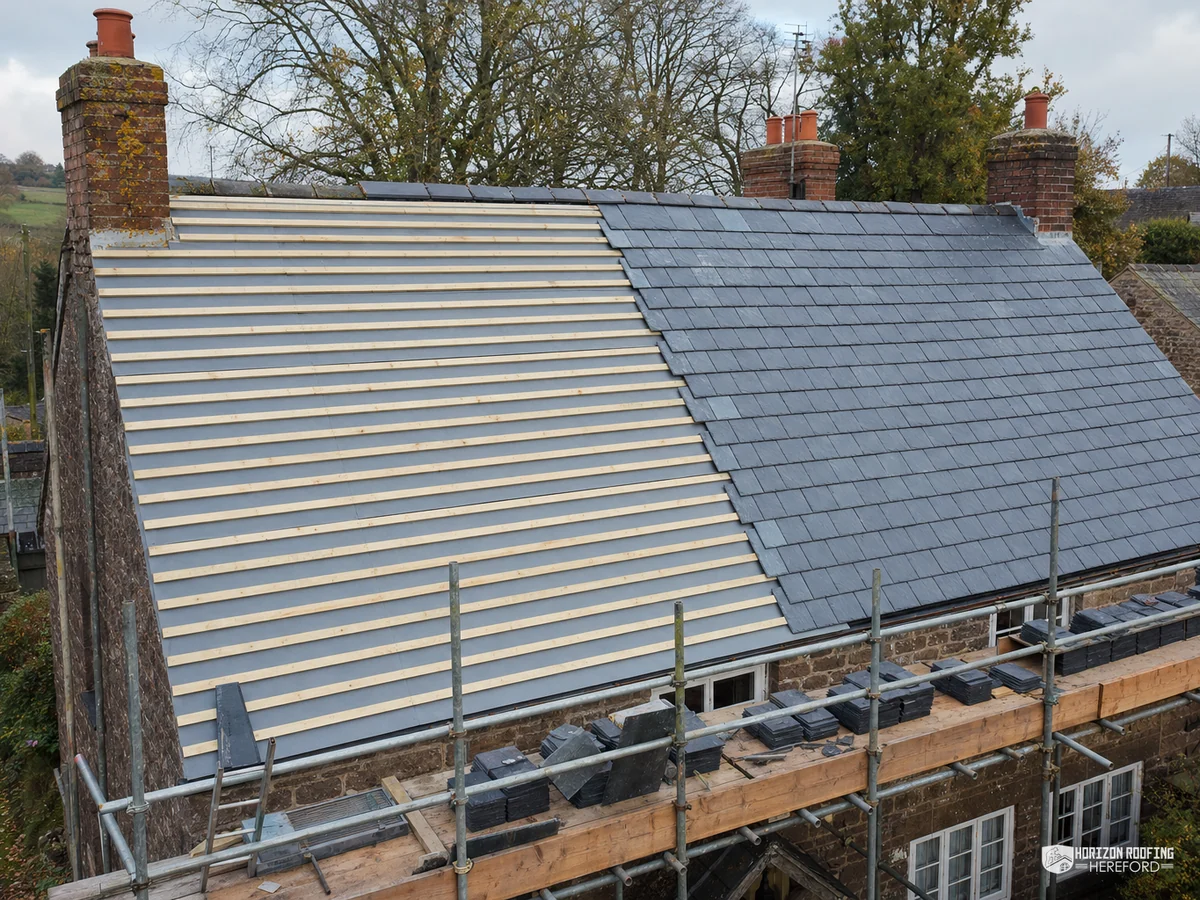
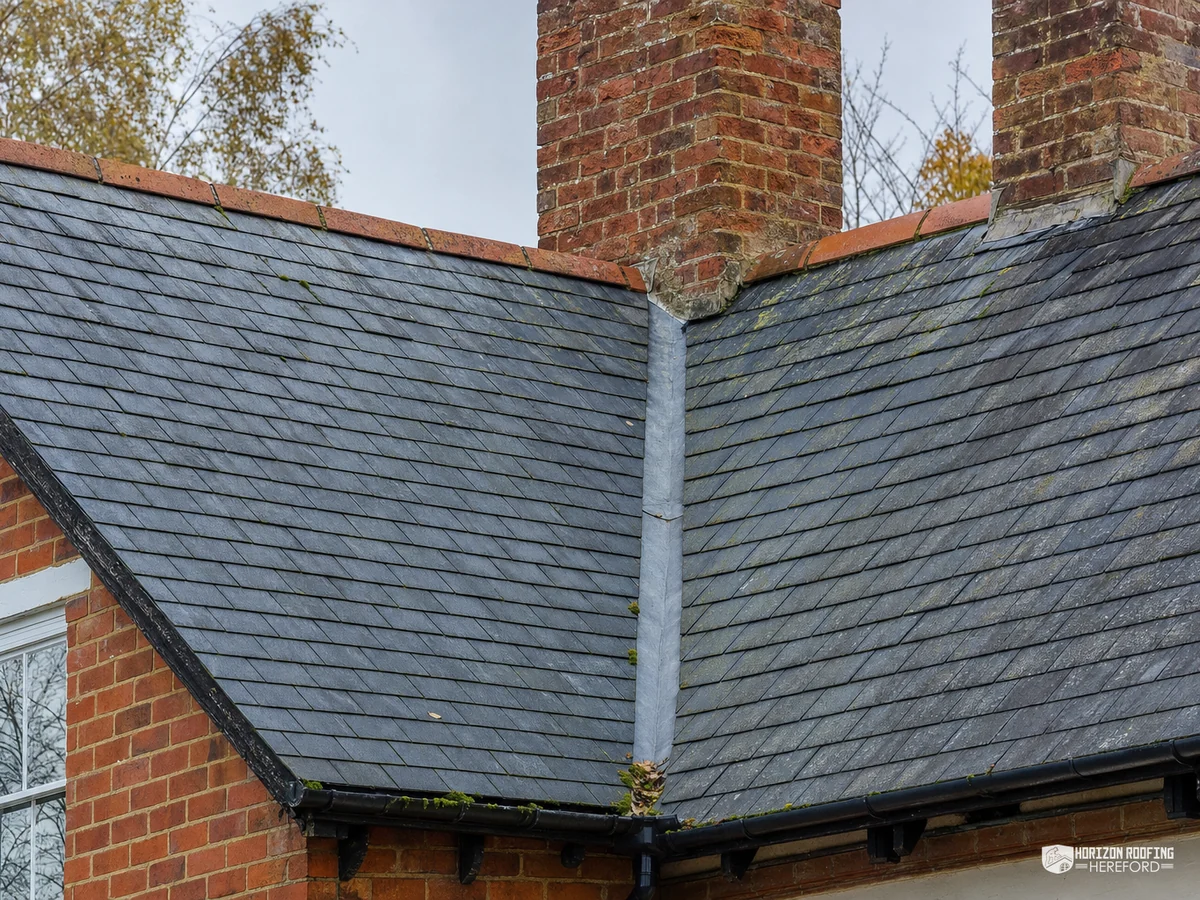
  • Slate roofs and chimney stacks along a red brick Victorian terrace
    Grade II* town buildingsShire Hall and 27 and 28 Hereford Street are Grade II*; consent comes first.
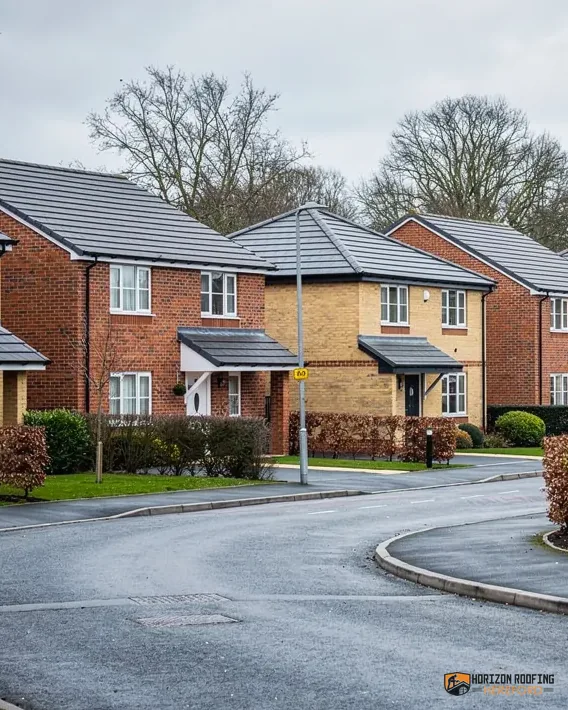
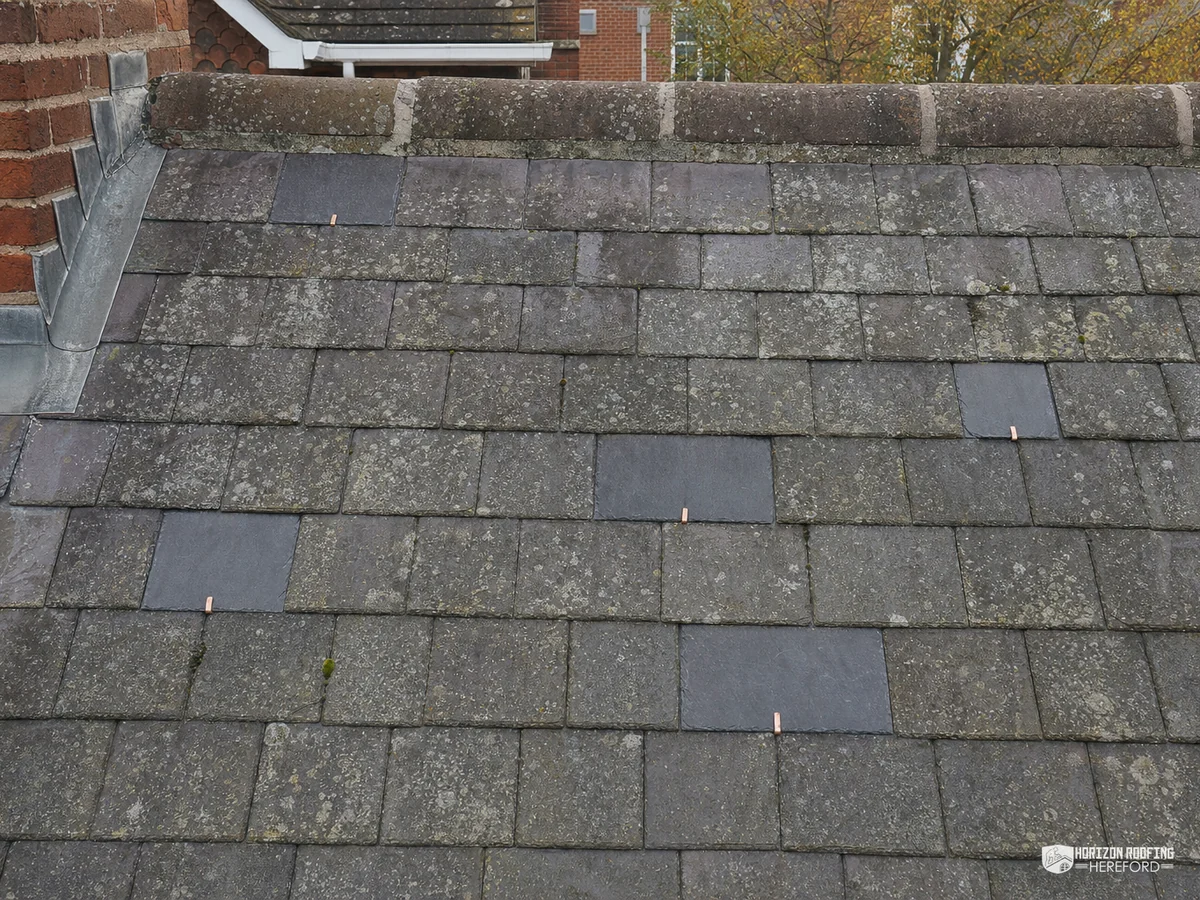
  • Newer homes with grey concrete tile roofs along a curving estate road
    A conservation area centreA new roof light in the conservation area needs planning permission.

Mapping Presteigne

Presteigne on a street map, with a dashed circle around the town and the nearest towns we cover. Tiles © Esri; map data © Esri, HERE, Garmin, OpenStreetMap contributors.

Presteigne: the listed centre, roof by roof

Stacks, listed buildings and a re-cover under Welsh rules in Presteigne

We start where a survey starts, at the chimney stacks, then take in the listed buildings and the conservation area that cover the centre, and end with a re-cover under the Welsh Building Regulations.

A drawn cut-away section through a Herefordshire border house: the front of the main roof is cut open to show the rafters, underlay, battens and slates, beside a black-and-white timber-framed gable. Numbered, from the ridge down: 1 Stack leadwork; 2 Listed walls; 3 Re-covering.

Fig. 1 A Presteigne house in section: stack, wall and slope, numbered one to three.

Callout 1 of 3

Presteigne chimneys and the lead round their bases

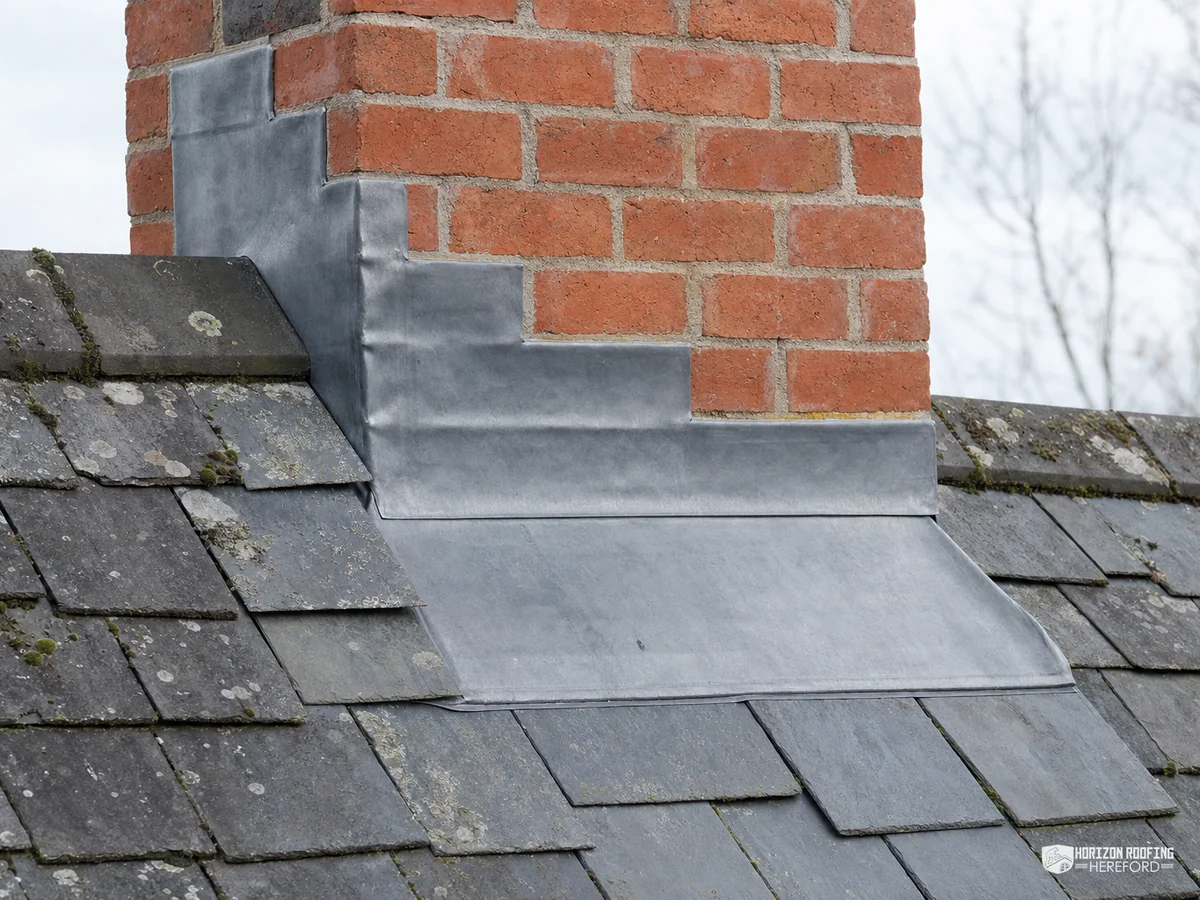
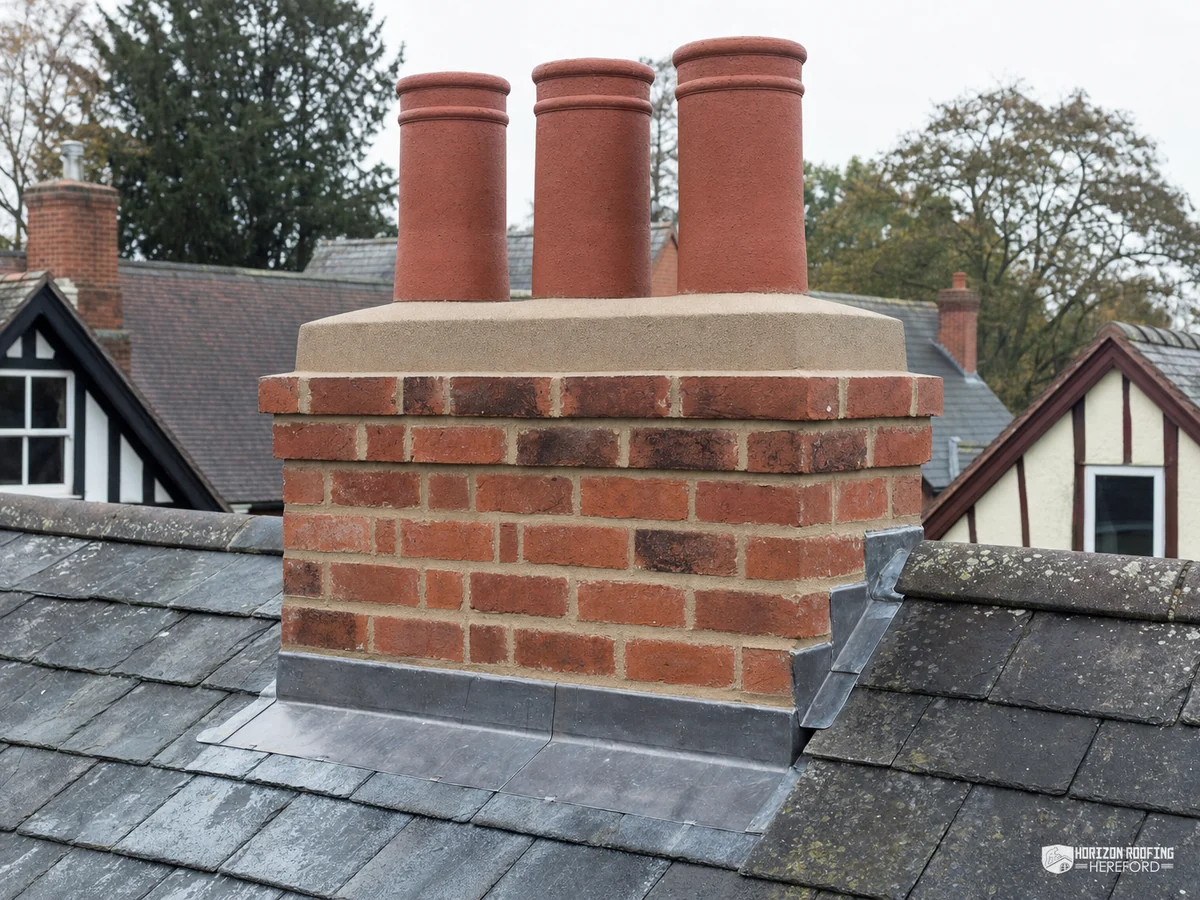
Our survey of a Presteigne house opens at the chimney. Standing clear of the slope, a stack takes wind and rain on every one of its faces, and so does the roof around its foot. Leadwork seals the line where masonry and covering meet. A flashing, a ribbon of lead let into the stack's joints and lapped over the slope, does the visible part of that job. A soaker, a small folded sheet of lead slipped beneath each course alongside the stack, does the hidden part. On the uphill side the back gutter, a lead channel, turns run-off aside before it reaches the masonry.

Thickness matters. Royston Lead's cast sheet table assigns a code to each gauge, and Code 3 is marked "Recommended for lead soakers only" while Codes 4, 5 and 6 are listed for flashings. One stack can therefore carry two gauges at once. We cut out a failed run and fit new lead, because sealant over a split joint only hides it. MyJobQuote writes that correctly installed lead flashing "can last for over 80 years", which is why sound leadwork stays in place and only the failed run is renewed.

The masonry gets its own check: the pointing, which means the mortar in the joints; the flaunching, a mortar bed that slopes away from the pots to shed water; and the pots. We tap the units for hollow sounds and look for stone or brick that has started to shed its face. Nobody can judge a stack from the pavement, so every face appears in the report's pictures. Where the stack is carried by a wall that two houses own together, the Party Wall etc. Act 1996 applies. The building owner sends the notice at least 2 months ahead of work such as taking out a chimney breast. A surveyor enters only if the neighbour objects or does not reply within 14 days.

Central Presteigne is a place where scaffold can need road space. A licence is required before scaffolding blocks part of a highway (Highways Act 1980, section 169), and we arrange the licence with our scaffolder. Scaffold is priced into the quote you receive, and the final report shows the stack as we left it. For rebuilding and repointing, read our chimney repairs page.

Looked at on a Presteigne stack

  • Lead flashings lifting or split
  • Soakers beside the stack
  • Pointing on all four faces
  • Flaunching round the pots
  • Pots sitting square

From the street you see one face of a stack, so we photograph all four.

Fig. 2 Chimneys, drawn close

Callout 2 of 3

Listed buildings, St Andrew's and the conservation area

Presteigne's centre includes several listed buildings. Cadw's list has St Andrew's Church at Grade I (record 8830, designated 28 November 1950), Shire Hall with its branch library and museum at Grade II* (record 8845, same date), and 27 and 28 Hereford Street at Grade II* (record 9372, designated 30 December 1993). The Old Rectory also stands at Grade II* (record 8825).

Welsh law sets the test for work on them. Under section 88 of the Historic Environment (Wales) Act 2023, any alteration that would touch a listed building's special character must be authorised, and section 89 is the consent that authorises it. Those two sections came into force on 4 November 2024. A listed house keeps its permitted development rights for roofs, though those do not replace consent. The covering chosen, the fixings behind it and the lead details are therefore agreed before the old covering comes off.

A church takes another road. Presteigne sits in Powys, yet St Andrew's answers to the Hereford diocese of the Church of England, and its main Sunday service is generally at 11 am. The Listed Buildings (Exempt Religious Buildings) (Wales) Regulations 2024 count buildings under Church of England faculty jurisdiction as exempt, so a faculty, not listed building consent, governs work on its roof. The same regulations bring in Church in Wales, Methodist and Roman Catholic buildings, and a Baptist chapel qualifies only when the Baptist Union's corporations hold it. Under the Welsh rules a United Reformed church gets no exemption. A chapel the list omits, or a closed one, needs listed building consent. Bring any paperwork you hold on the house, such as an earlier consent or a survey, and we read it beside our photographs. A consent application reads better when it states the covering, the fixings and the leadwork precisely.

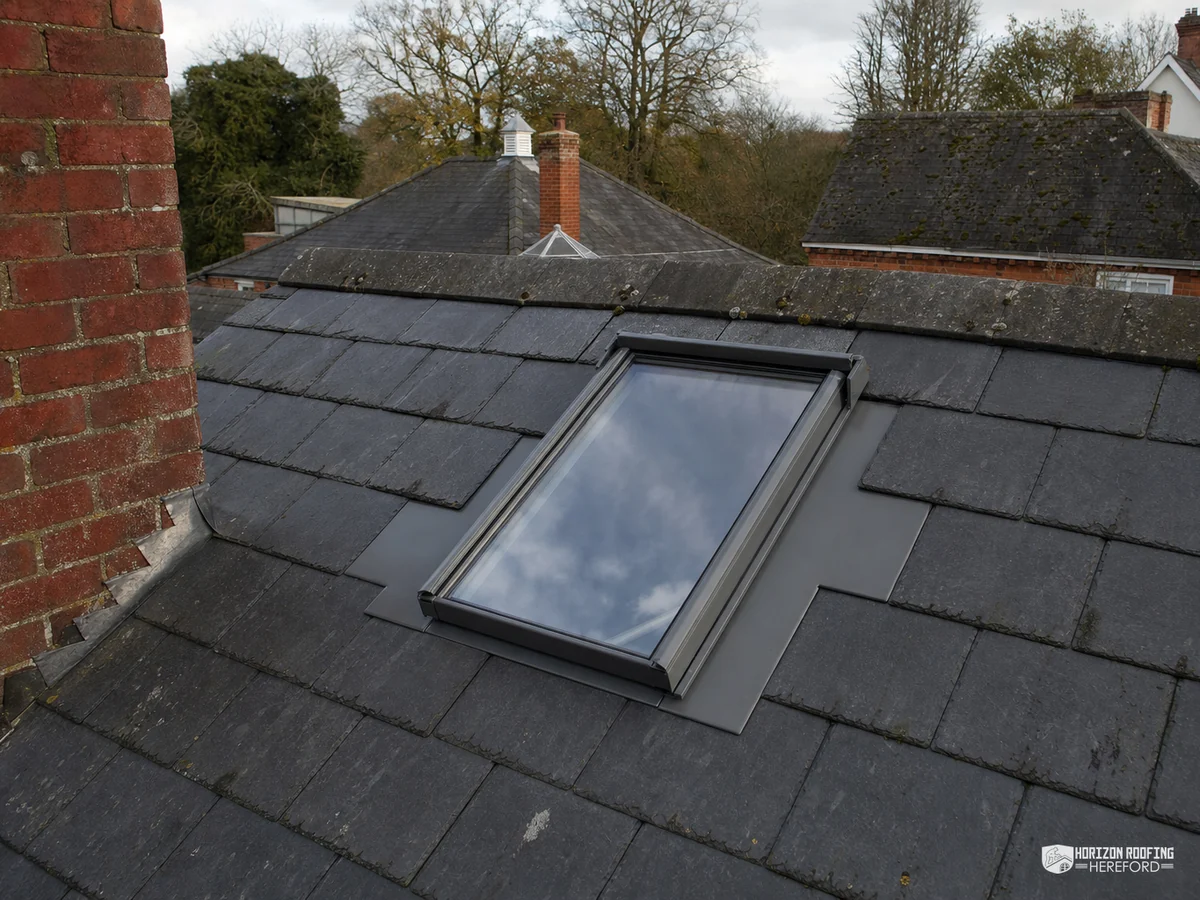
Powys County Council's Presteigne conservation area takes in the town centre, and Part 4 of the 2023 Act is the legal home of conservation areas. Ask the council whether an Article 4 direction applies at your address too. Roof windows and dormers meet their own Welsh limits, which our planning guide for roof windows explains. Our listed and heritage roofing page shows how we approach a protected house, beginning with a photographed survey of each slope.

A roof edge on a listed house

SoundCovering matches the listing and sits tight at the edge
Needs workSlipped courses, open mortar, a patch in the wrong material

Callout 3 of 3

Re-covering a Presteigne roof under the Welsh rules

Re-covering a Presteigne roof is governed from Cardiff, not London. The Welsh Government's guidance on re-roofing opens with this sentence: "In most situations, this work will need Building Regulations approval." Its page on roofs then sets a test by area, in which repairing or re-covering "less than 25 per cent of the area of a pitch or flat roof" does not normally need an application, whereas replacing or repairing "more than 25 per cent of the roof area" normally brings better insulation with it, as the Welsh Government puts it. Before pricing a job we measure the slopes involved, so you know which side of that line it lands on, and the report shows the measurements beside the photographs.

Changing the type of covering can change the load on the timbers. The Welsh Government illustrates a change of material with a swap from slate to tiles, and says a new covering that is significantly heavier or lighter makes Building Regulations approval likely, so that the structure is adequate. Paragraph 4.4 of the Welsh Approved Document A sets the threshold for a significant change in loading: "when the loading upon the roof is increased by more than 15%". A job like that starts with a loft inspection of the rafters and purlins and a word with the council's building control service or a registered building control approver, not with a delivery of tiles.

Sound roofing is worth keeping. Published lifespans give a sense of what a covering has left: HomeBuilding lists Welsh slate at "100+ years", reclaimed Welsh slate at "50-80 years" and plain concrete tiles at "40-50 years", and Marley says roof tiles "are expected to last for around 60 years". These are published ranges for new coverings, not forecasts for your roof. Once a slope is stripped, the battens are checked again with the covering off, because timber under slates shows its condition only then. Rotten ones are replaced, and the underlay is renewed before new tiles or slates go on.

Our roof replacement page traces a whole re-roof, from stripping the first course to bedding the last ridge tile. When a repair would serve the house better than a new covering, the survey report says so in plain words, with the photographs beside it. If the whole slope does need renewing, the quote states which covering, fixings and underlay it assumes, and it is one total for the job.

What the survey records on each slope

Nails and clips
Sound, slipped or corroded, each one photographed
Laps and courses
Checked for gaps, cracks and loose units
Battens
Tested from the loft for soft timber
Underlay
Looked at from inside for tears and damp
Daylight
Searched for from the loft with the lights off

Presteigne roofs: repairs, churches and consents

Is a Presteigne house better repaired than re-covered?

If a handful of courses have slipped and the rest of the covering holds, repair is the lighter job and keeps the existing roof working for the house. If battens or underlay have failed across a slope, a re-cover is the sensible answer. The survey covers the slopes, the loft and a daylight check, and the report says which route suits the house. Which? puts one to six replaced tiles at £75 to £400 and a new ridge tile at £80 to £300 (November 2025 survey, before VAT).

What should I check before roofing in Presteigne's conservation area?

Start with the address: the Presteigne conservation area, held by Powys County Council, takes in the centre of the town. Then ask the council whether an Article 4 direction applies, since the Welsh Government notes that such a direction can withdraw permitted development rights. In a Welsh conservation area a new roof light needs a planning application, because permitted development does not reach it. Repairing a roof as it is counts as a smaller question than creating a new opening, and we raise both with you at the survey.

What U-value must a re-covered Presteigne roof reach?

For a renovated roof, the Welsh Approved Document L aims at 0.16 W/m²K (Table 11.1) and accepts 0.35 at worst where 0.16 is not feasible. Paragraph 11.14 applies the upgrade across the entire element once more than 50% of it is renovated, with payback inside 15 years as the economic test. Table 4.1 sets 0.13 for a roof newly fitted to a house that is already built. On 4 March 2027 a new Welsh edition takes effect.

Does St Andrew's Church in Presteigne need listed building consent for roof work?

St Andrew's is Grade I (Cadw record 8830). Though it stands in Wales, the parish is in the Church of England's Hereford diocese, and the Welsh exempt list takes in Church of England faculty buildings. While worship remains its main use, roof repairs need a faculty instead of listed building consent. Speak to the parish before any scaffold is booked. A minister's residence is outside the exemption, so if it is listed, works affecting its character need consent.

Will scaffolding block a Presteigne pavement or lane?

Section 169 of the Highways Act 1980 bars scaffolding from a highway where it obstructs the way unless it is licensed; that is a licence we arrange with our scaffolder, and the price you receive already counts the scaffold. At the survey, point out any narrow footway, parked cars or shared access, so that the scaffold can be laid out around them and the street stays usable while the roof is open.

Do birds or bats hold up a Presteigne re-roof?

They can. Section 1 of the Wildlife and Countryside Act 1981 covers a bird's nest during building and occupation: taking, damaging or destroying it intentionally is an offence. Bats are protected together with the places they breed and rest, and in Wales Natural Resources Wales issues the licences. If we find droppings or a nest while surveying the loft, we stop and show you the photographs before any stripping begins.

Arrange a Presteigne survey, stacks first

Describe the roof in your own words, add a picture of the stack or slope if you have one, and we book the survey.

10-year workmanship guarantee, in writing