
01432 610152 Get a quote Call 01432 610152

Roofers in Huntley

Slate, tile and lead work for homes in Huntley, a 40-minute drive from central Hereford.

We read the slopes, then the valleys, then the walls, and photograph every finding before the price is written down.

Get a free quoteCall 01432 610152

Slate slopes, valleys and listed walls

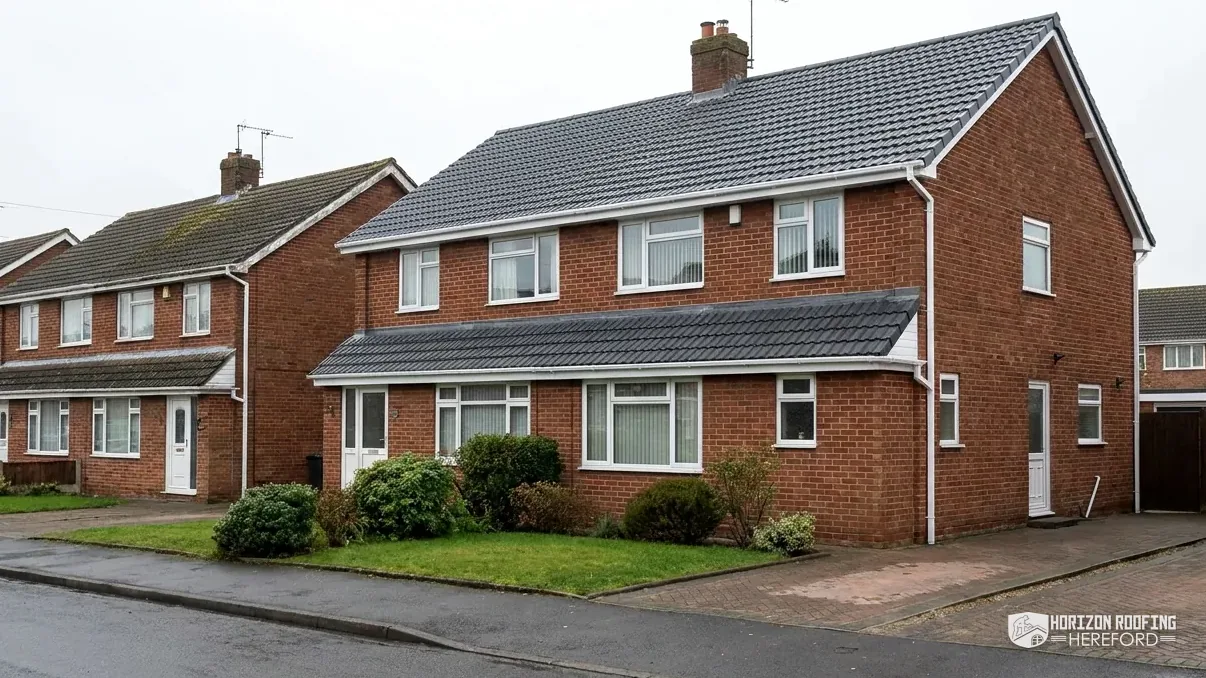
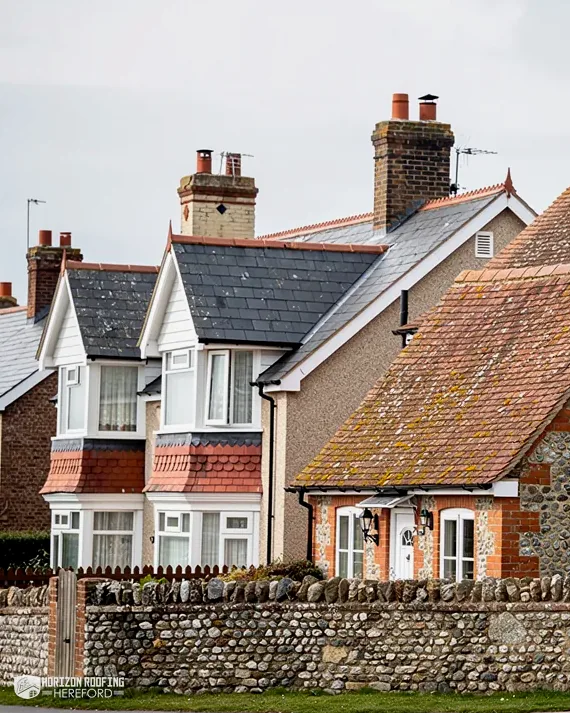
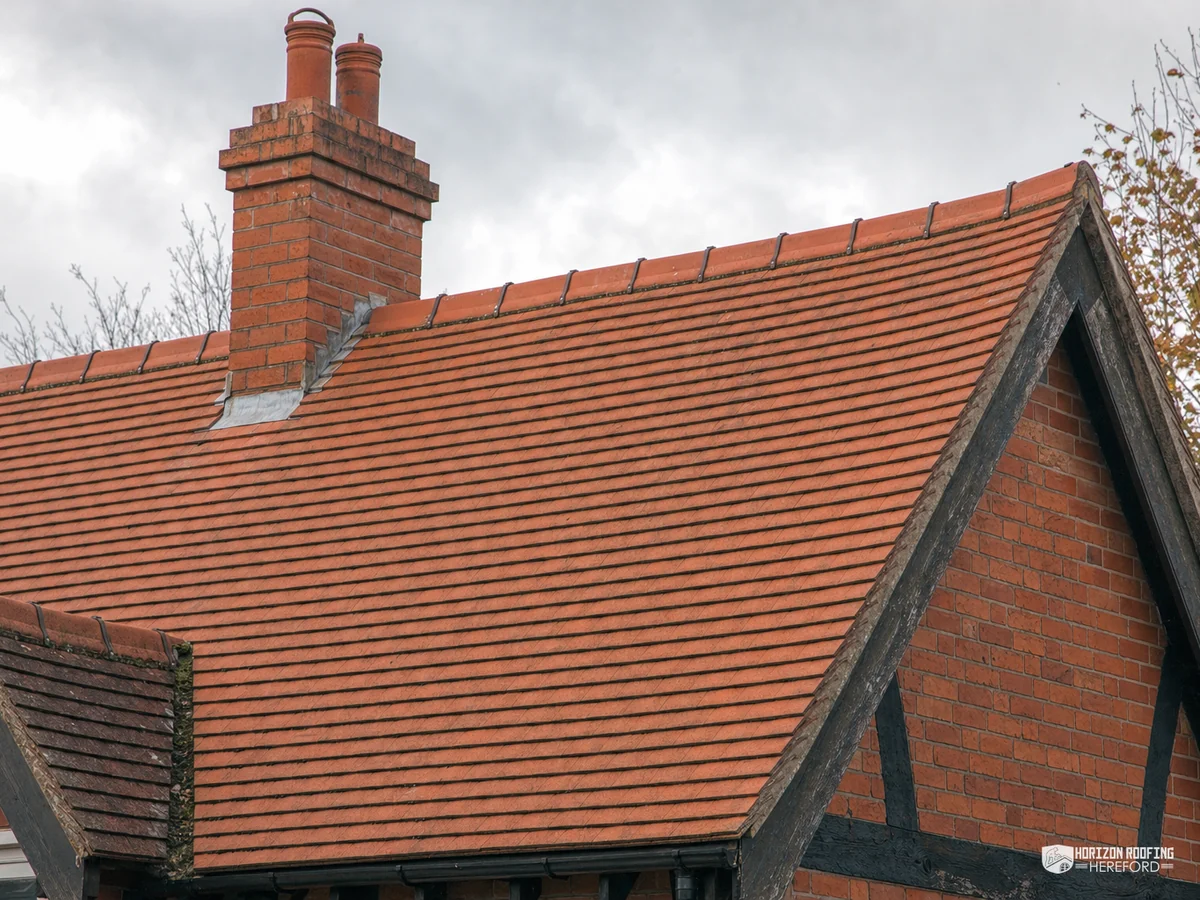
  • Older cottages with weathered clay tile roofs and brick chimneys behind a flint wall
    Slate roofs on brickWoodend's orange-red brick farm buildings are recorded with slate roofs.
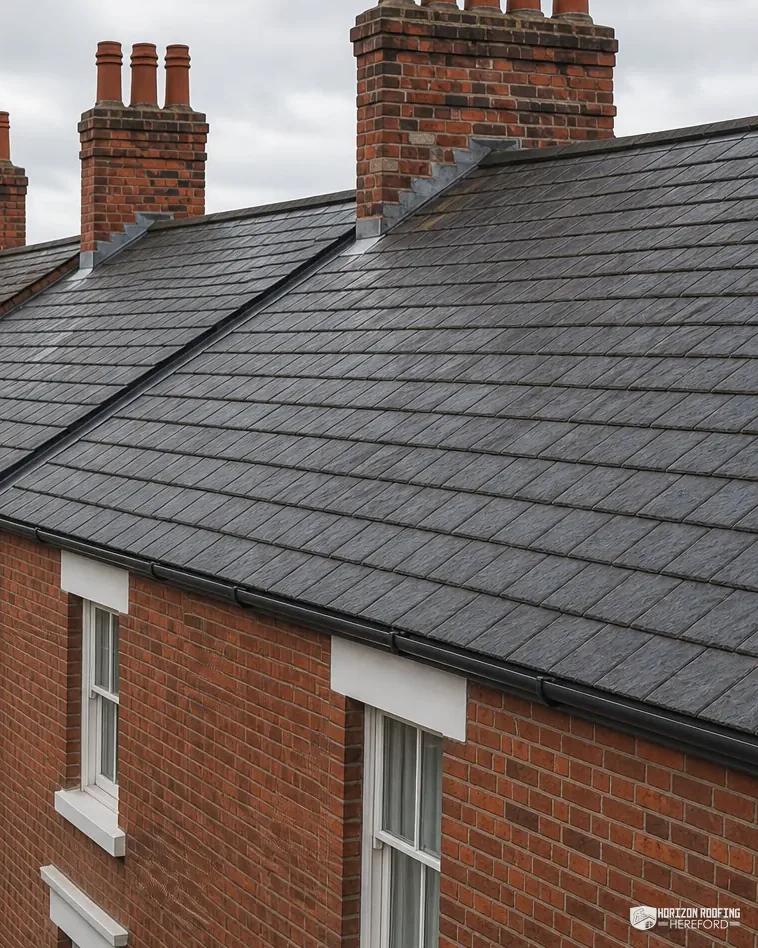
  • Slate roofs and chimney stacks along a red brick Victorian terrace
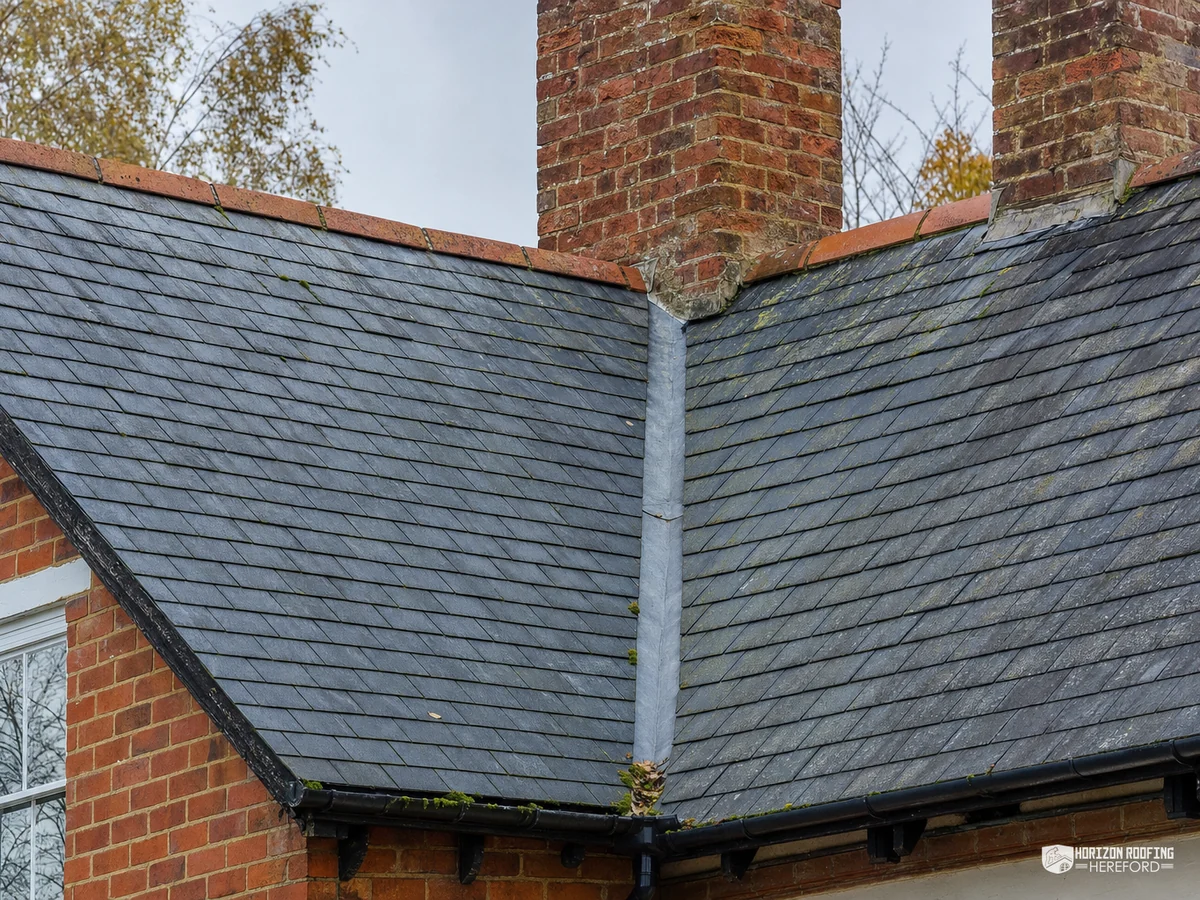
    Valleys and their leadA valley gives the run-off from two slopes a single lead channel to cross.
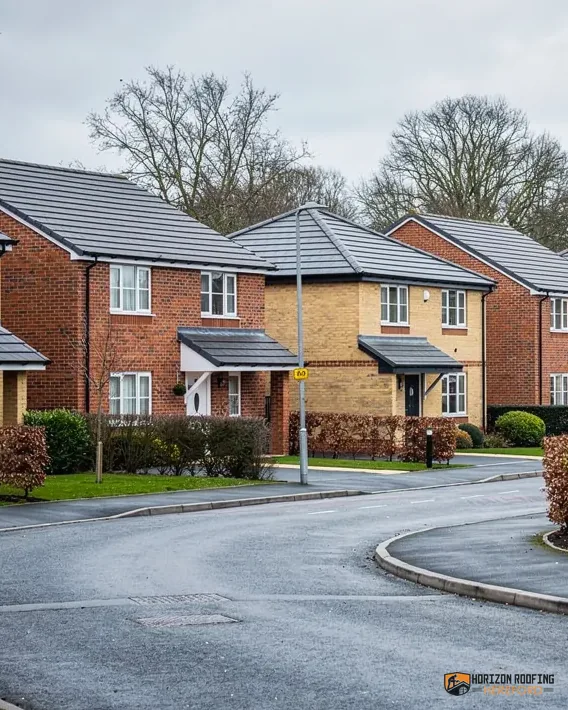
  • Newer homes with grey concrete tile roofs along a curving estate road
    Listed walls and rectory roofsThe Old Rectory and the Red Lion are Grade II, so consent comes first.

The Huntley area

Huntley on a street map, with a dashed circle around the town and the nearest towns we cover. Tiles © Esri; map data © Esri, HERE, Garmin, OpenStreetMap contributors.

Huntley roofs, slate to listed wall

A Huntley roof read in three stops, from slate slope to listed wall

The slopes come first, then the valleys where they meet, then the walls underneath, including the listed buildings, with the rules for each set out in the order they arise.

A drawn cut-away section through a Herefordshire border house: the front of the main roof is cut open to show the rafters, underlay, battens and slates, beside a black-and-white timber-framed gable. Numbered, from the ridge down: 1 Slate slope; 2 Valley lead; 3 Listed walls.

Fig. 1 Slate roof cut open: slope, valley and wall, each numbered.

Callout 1 of 3

Slate slopes and the brick beneath them

The Victoria County History's 2010 account of Huntley parish describes the outbuildings of Edmund Probyn's late-1850s farmstead at Woodend, designed by J. & J. Girdwood, as "of orange-red brick with slate roofs and form an E which opens to the south". That covers a single group of buildings and tells us nothing about any other roof in the parish. It does show that slate on brick belongs to the local picture, and the slope is where we begin, read from the ground first and course by course.

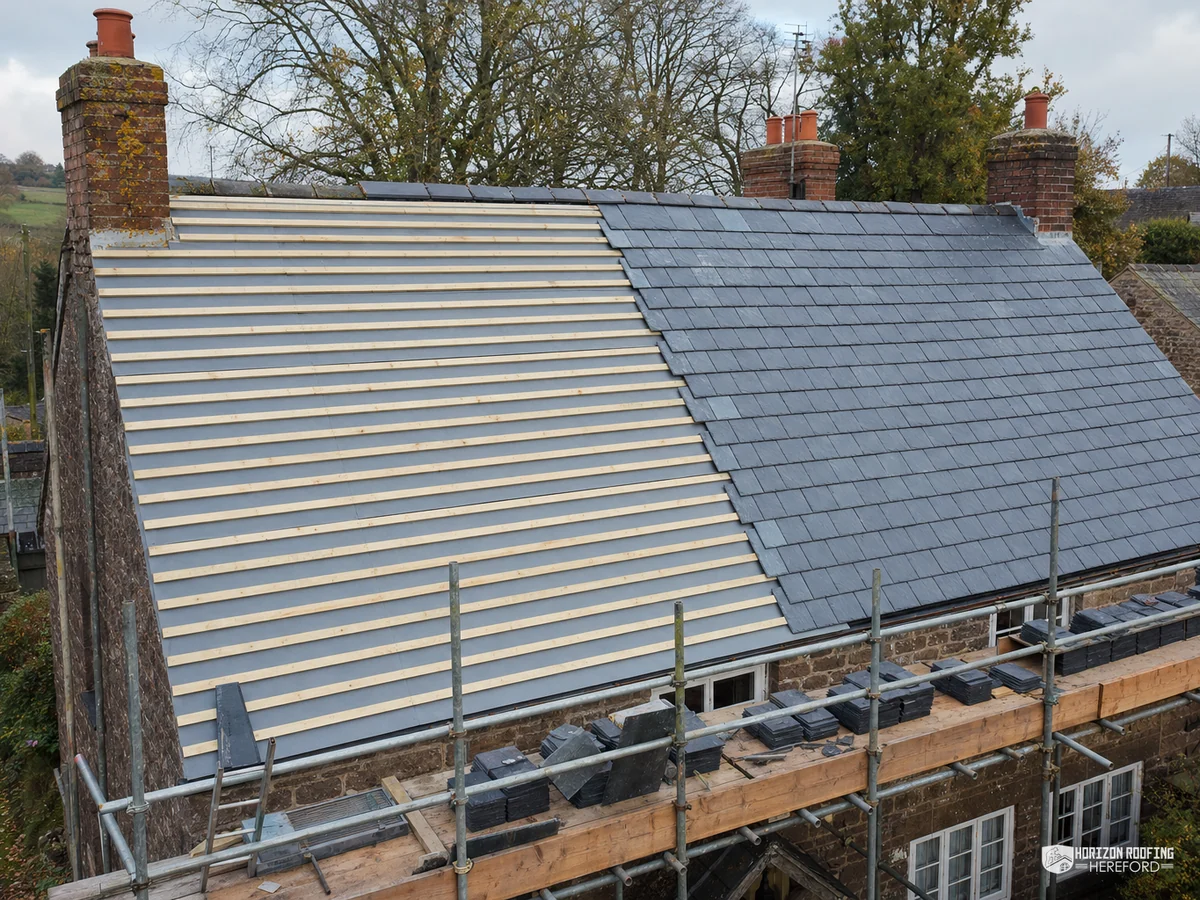
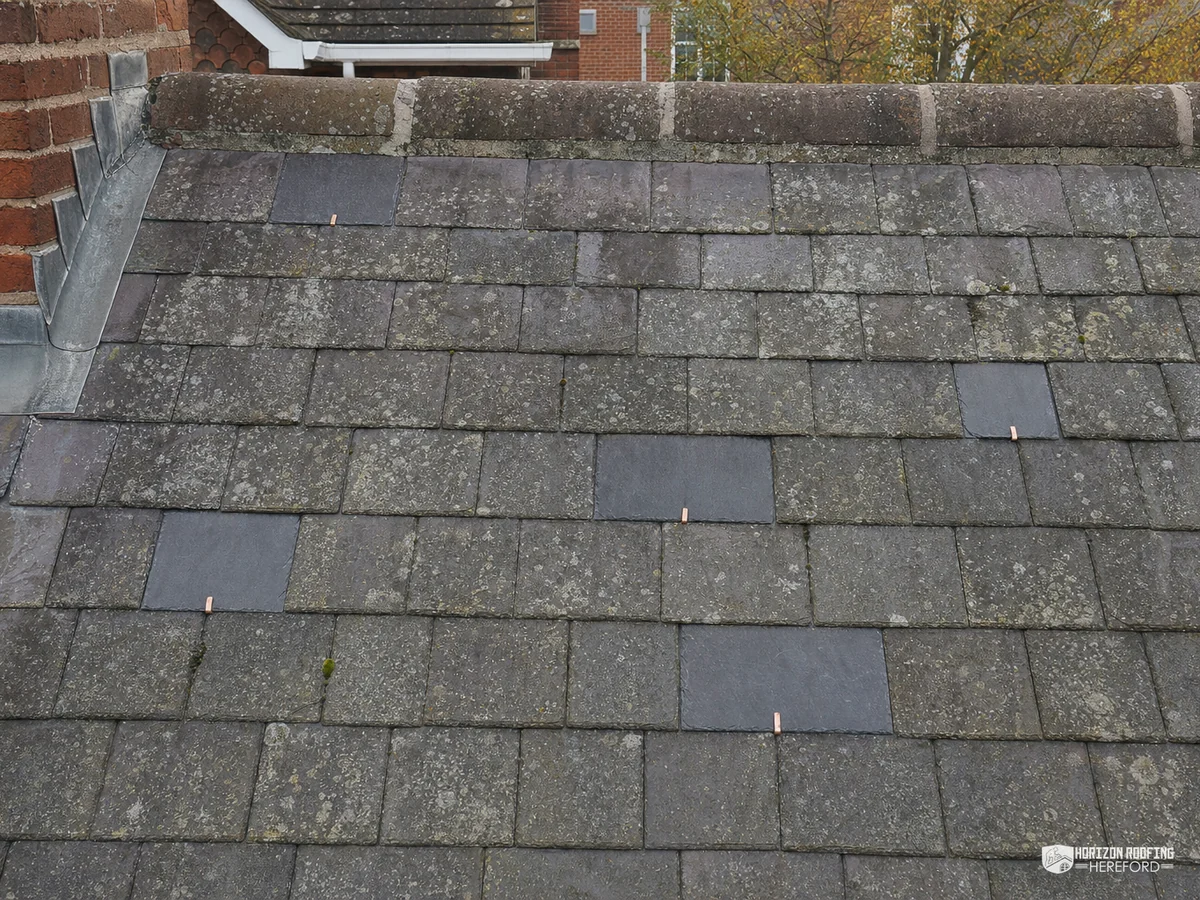
A slate roof fails in small steps. Nails corrode or the slate itself splits along its layers, one slate slips a few centimetres and leaves a gap, and the batten beneath starts to take water. We count the slipped and cracked slates from the ground and again from the roof, and the photographs show each one where it sits. A handful of failures is a repair: the slate is drawn out and a replacement slid in and fixed. Pitch matters to slate, so it goes on the survey sheet every time. Cupa, a slate supplier, says hook fixings should be avoided below 25º, and says BS 5534 puts the floor at 20 degrees for natural slate when exposure is moderate, the slate is 500mm long and the overlap is 115mm. A slate laid shallower than its maker allows will let water back up under the lap, and no amount of patching fixes that. Where the pitch is marginal, the report names the covering that suits the slope.

Lifespan depends on origin. HomeBuilding's table lists Welsh slate at 100+ years, Spanish natural slate at 75 to 100 years and reclaimed Welsh slate at 50 to 80 years, while SPAB calls a well-slated roof likely to last more than a century. These are typical figures and not promises, and they explain why sound slates on a worn roof may be worth stripping, sorting and fixing again, with matched slates filling the gaps.

Matching raises a supply question. SPAB advises that "Claims of unavailability or long delivery times should always be checked with the quarries", so the survey includes a call to a quarry before anyone is told a slate cannot be had. If the whole slope has gone, the choice lies between that careful re-covering and a new roof, with the report naming whichever the evidence supports. Our slate roofing page covers natural slate in more depth.

Slate lifespans as published

Welsh slate
HomeBuilding: 100+ years
Spanish natural slate
HomeBuilding: 75 to 100 years
Reclaimed Welsh slate
HomeBuilding: 50 to 80 years
A well-slated roof
SPAB: likely to be more than 100 years

Sound slates on a tired roof can be lifted, sorted and laid again.

Fig. 2 The slopes, drawn close

Callout 2 of 3

The valley where two slopes share one channel

Two slopes that meet at an inside angle form a valley, and whatever both slopes shed ends up in it. In a lead valley the channel is sheet lead laid over boards, with the slates cut to a clean line along each side. Royston Lead's code table lists Code 4 for pitched valley gutters, Codes 5 and 6 for that job and for parapet and box gutters too, and the heavier Codes 7 and 8 for valley gutters as well. The survey sheet records which code is on your roof and whether that thickness suits the length of the run.

We look for splits across the width of the lead, for a lap that has lifted, and for litter that blocks the channel and pushes water back beneath the slate edge. Moss and leaves come out by hand. Marley does not recommend jet washing slate or tile at high power, so a stiff brush is used here and the surface is left as it was found. The low end of a long valley, where the most water arrives, is photographed on its own, and a second photograph is taken from the ridge end so the whole line of the channel can be seen at once.

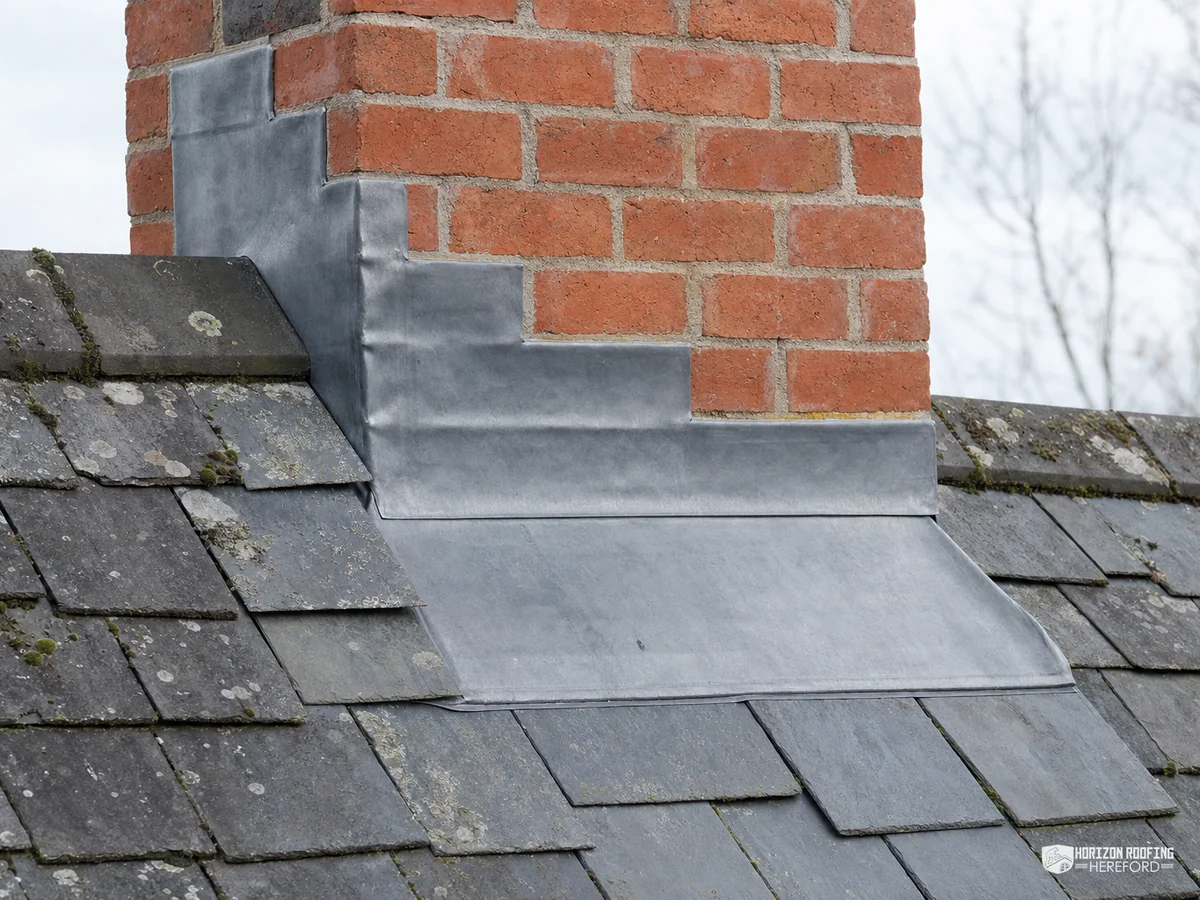
Lead lasts well when it is correctly laid. MyJobQuote says correctly installed lead flashing "can last for over 80 years", and that sentence is about flashing, so we do not stretch it to cover a valley. What the survey does reveal is whether the lead has moved, split or thinned, and whether the boards beneath have stayed dry. A split near the foot is cut out and a section renewed; a valley worn from end to end is relaid.

A stain on a ceiling can sit well away from the fault above it, so repairs begin by tracing the water uphill, which is why we go into the loft as well as onto the slope. Boards that have dried out are checked with a hand pressed along them for soft patches before any new lead is laid. Our roof repairs page describes the visit from start to finish.

The valley channel at Huntley

SoundClear channel, tight laps, slates cut true either side
Needs workSplit lead, a lifted lap, litter backing water under slates

Callout 3 of 3

The Old Rectory, the Red Lion and nearby rules

The third stop is the wall the roof stands on. The Red Lion is listed Grade II (list entry 1186471, first listed 4 July 1985), and so is the Old Rectory (list entry 1186472, first listed 4 July 1985), which the Victoria County History places just off North Road and describes as timber-framed, appearing "to be the late 16th-century two-storeyed cross wing of a house of high status". Pool House is Grade II as well (list entry 1299166). Under section 7 of the Planning (Listed Buildings and Conservation Areas) Act 1990, a listed building cannot have its character altered without authorisation. For a house, the council's listed building consent is the authorisation, and it sits alongside any permitted development right.

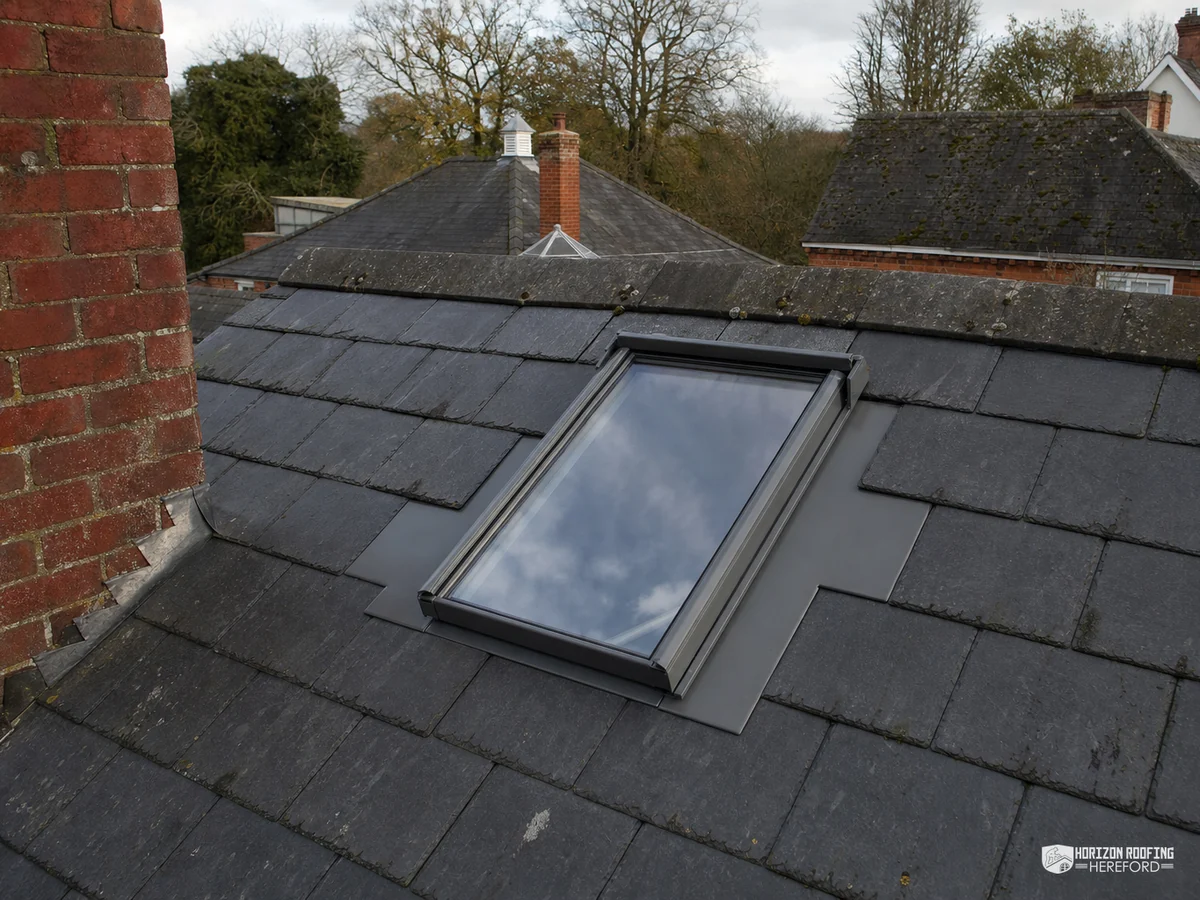
Blaisdon Conservation Area lies near Huntley. The conservation area list kept by Forest of Dean District Council settles whether your house falls within a boundary, and the same council will answer whether an Article 4 direction touches your street. Ask both in writing before planning roof windows or a different covering, and file the replies with the survey.

Insulating a roof brings Part L in. For a retained roof in England, AD L 2021 Table 4.3 sets a threshold of 0.35 and an improved figure of 0.16, and paragraph 4.13 relaxes the target if 0.16 cannot practically be reached, or if the simple payback would run past 15 years, so the upgrade can stop at the lowest feasible U-value, generally not worse than 0.7. AD L 2026 replaces the table, as Table 3.3, from 24 March 2027. Re-covering is tested differently: the Planning Portal sets two limits together, "Less than 25 per cent of the total 'building envelope'" and "Less than 50 per cent of the roof is affected", and Forest of Dean District Council Building Control, on 01594 812315, deals with anything outside them.

Where scaffold for any of this work stands on the highway it is licensed, and we arrange the licence with our scaffolder. Gloucestershire County Council is the highway authority for the Huntley area. Heritage jobs run longer because consent and sourcing come first, and our listed and heritage roofing page follows a protected house from the first visit to the final slate. Where a listed roof needs new slate, the replacement is matched by size, thickness and colour to the old ones on the same slope, and the reclaimed slates that are still sound go back first.

What moves a Huntley roof price

Area
How much of the slope is renewed, reset or only patched
Access
Height, boundaries and whether scaffold stands on the highway
Lead
Valleys, flashings and the code of lead each position needs
Listed status
Consent, a written method and matching the old covering

One written total price, never itemised.

Huntley roofs: slate, lead and listed houses

How long will a slate roof last on a house in Huntley?

That turns on the slate. HomeBuilding gives Welsh slate as 100+ years, Spanish natural slate as 75 to 100 years and reclaimed Welsh slate as 50 to 80 years, and SPAB calls a well-slated roof likely to last more than a century. All of these are typical figures and not promises. The survey reads the nails, the battens and the slate edges, since a fixing can fail long before the slate itself does.

Is there a conservation area near Huntley, and does it cover my roof?

Blaisdon Conservation Area lies near Huntley, but its nearness alone cannot show whether your house falls within a boundary. Forest of Dean District Council publishes the list, so look your address up on it, street by street, before any roof work is planned. Ask the council too whether an Article 4 direction is in force, because either answer changes what you can do without an application. Keep both replies with your survey.

Do the Old Rectory and the Red Lion need consent for roof work?

Both are listed Grade II, so any work touching their special character requires listed building consent, which Forest of Dean District Council grants. Permitted development rights remain, but consent is needed as well. Owners of other listed houses nearby are placed the same way. We photograph the whole roof beforehand and supply a written method, so the council sees the full picture.

What does Part L ask for if I insulate a Huntley loft?

In England, AD L 2021 Table 4.3 sets a threshold of 0.35 and an improved roof figure of 0.16 for a retained roof. Paragraph 4.13 allows the lowest feasible U-value where 0.16 would not pay back within 15 years, generally not worse than 0.7. From 24 March 2027 the figures move to Table 3.3 of AD L 2026. Forest of Dean District Council Building Control can confirm the route.

Can a few slipped slates be replaced without re-roofing at Huntley?

Yes, provided the remaining slates and battens pass the survey. Checkatrade's June 2026 guide, excluding VAT, puts natural slate repairs at £150 to £220 per m², for repairs up to 3 m². That is a national figure and not our price, and it must not be multiplied into a total. The survey counts the failed slates, photographs each one and tells you if repair is the better answer.

Do roof repairs in Huntley call for a bat check?

They can. Wild bats and the places they roost have legal protection, and repairing a roof can fall within it. For an address in England, Natural England issues any licence that proves necessary. The Habitats Regulations 2017 reach further still, because regulation 43 treats harm to a roost as an offence whatever the intention behind it, which is why a roofline check comes before any strip-out begins. Please tell us before the survey if you have seen bats at the roofline.

Arrange a slate and valley survey in Huntley

Tell us which slope worries you, attach a photograph, and we will book the visit.

10-year workmanship guarantee, in writing