


Callout 1 of 3
The valley, where two slopes drain into one line
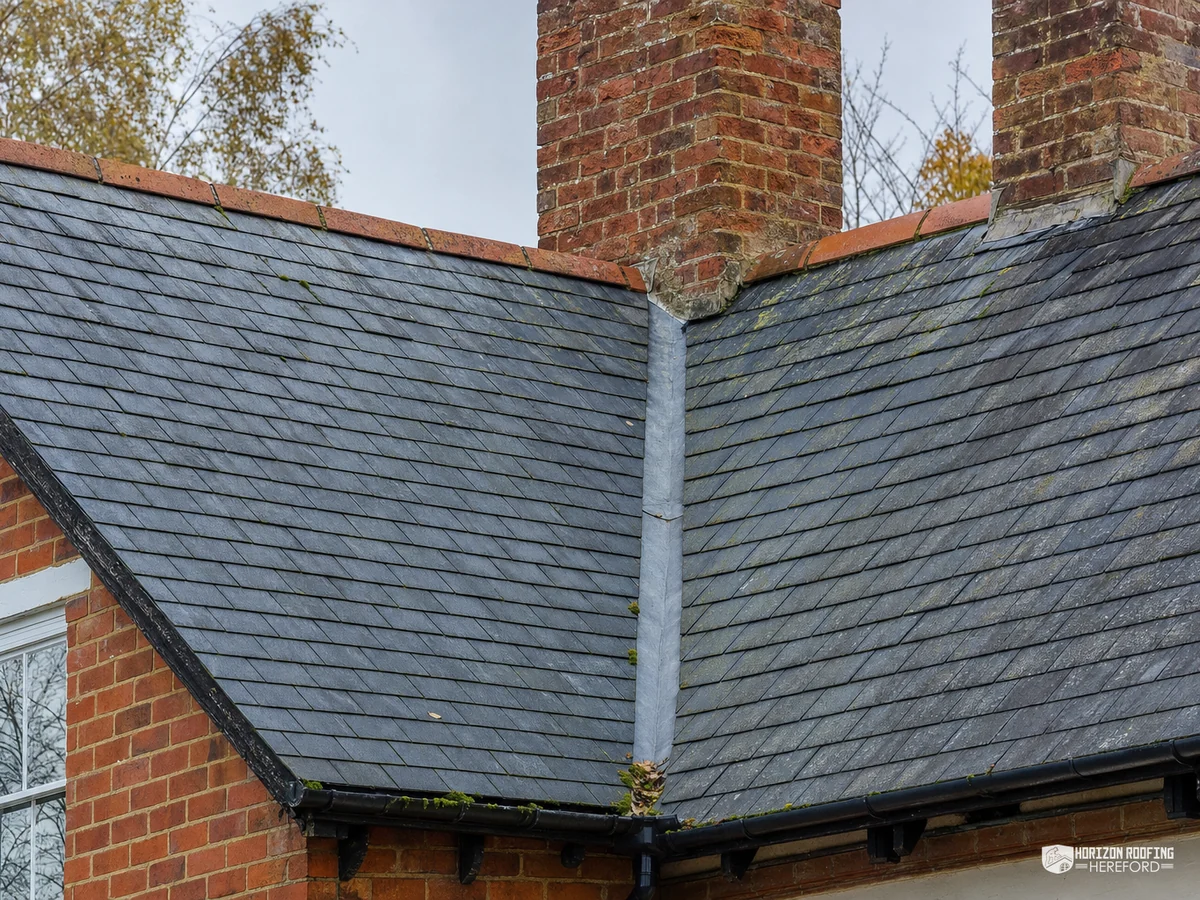
Look at a house with an L-shaped or T-shaped plan and you will find an internal angle where two slopes meet and tip their rain into one channel. That channel is the valley, and everything that falls on both slopes passes through it. After the ridge, it is the next place our survey visits at a Dunley house, because the load it carries is the sum of two roofs and it is hard to see from the ground.
Valleys are built in a few ways. An open valley shows a strip of lead between the edges of the covering. A closed valley lets the tiles meet and overlap above the lining. A laced valley weaves the courses together. Whichever form it takes, the working part is the lining under or between the tiles, and on a lead valley that is the sheet itself. Royston Lead's table gives Codes 4 to 8 for pitched valley gutters and describes Code 3 as suitable for soakers only, so the valley lining gets a heavier code chosen for the job.
We look for leaves and moss packed into the channel, for tiles whose cut edges have chipped, and for lead with a hairline split at a fold after years of expanding and shrinking. At a closed valley we lift a few tiles at the edge to see the underlay beneath, because a membrane that stops short of the lining lets water travel sideways into the timbers. We also press the valley boards, the timber on which the lead lies, since a new lining laid over a soft base fails again. From the loft, the rafters either side are checked for stains, because a leak there can trace a long way down before it appears on a ceiling.
A damaged lining sometimes allows a local repair. When the whole lining has given up, replacing the full length is the sounder answer, and the photographs make that plain before a price is given. Either way, new lead is shaped with room to expand on a warm afternoon, so its fixings are not asked to hold it still. Our lead roofing hub covers sheet lead, flashings and the linings of valleys.
A valley question from a Dunley owner
Can a leaking valley be repaired without stripping the slopes?
Sometimes. If the lead has split in one place, a section can be renewed by lifting only the tiles beside it. If the lining has given way over its full run, both edges of covering come up to fit a new length. The photographs show which applies.
Two slopes of rain meet in the valley, so the lining there gets looked at twice.